What it is
Bill proposes easing the exit right when dividends are not paid
It is a members’ bill. Introduced by parliamentary groups, the Senate, regional governments or citizens. It was introduced on 24 November 2017. Introduced by: Grupo Parlamentario Popular en el Congreso.
Official title: Private member's bill amending Article 348 bis of the Capital Companies Act.
Source: Congreso de los Diputados, file 122/000151· updated 11 Nov
Automatic summary, not yet reviewed
- The bill explains that Article 348 bis of the Capital Companies Act lets minority shareholders leave the company if the general meeting does not approve a minimum dividend. Its sponsors believe this rule can cause liquidity problems and want to change it.
- The bill would require profits for three years in a row before the exit right applies, and would lower the mandatory minimum dividend from one third to one fourth of profits. It would also allow calculating that minimum using the average of the last five years.
- Removing or changing this exit cause would require the consent of all shareholders, unless the right to leave is recognized for those who vote against. The rule would also no longer apply if the company's bylaws say otherwise.
- The exit right could not be used by listed companies or those admitted to multilateral trading systems, nor by companies in insolvency or refinancing debts. The law would take effect the day after its publication in the official state gazette.
Who it affects
- Minority shareholders of non-listed companies: Could leave the company if the minimum dividend is not paid, but under stricter requirements than now.
- Majority shareholders and directors of companies: Would have more room to reinvest profits, since the minimum payout would be smaller and less automatic.
- Listed companies and companies admitted to multilateral trading systems: Are excluded from the exit right, as they are now.
- Companies in insolvency proceedings or refinancing debts: Could not be forced to pay dividends or return contributions to shareholders who leave.
Words worth knowing
- Derecho de separación (exit right)
- A shareholder's ability to leave the company and recover the value of their investment in certain cases.
- Dividendo (dividend)
- The part of a company's profits distributed to its shareholders.
- Junta general (general meeting)
- Meeting of the company's shareholders where major decisions are made.
- Concurso de acreedores (insolvency proceeding)
- A court procedure for a company that cannot pay its debts.
- Estatutos (bylaws)
- The internal rules of the company approved by shareholders when it is created.
It summarizes the text as it was introduced. It is written by artificial intelligence and may contain mistakes: the official text is what counts. Read the official text · How we make summaries
Where it stands
How far did it get?
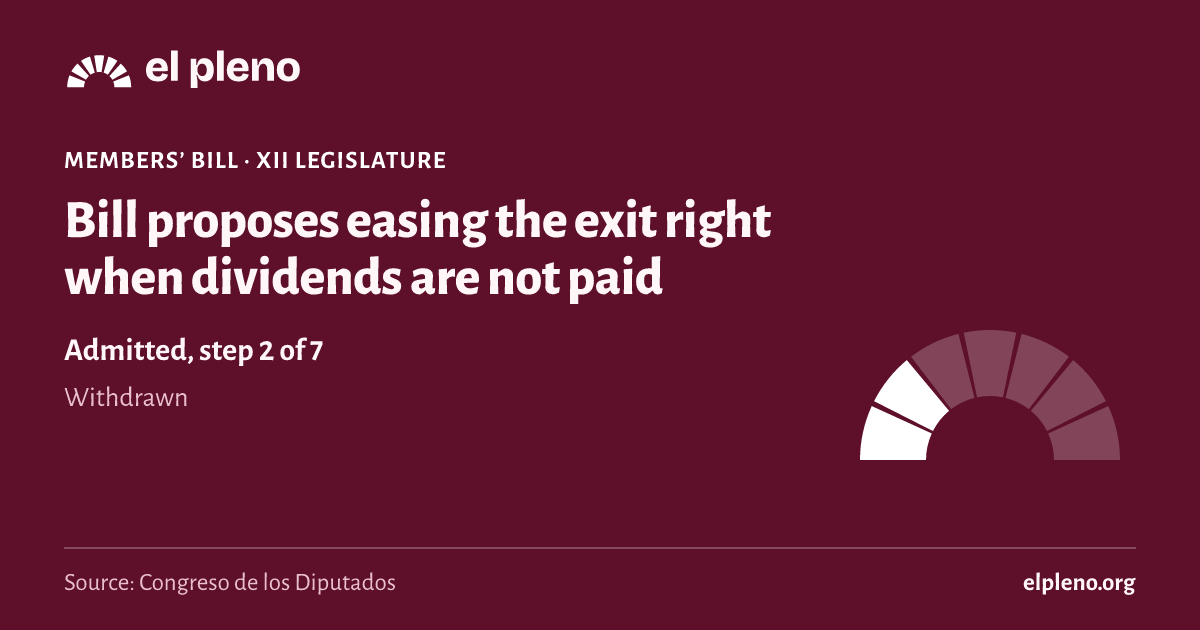
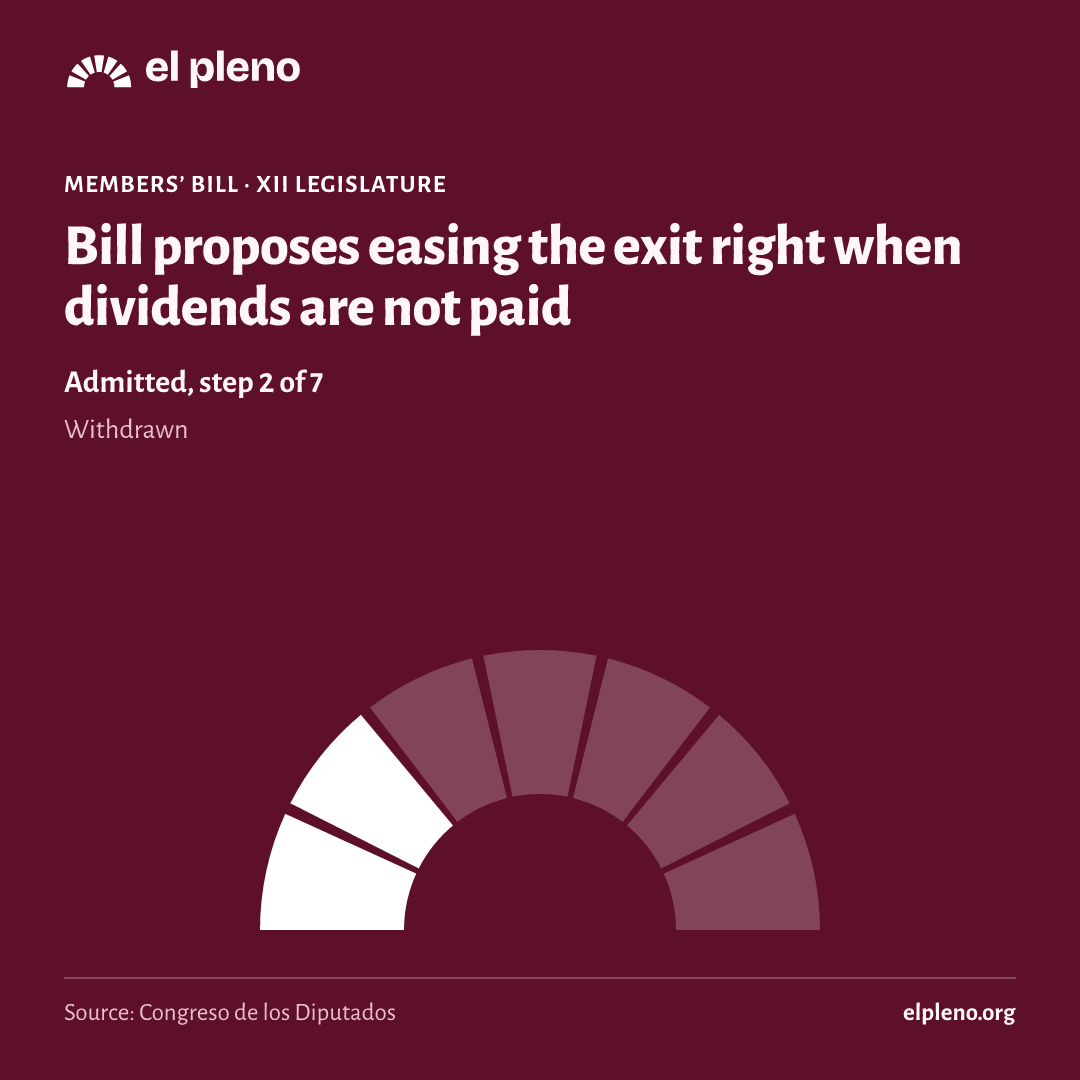
It took 2 of 7 steps. It reached Admitted, and today it is withdrawn.
- Introduced24 November 2017Someone registers the text in the Congreso.
- Admitted28 November 2017The Bureau of the Congreso accepts it and, for a members’ bill, the plenary decides whether to consider it.
- Amendmentsnot reachedGroups propose changes.
- Committeenot reachedA committee goes through the text in detail.
- Plenarynot reachedAll 350 deputies vote.
- Senatenot reachedThe Senate can pass it, amend it or veto it.
- BOEnot reachedIt is published in the Official State Gazette (BOE) and comes into force.
See the 6 official steps on a timeline
Was there a plenary vote?
We have no plenary vote linked to this law in the Congreso’s data.
What happens next
What happens now?
Whoever introduced it withdrew it, or it was merged into another one. It goes no further.
Sources
Where does all this come from?
- Congreso de los Diputados, file 122/000151
Official title, type, author, dates and stage.
Retrieved 11 November 2026
- The data comes from the open files of the Congreso, the Senate and the BOE, unaltered.
- Each deputy’s province is the one of their seat on the day of the vote.
- We only say “passed” or “rejected” when the majority needed is certain; otherwise we say which side had more votes.