What it is
Bill to protect forests and prevent large wildfires
It is a members’ bill. Introduced by parliamentary groups, the Senate, regional governments or citizens. It was introduced on 7 November 2017. Introduced by: Grupo Parlamentario Confederal de Unidos Podemos-En Comú Podem-En Marea.
Official title: Private member's bill on urgent measures to strengthen the conservation and sustainable management of forest systems and the protection of forest soils affected by fires.
Source: Congreso de los Diputados, file 122/000145· updated 11 Nov
Automatic summary, not yet reviewed
- The bill would have the State set common, uniform criteria to identify High Wildfire Risk Zones across Spain, plus common guidelines for coordinating and training wildfire prevention and firefighting efforts.
- It would create the 'Montes protectores A protection category for private forests with special characteristics, giving priority access to economic incentives.' category for private forests and expand the grounds for declaring public utility forests, for example if they are mostly native species or lie within protected areas. Municipalities and nonprofit associations could also start these declaration processes.
- It would recognize agrosilvopastoral systems, such as the dehesa, which combine woodland with extensive grazing, and promote territorial exploitation contracts that credit land users for conservation and wildfire prevention work.
- It would generally restrict changes to the vegetation cover of protected and natural forests, limit the spread of pyrophytic species such as eucalyptus and certain pines, and require those stands to be declared High Wildfire Risk Zones with a defense plan within one year.
- It would tighten the ban on changing the use of burned forest land for at least 30 years, prohibit replanting it with pyrophytic species, and create a public registry of such land. It would also keep burned land classified as rural land.
- It would require, within one year, a basic national statute regulating the duties and resources of forest and environmental agents.
Who it affects
- Small private forest owners, who hold most of Spain's forest land: Their forests could be designated as protected, become subject to land stewardship agreements, and see their management restricted if located in high wildfire risk zones.
- Livestock farmers and users of agrosilvopastoral systems: They could sign territorial exploitation contracts with public support for their conservation and prevention work.
- Timber and pulp companies: They would face tighter limits on planting species such as eucalyptus and certain pines.
- Forest and environmental agents: They would get a basic state statute organizing their duties and resources.
- Owners of burned forest land: They could not change the land's use for at least 30 years or replant it with pyrophytic species.
Words worth knowing
- Montes protectores
- A protection category for private forests with special characteristics, giving priority access to economic incentives.
- Especies pirófitas (pyrophytic species)
- Plant species, such as eucalyptus or certain pines, that burn easily or encourage wildfires.
- Zonas de Alto Riesgo de Incendio (High Wildfire Risk Zones)
- Forest areas that can be declared high wildfire risk and must have specific defense plans.
- Custodia del territorio (land stewardship)
- Voluntary agreements between landowners and conservation organizations to manage land sustainably.
- Sistemas agrosilvopastoriles (agrosilvopastoral systems)
- Land management combining woodland, crops and extensive grazing, such as the dehesa.
It summarizes the text as it was introduced. It is written by artificial intelligence and may contain mistakes: the official text is what counts. Read the official text · How we make summaries
Where it stands
How far did it get?
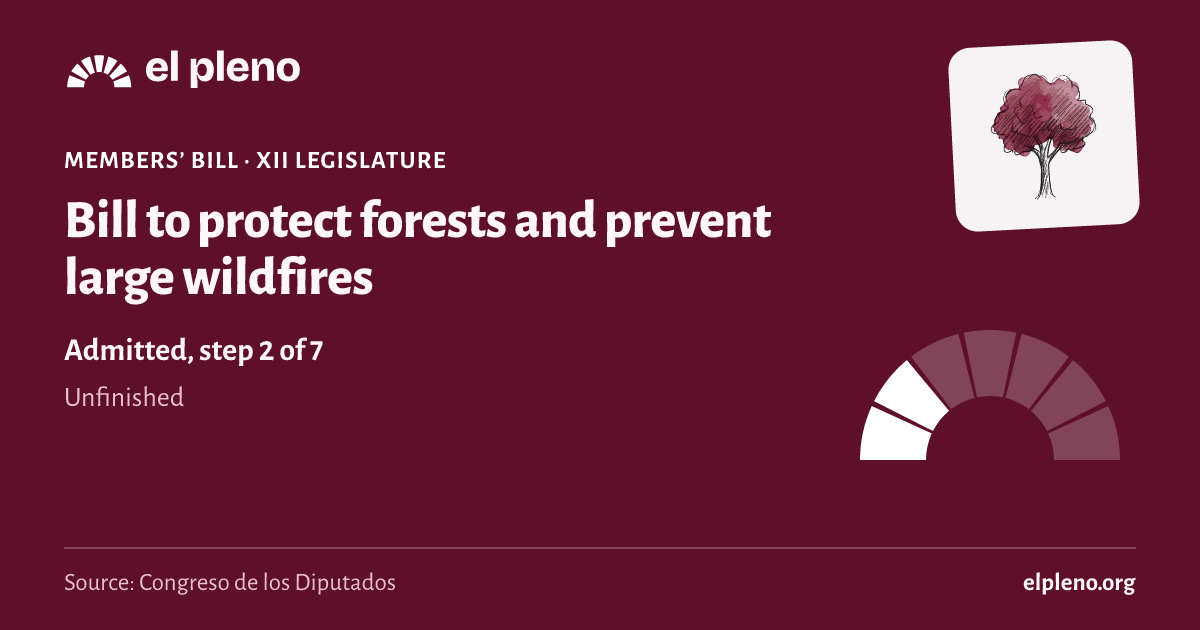
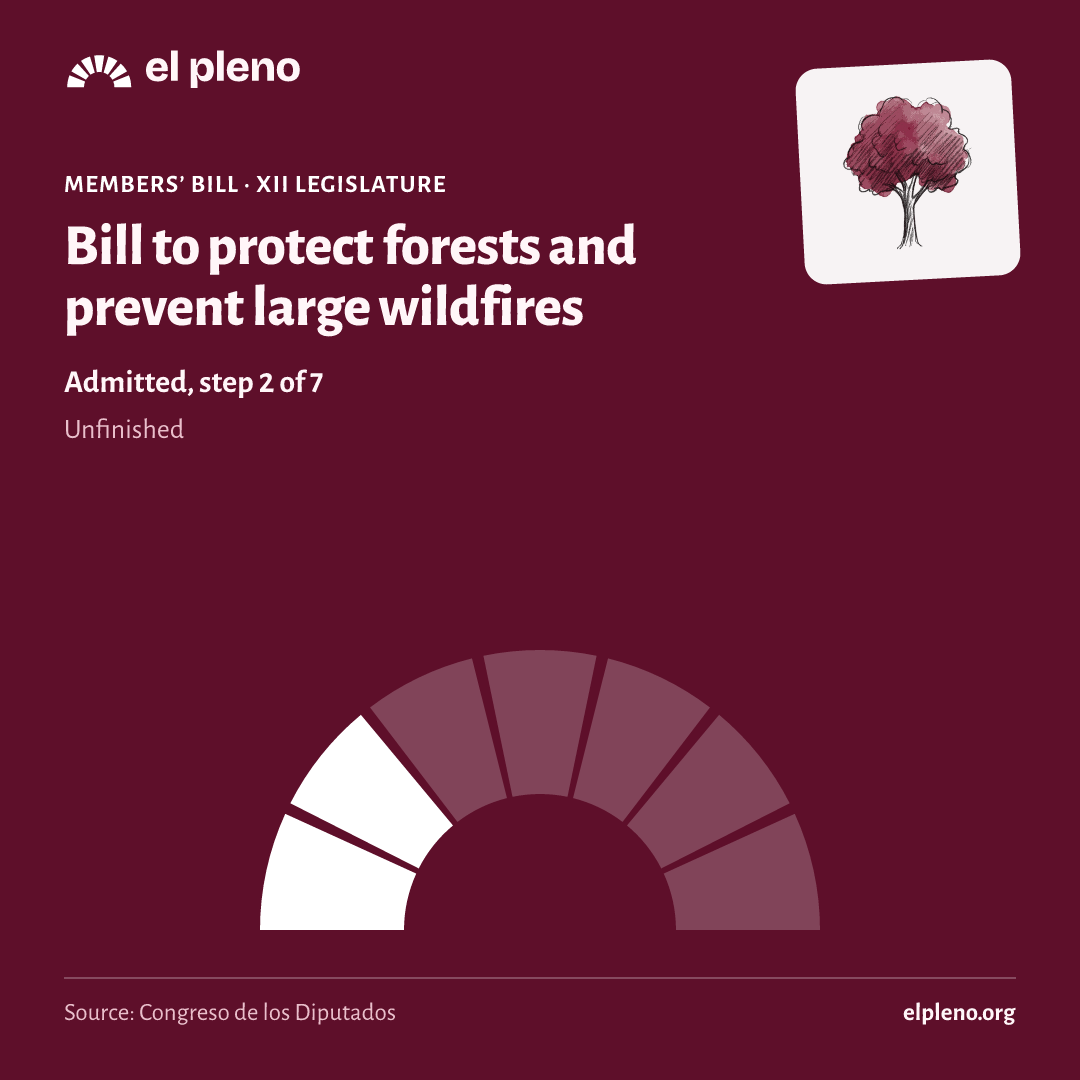
It took 2 of 7 steps. It reached Admitted, and today it is unfinished.
- Introduced7 November 2017Someone registers the text in the Congreso.
- Admitted14 November 2017The Bureau of the Congreso accepts it and, for a members’ bill, the plenary decides whether to consider it.
- Amendmentsnot reachedGroups propose changes.
- Committeenot reachedA committee goes through the text in detail.
- Plenarynot reachedAll 350 deputies vote.
- Senatenot reachedThe Senate can pass it, amend it or veto it.
- BOEnot reachedIt is published in the Official State Gazette (BOE) and comes into force.
See the 6 official steps on a timeline
Was there a plenary vote?
We have no plenary vote linked to this law in the Congreso’s data.
What happens next
What happens now?
The legislature ended before it finished. To go on, someone would have to introduce it again in the new Cortes.
It has not been presented again yet.
Sources
Where does all this come from?
- Congreso de los Diputados, file 122/000145
Official title, type, author, dates and stage.
Retrieved 11 November 2026
- The data comes from the open files of the Congreso, the Senate and the BOE, unaltered.
- Each deputy’s province is the one of their seat on the day of the vote.
- We only say “passed” or “rejected” when the majority needed is certain; otherwise we say which side had more votes.