

What it is
Proposal to have court clerks run the Civil Registry
It is a members’ bill. Introduced by parliamentary groups, the Senate, regional governments or citizens. It was introduced on 18 October 2017. Introduced by: Grupo Parlamentario Confederal de Unidos Podemos-En Comú Podem-En Marea.
Official title: Private member's bill amending the Civil Registry Act and related provisions.
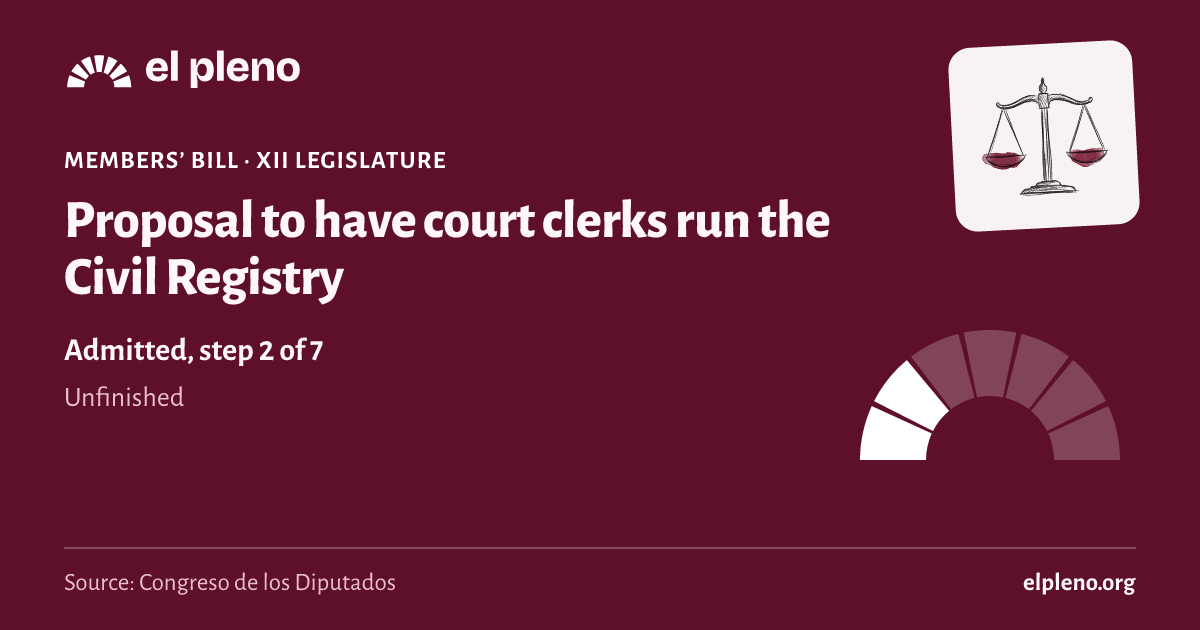
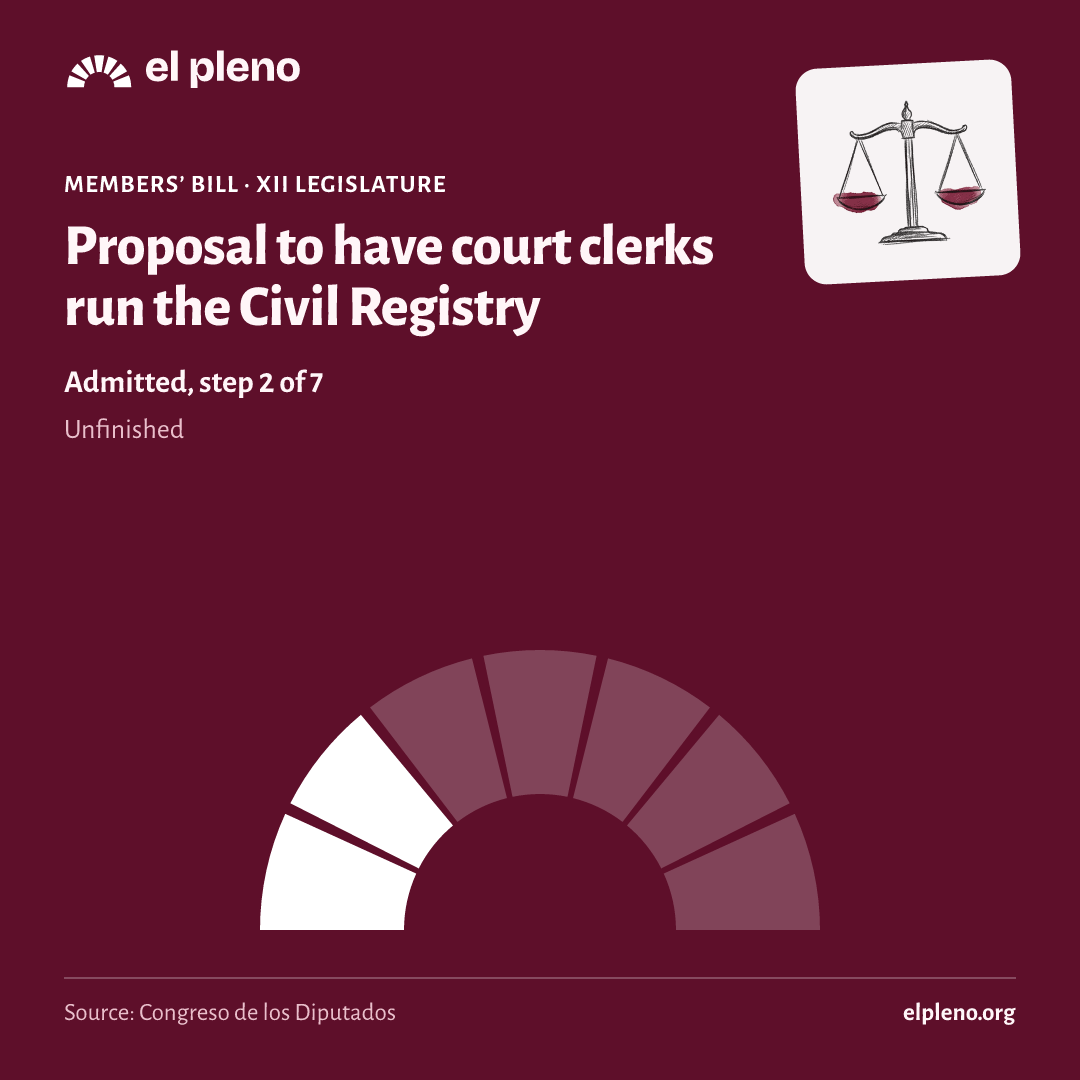
Source: Congreso de los Diputados, file 122/000136· updated 11 Nov
Automatic summary, not yet reviewed
- The bill would have the Civil Registry run by court clerks (Letrados de la Administración de Justicia) instead of judges, and would keep an office in each judicial district to keep the service close to citizens.
- The Civil Registry would be electronic, with a single database owned by the state's general administration.
- There would be a General Office in every town that is the seat of a judicial district, plus the Central Office, Consular Offices and Delegated Offices in the Peace Courts (Juzgados de Paz).
- The file required before a civil marriage would be handled by the Registry Head, and the wedding could be held before a Peace Court judge, mayor, Registry Head or notary, chosen by the couple.
- To obtain Spanish nationality by residence, the bill keeps a 100-euro fee and two tests: one in Spanish at level A2 and another on the Spanish Constitution and culture, with exemptions for minors, people with judicially modified capacity and large families.
- The proposed law would take effect on June 30, 2018, with some exceptions for certain provisions.
Words worth knowing
- Registro Civil (Civil Registry)
- Public office where key life events are recorded: birth, filiation, marriage and death.
- Folio único personal (single personal file)
- A single electronic file per person holding all their Civil Registry entries.
- Letrado de la Administración de Justicia (court clerk)
- A civil servant working in the courts who performs legal tasks such as certifying documents and handling case files.
- Partido judicial (judicial district)
- A territory grouping several municipalities, used to organize the courts.
- Desjudicialización (removing judicial role)
- Moving a task from judges to other civil servants, here from judges to court clerks for the Civil Registry.
It summarizes the text as it was introduced. It is written by artificial intelligence and may contain mistakes: the official text is what counts. Read the official text · How we make summaries
Where it stands
How far did it get?
It took 2 of 7 steps. It reached Admitted, and today it is unfinished.
- Introduced18 October 2017Someone registers the text in the Congreso.
- Admitted24 October 2017The Bureau of the Congreso accepts it and, for a members’ bill, the plenary decides whether to consider it.
- Amendmentsnot reachedGroups propose changes.
- Committeenot reachedA committee goes through the text in detail.
- Plenarynot reachedAll 350 deputies vote.
- Senatenot reachedThe Senate can pass it, amend it or veto it.
- BOEnot reachedIt is published in the Official State Gazette (BOE) and comes into force.
See the 6 official steps on a timeline
Was there a plenary vote?
We have no plenary vote linked to this law in the Congreso’s data.
What happens next
What happens now?
The legislature ended before it finished. To go on, someone would have to introduce it again in the new Cortes.
It has not been presented again yet.
Sources
Where does all this come from?
- Congreso de los Diputados, file 122/000136
Official title, type, author, dates and stage.
Retrieved 11 November 2026
- The data comes from the open files of the Congreso, the Senate and the BOE, unaltered.
- Each deputy’s province is the one of their seat on the day of the vote.
- We only say “passed” or “rejected” when the majority needed is certain; otherwise we say which side had more votes.