What it is
Bill to legalize and regulate surrogacy in Spain
It is a members’ bill. Introduced by parliamentary groups, the Senate, regional governments or citizens. It was introduced on 27 June 2017. Introduced by: Grupo Parlamentario Ciudadanos.
Official title: Private member's bill regulating the right to surrogacy.
Source: Congreso de los Diputados, file 122/000117· updated 11 Nov
Automatic summary, not yet reviewed
- The bill would establish surrogacy as a right, under conditions of freedom, equality, dignity and no profit. Current Law 14/2006 voids surrogacy contracts, and this bill would repeal that provision.
- Surrogacy would be altruistic: the surrogate mother could only receive compensation for expenses and discomfort arising from the process, never a profit. She would also be entitled to an insurance policy paid for by the intended parents.
- The surrogate mother would have to meet requirements such as being over 25 and under an age set by regulation, being in good physical and mental health, having previously given birth to a healthy child, legally residing in Spain, and not having been a surrogate more than once. Intended parents would have to be 25 to 45 years old, legally reside in Spain, and have exhausted or be incompatible with other assisted reproduction techniques.
- Before any reproduction technique is applied, the parties would have to sign a surrogacy contract before a notary with minimum required content (identities, consent, compensation, techniques, insurance, place of birth). Contracts would not be allowed if there is an employment or economic subordination relationship between the parties.
- There would be no legal parent-child link between the surrogate mother and the child: parentage would be determined in favor of the intended parents, who could not challenge it and would have to take charge of the child immediately after birth. A National Surrogacy Registry would be created, and registration would be mandatory.
- Penalties would be set: fines of up to €1,000 for minor offenses, €1,001 to €10,000 for serious ones, and €10,001 up to one million euros for very serious ones. For the most serious offenses or unauthorized activity, the center could be closed.
Who it affects
- Women who want to act as surrogate mothers: They would have to register in the national registry, pass medical exams, and meet age, health and residency requirements.
- Individuals or couples seeking to be intended parents: They would have to be 25 to 45 years old, legally reside in Spain, and have exhausted or be incompatible with other assisted reproduction techniques.
- Health centers and services: They would need specific health authorization to perform surrogacy and could be fined or closed down.
- Children born through surrogacy: Parentage would be determined in favor of the intended parents, with no legal link to the surrogate mother.
Words worth knowing
- Gestación por subrogación (surrogacy)
- A woman agrees to become pregnant through assisted reproduction techniques and give birth to the child of another person or couple, the intended parents.
- Progenitores subrogantes (intended parents)
- The people who provide their own genetic material and become parents through this surrogacy.
- Filiación (parentage)
- The legal bond that determines who a person's parents are.
- Compensación resarcitoria (reimbursement compensation)
- Money that only covers expenses and discomfort from the process, so surrogacy is not a business.
It summarizes the text as it was introduced. It is written by artificial intelligence and may contain mistakes: the official text is what counts. Read the official text · How we make summaries
Where it stands
How far did it get?
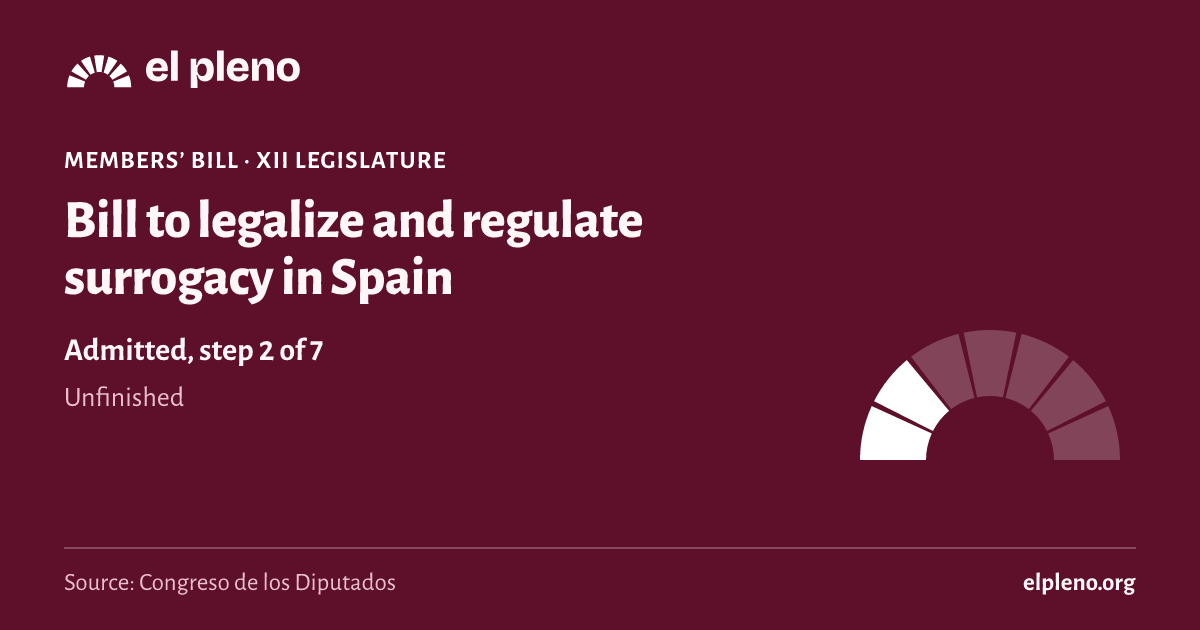
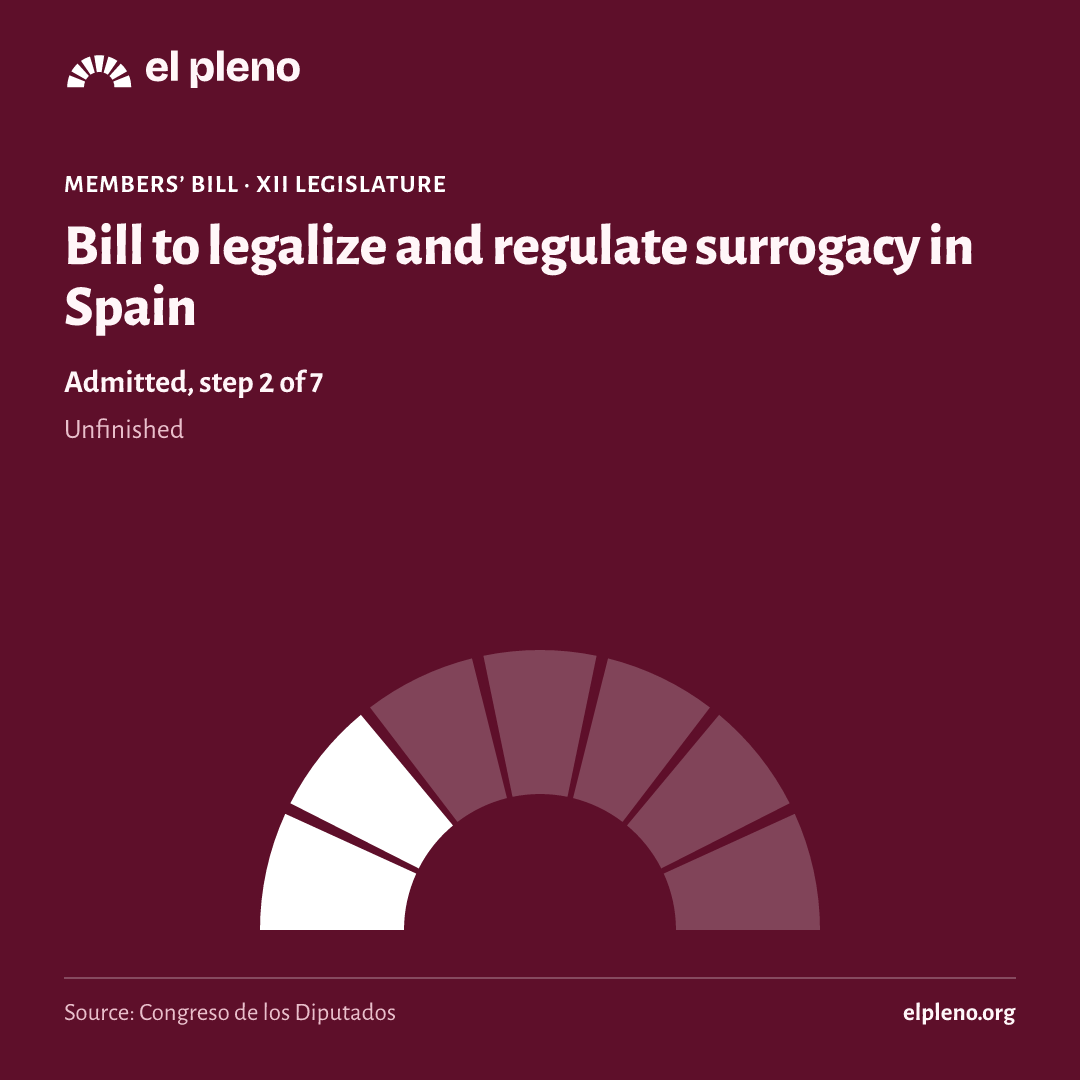
It took 2 of 7 steps. It reached Admitted, and today it is unfinished.
- Introduced27 June 2017Someone registers the text in the Congreso.
- Admitted5 September 2017The Bureau of the Congreso accepts it and, for a members’ bill, the plenary decides whether to consider it.
- Amendmentsnot reachedGroups propose changes.
- Committeenot reachedA committee goes through the text in detail.
- Plenarynot reachedAll 350 deputies vote.
- Senatenot reachedThe Senate can pass it, amend it or veto it.
- BOEnot reachedIt is published in the Official State Gazette (BOE) and comes into force.
See the 6 official steps on a timeline
Was there a plenary vote?
We have no plenary vote linked to this law in the Congreso’s data.
What happens next
What happens now?
The legislature ended before it finished. To go on, someone would have to introduce it again in the new Cortes.
It has not been presented again yet.
Sources
Where does all this come from?
- Congreso de los Diputados, file 122/000117
Official title, type, author, dates and stage.
Retrieved 11 November 2026
- The data comes from the open files of the Congreso, the Senate and the BOE, unaltered.
- Each deputy’s province is the one of their seat on the day of the vote.
- We only say “passed” or “rejected” when the majority needed is certain; otherwise we say which side had more votes.