What it is
Proposal to fine companies that pay suppliers late
It is a members’ bill. Introduced by parliamentary groups, the Senate, regional governments or citizens. It was introduced on 9 May 2017. Introduced by: Grupo Parlamentario Ciudadanos.
Official title: Private member's bill to strengthen the fight against late payments in commercial transactions.
Source: Congreso de los Diputados, file 122/000098· updated 11 Nov
Automatic summary, not yet reviewed
- The bill starts from a serious problem: many companies and public authorities pay their invoices after the agreed deadline. This hurts small and medium-sized businesses and self-employed workers the most, since they have less capacity to withstand late payments.
- The bill would create a Late Payment Arbitration System: a free, voluntary system for companies to settle disputes over late payments without going to court. Companies that join would receive a quality label and appear in a public registry.
- It would also create a State Observatory on Late Payment, attached to the Ministry of Finance, to advise, prepare reports and propose measures. Every year it would send the Government and the Autonomous Communities a report on payment periods and the fines imposed.
- The main novelty is a fine system: exceeding the legal payment period by more than twenty days would be a serious offense, and by more than sixty days, a very serious one. Fines would range from about €60 to nearly €820,000 in the most extreme case.
- Companies that pay the outstanding debt quickly would see their fine reduced: 70% if they pay within six days, 50% between seven and fourteen days, and 30% between fifteen and twenty-nine days. Micro, small and medium-sized companies could even request a full waiver of the fine if they prove that others owe them more money.
- To detect late payments, anonymous online reporting channels would be set up, including a 'Buzón de Lucha contra la Morosidad' (Late Payment Reporting Mailbox) run by the Tax Agency. In addition, companies and public authorities would have to publish their average supplier payment periods.
Who it affects
- Companies that invoice other companies or public authorities: They would have to pay within legal deadlines or face fines of up to nearly €820,000.
- Small and medium-sized businesses, microbusinesses and self-employed workers: They could use the free arbitration system, report violations anonymously and benefit from the new transparency measures.
- Public authorities and public companies: They would be subject to quarterly reports on their payments and required to promote arbitration in their contracts.
- Autonomous Communities (regional governments): They would be the ones checking violations and imposing fines.
- Any individual or company: They could anonymously report late payments they become aware of.
Words worth knowing
- Morosidad (late payment)
- Paying invoices later than the agreed deadline or the legal deadline.
- Intereses de demora (default interest)
- Extra money the debtor must pay as a penalty for paying late.
- Arbitraje (arbitration)
- A way to settle a dispute without going to court: a third party decides and both sides accept the decision.
- Concurso de acreedores (insolvency proceeding)
- The situation of a company that cannot pay its debts and is placed under a special legal procedure.
- Pyme (SME)
- Small and medium-sized enterprise, based on its size and number of workers.
It summarizes the text as it was introduced. It is written by artificial intelligence and may contain mistakes: the official text is what counts. Read the official text · How we make summaries
Where it stands
How far did it get?
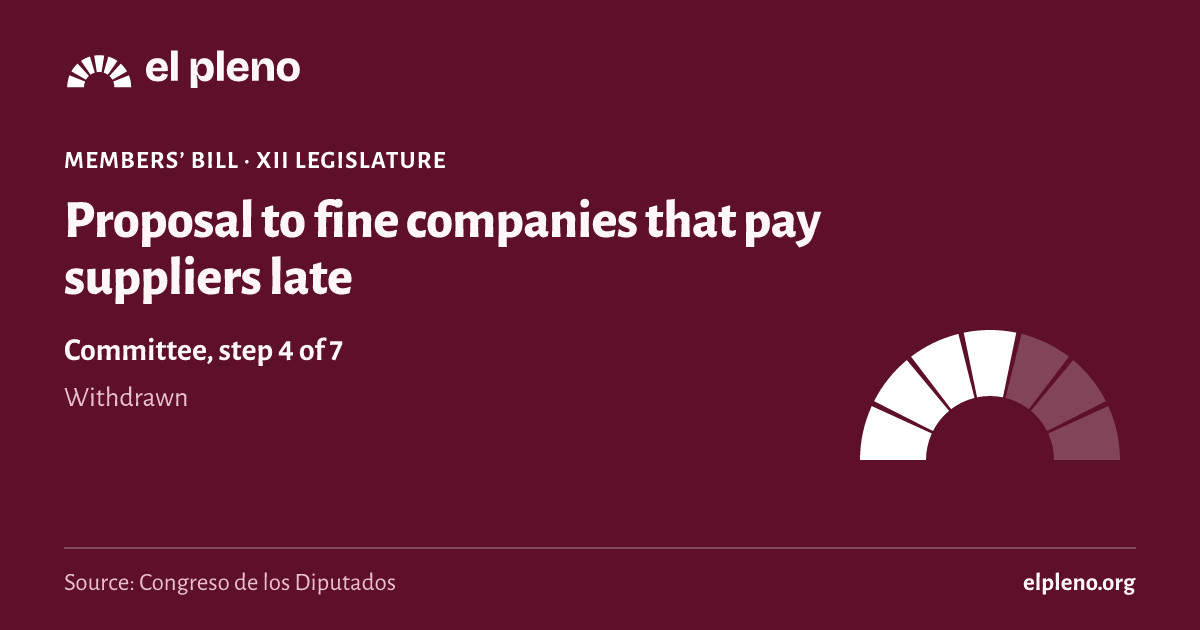
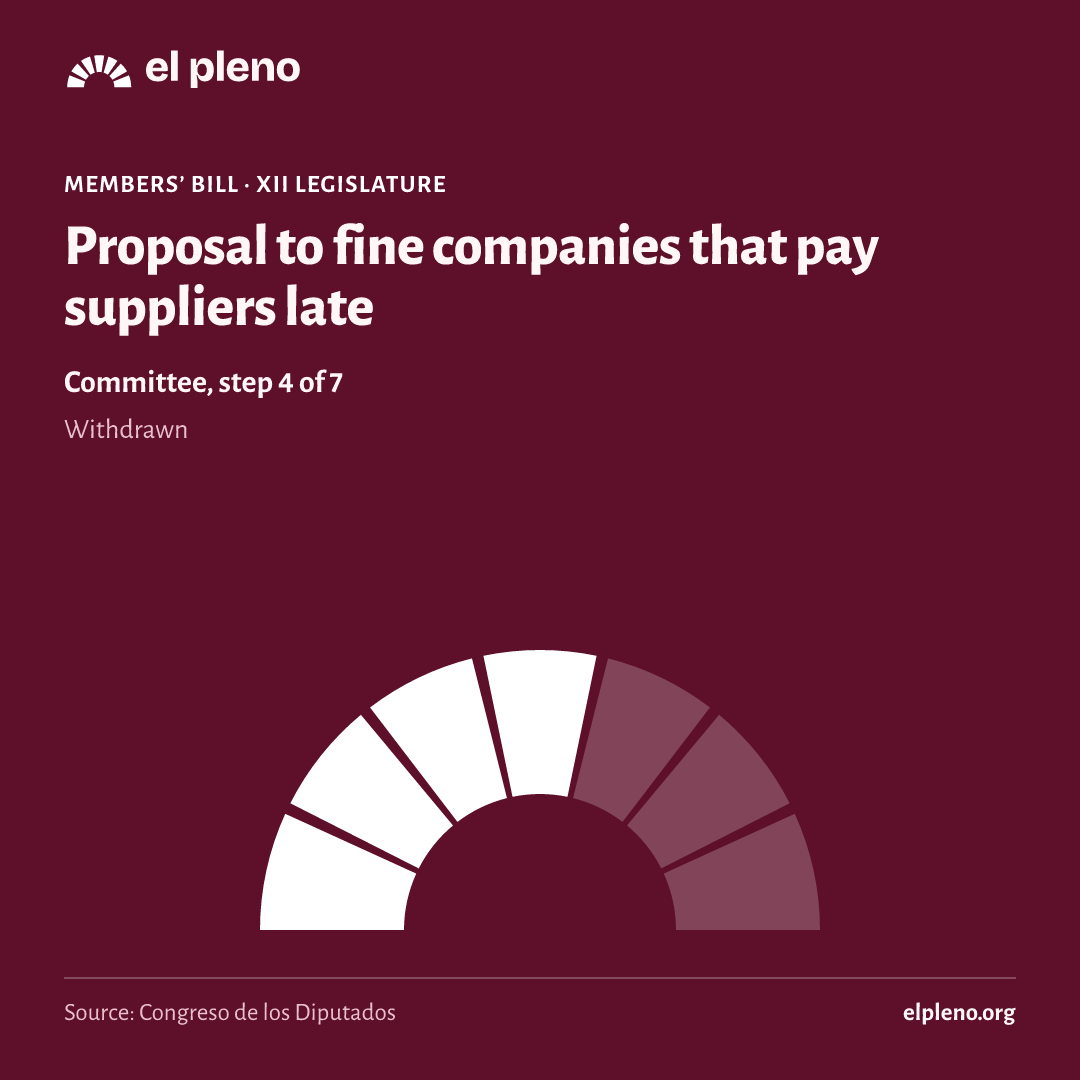
It took 4 of 7 steps. It reached Committee, and today it is withdrawn.
- Introduced9 May 2017Someone registers the text in the Congreso.
- Admitted16 May 2017The Bureau of the Congreso accepts it and, for a members’ bill, the plenary decides whether to consider it.
- Amendments30 June 2017Groups propose changes.
- Committee22 November 2017A committee goes through the text in detail.
- Plenarynot reachedAll 350 deputies vote.
- Senatenot reachedThe Senate can pass it, amend it or veto it.
- BOEnot reachedIt is published in the Official State Gazette (BOE) and comes into force.
See the 12 official steps on a timeline
20 June 2017
How did the plenary vote?
Voted on: Private member's bill by the Ciudadanos Parliamentary Group, to strengthen the fight against late payment in commercial transactions.
Source: Congreso de los Diputados, vote 2 of sitting 60· updated 10 Nov
Each dot is a seat. Tap one, or use the arrow keys, to see who it is.
Your province
How did the deputies from your province vote?
And your senators: the Senate does not link its votes to this law in its open data, so we cannot put them side by side here.
Or see how most of each province voted
- A Coruña More votes in favour 8 yes · 0 no
- Albacete More votes in favour 4 yes · 0 no
- Alicante/Alacant More votes in favour 10 yes · 0 no
- Almería More votes in favour 6 yes · 0 no
- Araba/Álava More votes in favour 4 yes · 0 no
- Asturias More votes in favour 7 yes · 0 no
- Ávila More votes in favour 3 yes · 0 no
- Badajoz More votes in favour 6 yes · 0 no
- Barcelona More votes in favour 30 yes · 0 no
- Bizkaia More votes in favour 6 yes · 0 no
- Burgos More votes in favour 4 yes · 0 no
- Cáceres More votes in favour 3 yes · 0 no
- Cádiz More votes in favour 8 yes · 0 no
- Cantabria More votes in favour 5 yes · 0 no
- Castellón/Castelló More votes in favour 5 yes · 0 no
- Ceuta More votes in favour 1 yes · 0 no
- Ciudad Real More votes in favour 5 yes · 0 no
- Córdoba More votes in favour 6 yes · 0 no
- Cuenca More votes in favour 3 yes · 0 no
- Gipuzkoa More votes in favour 5 yes · 0 no
- Girona More votes in favour 6 yes · 0 no
- Granada More votes in favour 6 yes · 0 no
- Guadalajara More votes in favour 3 yes · 0 no
- Huelva More votes in favour 5 yes · 0 no
- Huesca More votes in favour 3 yes · 0 no
- Illes Balears More votes in favour 8 yes · 0 no
- Jaén More votes in favour 5 yes · 0 no
- La Rioja More votes in favour 4 yes · 0 no
- Las Palmas More votes in favour 8 yes · 0 no
- León More votes in favour 4 yes · 0 no
- Lleida More votes in favour 3 yes · 0 no
- Lugo More votes in favour 4 yes · 0 no
- Madrid More votes in favour 33 yes · 0 no
- Málaga More votes in favour 11 yes · 0 no
- Melilla More votes in favour 1 yes · 0 no
- Murcia More votes in favour 10 yes · 0 no
- Navarra More votes in favour 5 yes · 0 no
- Ourense More votes in favour 4 yes · 0 no
- Palencia More votes in favour 3 yes · 0 no
- Pontevedra More votes in favour 7 yes · 0 no
- Salamanca More votes in favour 4 yes · 0 no
- Santa Cruz de Tenerife More votes in favour 7 yes · 0 no
- Segovia More votes in favour 3 yes · 0 no
- Sevilla More votes in favour 12 yes · 0 no
- Soria More votes in favour 2 yes · 0 no
- Tarragona More votes in favour 6 yes · 0 no
- Teruel More votes in favour 3 yes · 0 no
- Toledo More votes in favour 6 yes · 0 no
- Valencia/València More votes in favour 15 yes · 0 no
- Valladolid More votes in favour 5 yes · 0 no
- Zamora More votes in favour 3 yes · 0 no
- Zaragoza More votes in favour 7 yes · 0 no
More details: how each group and each province voted
The groups
Who voted in favour and who against?
In favour, most of Socialista, Vasco (EAJ-PNV), Mixto, Ciudadanos, Gcup-ec-em, GER and Popular en el Congreso.
By province: in 52 most voted in favour; in 0, against.
Coloured by how most of each province’s deputies voted.
- In favour: 52
- Against: 0
| Group | Seats | How it voted |
|---|---|---|
| Socialista | 84 | 82 in favour · 2 did not vote |
| Vasco (EAJ-PNV) | 5 | 4 in favour · 1 did not vote |
| Mixto | 19 | 16 in favour · 3 did not vote |
| Ciudadanos | 32 | 32 in favour |
| Gcup-ec-em | 67 | 64 in favour · 3 did not vote |
| GER | 9 | 9 in favour |
| Popular en el Congreso | 134 | 128 in favour · 6 did not vote |
What happens next
What happens now?
Whoever introduced it withdrew it, or it was merged into another one. It goes no further.
Sources
Where does all this come from?
- Congreso de los Diputados, file 122/000098
Official title, type, author, dates and stage.
Retrieved 11 November 2026
- Congreso de los Diputados, vote 2 of sitting 60
The count and every seat’s vote.
Retrieved 10 November 2026
- The data comes from the open files of the Congreso, the Senate and the BOE, unaltered.
- Each deputy’s province is the one of their seat on the day of the vote.
- We only say “passed” or “rejected” when the majority needed is certain; otherwise we say which side had more votes.