What it is
Bill to recognize all victims of the Franco dictatorship
It is a members’ bill. Introduced by parliamentary groups, the Senate, regional governments or citizens. It was introduced on 27 April 2017. Introduced by: Grupo Parlamentario de Esquerra Republicana.
Official title: Private member's bill for the recognition of all victims of the dictatorship and the recovery of Historical Memory.
Source: Congreso de los Diputados, file 122/000096· updated 11 Nov
Automatic summary, not yet reviewed
- The bill, introduced by Esquerra Republicana in 2017 and admitted for processing, seeks to amend Law 52/2007 to recognize and provide redress to all victims of the dictatorship who had not yet received recognition, and to recover the memory of the Second Republic and Francoist repression.
- The bill would declare void the sentences of courts martial, the Public Order Court and other Francoist courts, and would grant victim status, with legal, moral and economic redress, to those who suffered executions, torture, exile, purges or confiscations. It would also require returning seized property and documents, or compensating their current value.
- It would recognize the Second Republic as a democratic State under the rule of law, declare April 14 as Historical Memory Day, and provide outreach campaigns, documentary series on TVE, and the inclusion of this content in schools and libraries.
- The State would take on locating and identifying people missing in mass graves, with DNA banks and all costs covered by the State Budget. It would also create an office to search for children stolen under Francoism and a database with DNA from victims and relatives.
- The bill provides for 135,000-euro compensation for the beneficiaries of those who died fighting Francoism, recognition of the anti-Franco armed struggle and of victims deported to Nazi camps, removal of Francoist honors within one year, and turning sites such as the Valle de los Caídos into museums.
- It would create a State Council for the Teaching of Historical Memory, split equally between the Government and civil society, to prepare reports, advise on tributes and monitor compliance with the law, plus an economic fund to finance everything planned.
Words worth knowing
- Proposición de ley
- A bill introduced by a parliamentary group so it can become a law. It is not an approved law until it goes through the legislative process.
- Consejo de Guerra
- A military court that tried people, including civilians, during the war and the dictatorship.
- Crímenes contra la Humanidad
- Crimes against humanity: very serious offenses committed systematically against the population, which under international law never expire.
- Museización
- Turning a historic site into a museum or interpretation center so it can be visited and explained.
- Ley de Amnistía de 1977
- The 1977 Amnesty Law, which pardoned political offenses by both sides of the dictatorship and the opposition. The bill considers it unconstitutional.
It summarizes the text as it was introduced. It is written by artificial intelligence and may contain mistakes: the official text is what counts. Read the official text · How we make summaries
Where it stands
How far did it get?
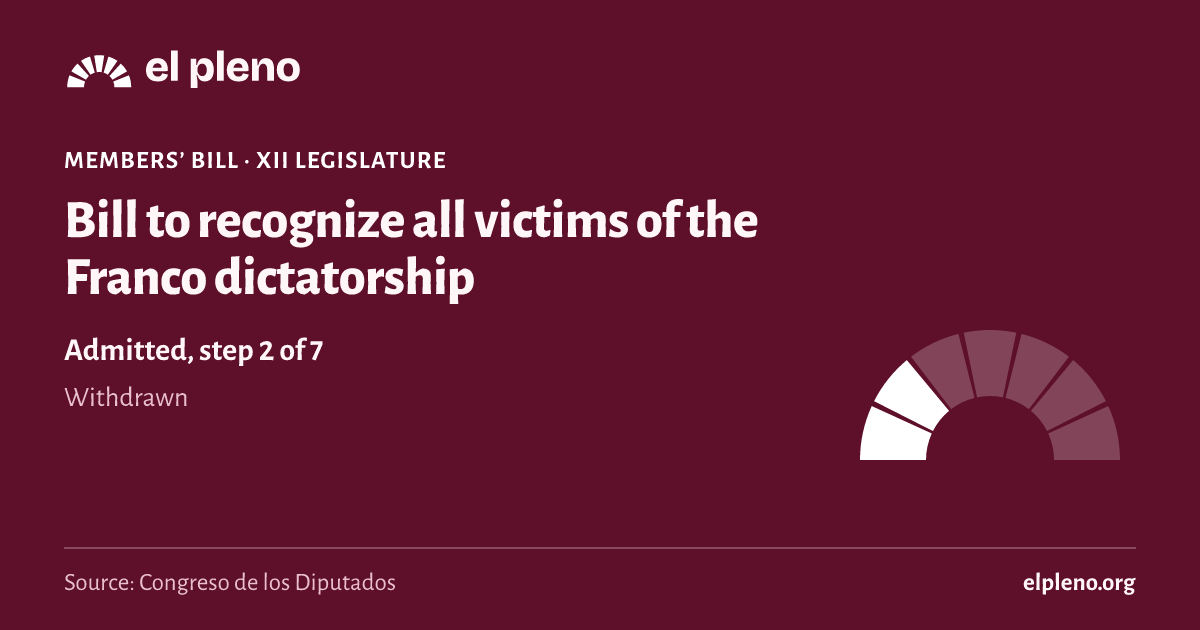
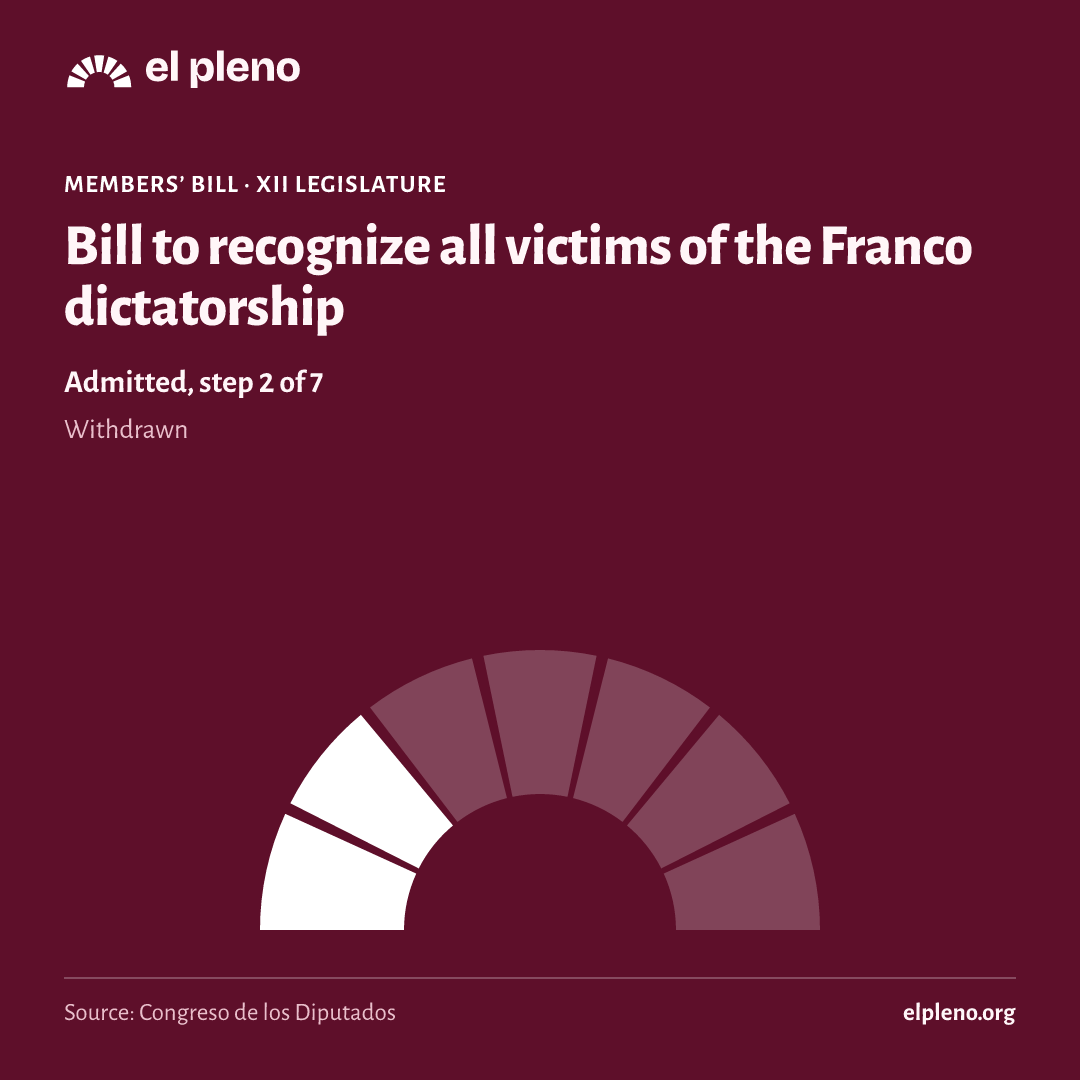
It took 2 of 7 steps. It reached Admitted, and today it is withdrawn.
- Introduced27 April 2017Someone registers the text in the Congreso.
- Admitted8 May 2017The Bureau of the Congreso accepts it and, for a members’ bill, the plenary decides whether to consider it.
- Amendmentsnot reachedGroups propose changes.
- Committeenot reachedA committee goes through the text in detail.
- Plenarynot reachedAll 350 deputies vote.
- Senatenot reachedThe Senate can pass it, amend it or veto it.
- BOEnot reachedIt is published in the Official State Gazette (BOE) and comes into force.
See the 5 official steps on a timeline
Was there a plenary vote?
We have no plenary vote linked to this law in the Congreso’s data.
What happens next
What happens now?
Whoever introduced it withdrew it, or it was merged into another one. It goes no further.
Presented before in:
- IX Legislature, Congreso de los Diputados· Rejected Private member's bill for the recognition of all victims of the dictatorship and the recovery of Historical Memory.
- IX Legislature, Congreso de los Diputados· Rejected Private member's bill for the recognition of all victims of the dictatorship and the recovery of Historical Memory.
Sources
Where does all this come from?
- Congreso de los Diputados, file 122/000096
Official title, type, author, dates and stage.
Retrieved 11 November 2026
- The data comes from the open files of the Congreso, the Senate and the BOE, unaltered.
- Each deputy’s province is the one of their seat on the day of the vote.
- We only say “passed” or “rejected” when the majority needed is certain; otherwise we say which side had more votes.