What it is
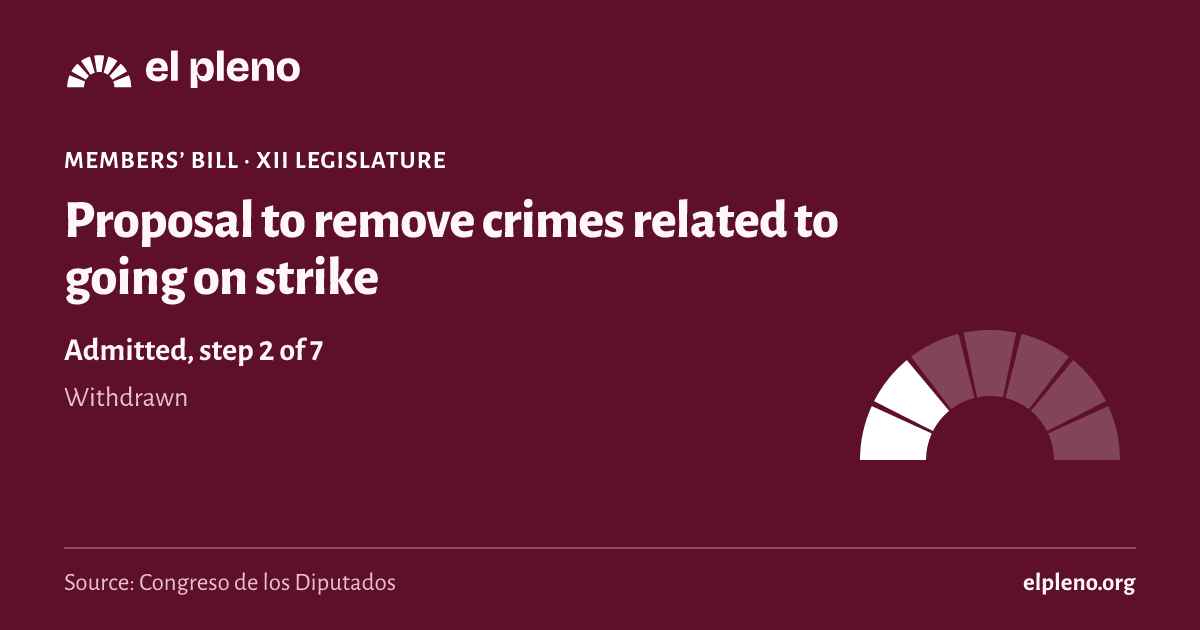
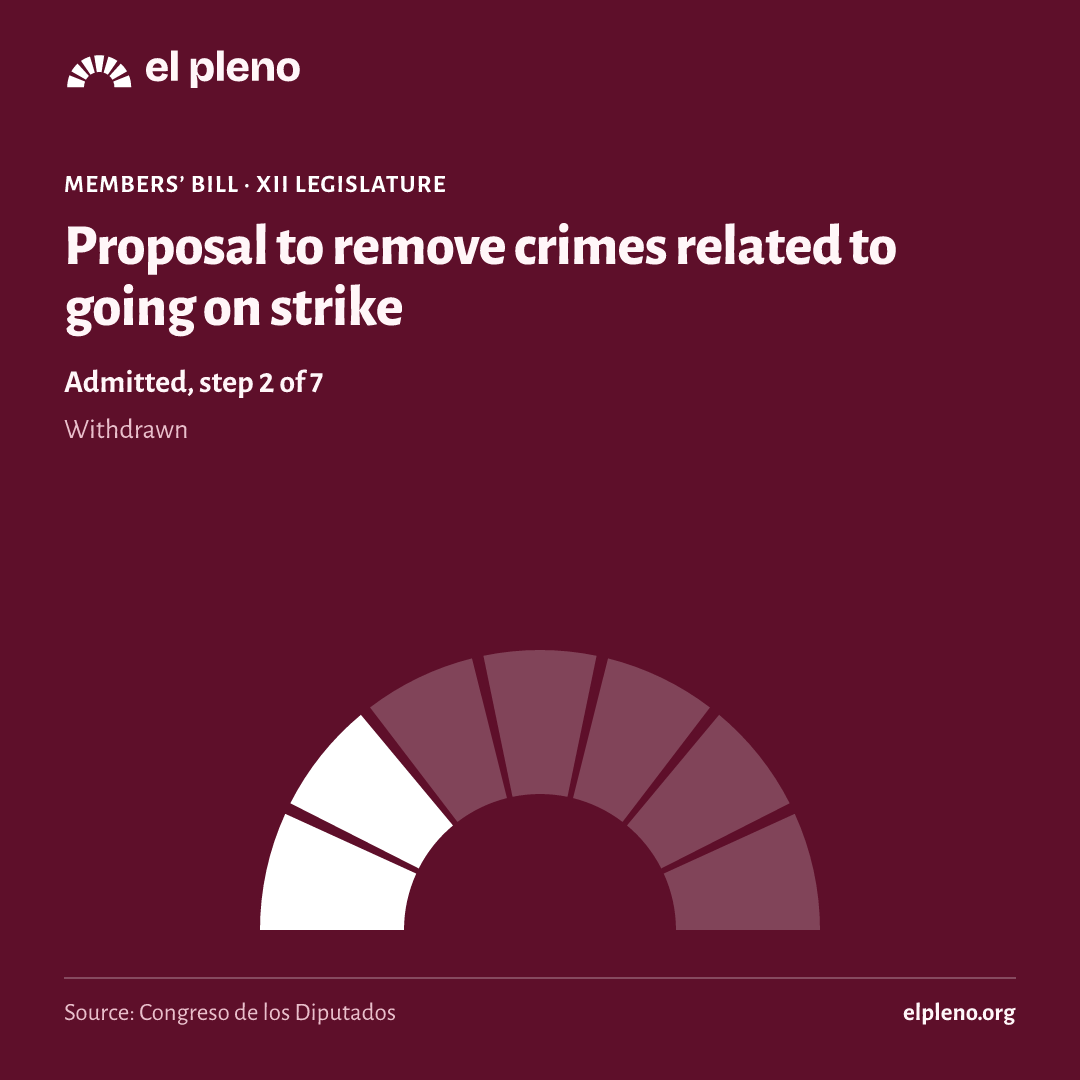
Proposal to remove crimes related to going on strike
It is a members’ bill. Introduced by parliamentary groups, the Senate, regional governments or citizens. It was introduced on 17 March 2017. Introduced by: Grupo Parlamentario de Esquerra Republicana.
Official title: Organic private member's bill amending Organic Act 10/1985, of 23 November, on the Penal Code, to decriminalize the right to strike.
Source: Congreso de los Diputados, file 122/000088· updated 11 Nov
Automatic summary, not yet reviewed
- The bill notes that the Constitution recognizes the right to strike, but that almost four decades later the law to develop it has not been passed, and strikes are still governed by a pre-Constitution rule, the 1977 royal decree-law A rule with the force of law that the Government passes because it is urgent. It applies from its publication, but the Congreso must validate it within 30 days or it lapses. on Labor Relations.
- According to the authors, section 3 of Article 315 of the Criminal Code is being used to limit the right to strike in practice, with more than 300 workers prosecuted under it.
- The bill would delete section 3 of Article 315 of the Criminal Code, the one that punishes crimes related to strikes. As a result, pending criminal cases under that provision would be dismissed.
- If approved, the reform would take effect the day after its publication in the Official State Gazette (Boletín Oficial del Estado).
Who it affects
- Workers and unions prosecuted for strike-related actions: They would no longer be prosecuted under section 3 of Article 315 of the Criminal Code, and their cases would be dismissed.
- Employers and public authorities that reported these acts: They would lose the criminal route to act against strike-related conduct that this section currently punishes.
Words worth knowing
- Despenalización (decriminalization)
- No longer treating as a crime something that used to be one.
- Proposición de Ley Orgánica (organic law bill)
- A text proposing to change a major law, introduced in Congress but not yet approved.
- Piquete informativo (informational picket)
- A group of people who inform workers that a strike is happening and what their rights are.
- royal decree-law
- A rule with the force of law that the Government passes because it is urgent. It applies from its publication, but the Congreso must validate it within 30 days or it lapses.
- decree-law
- A rule with the force of law that the Government passes because it is urgent. It applies from its publication, but the Congreso must validate it within 30 days or it lapses.
It summarizes the text as it was introduced. It is written by artificial intelligence and may contain mistakes: the official text is what counts. Read the official text · How we make summaries
Where it stands
How far did it get?
It took 2 of 7 steps. It reached Admitted, and today it is withdrawn.
- Introduced17 March 2017Someone registers the text in the Congreso.
- Admitted28 March 2017The Bureau of the Congreso accepts it and, for a members’ bill, the plenary decides whether to consider it.
- Amendmentsnot reachedGroups propose changes.
- Committeenot reachedA committee goes through the text in detail.
- Plenarynot reachedAll 350 deputies vote.
- Senatenot reachedThe Senate can pass it, amend it or veto it.
- BOEnot reachedIt is published in the Official State Gazette (BOE) and comes into force.
See the 6 official steps on a timeline
Was there a plenary vote?
We have no plenary vote linked to this law in the Congreso’s data.
What happens next
What happens now?
Whoever introduced it withdrew it, or it was merged into another one. It goes no further.
Sources
Where does all this come from?
- Congreso de los Diputados, file 122/000088
Official title, type, author, dates and stage.
Retrieved 11 November 2026
- The data comes from the open files of the Congreso, the Senate and the BOE, unaltered.
- Each deputy’s province is the one of their seat on the day of the vote.
- We only say “passed” or “rejected” when the majority needed is certain; otherwise we say which side had more votes.