What it is
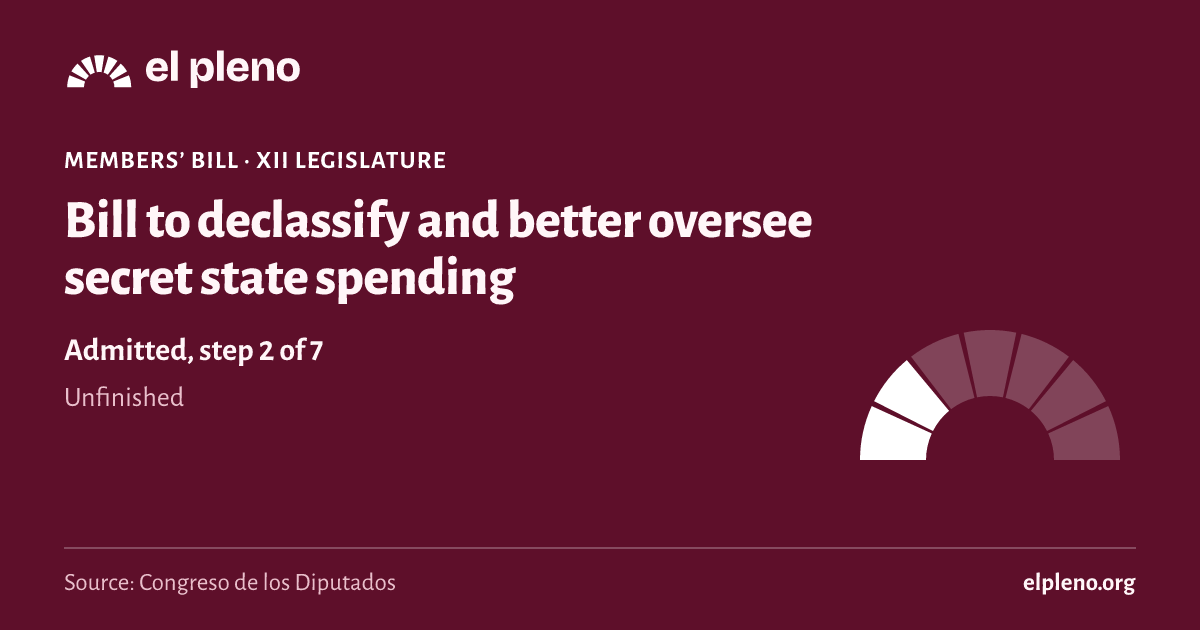
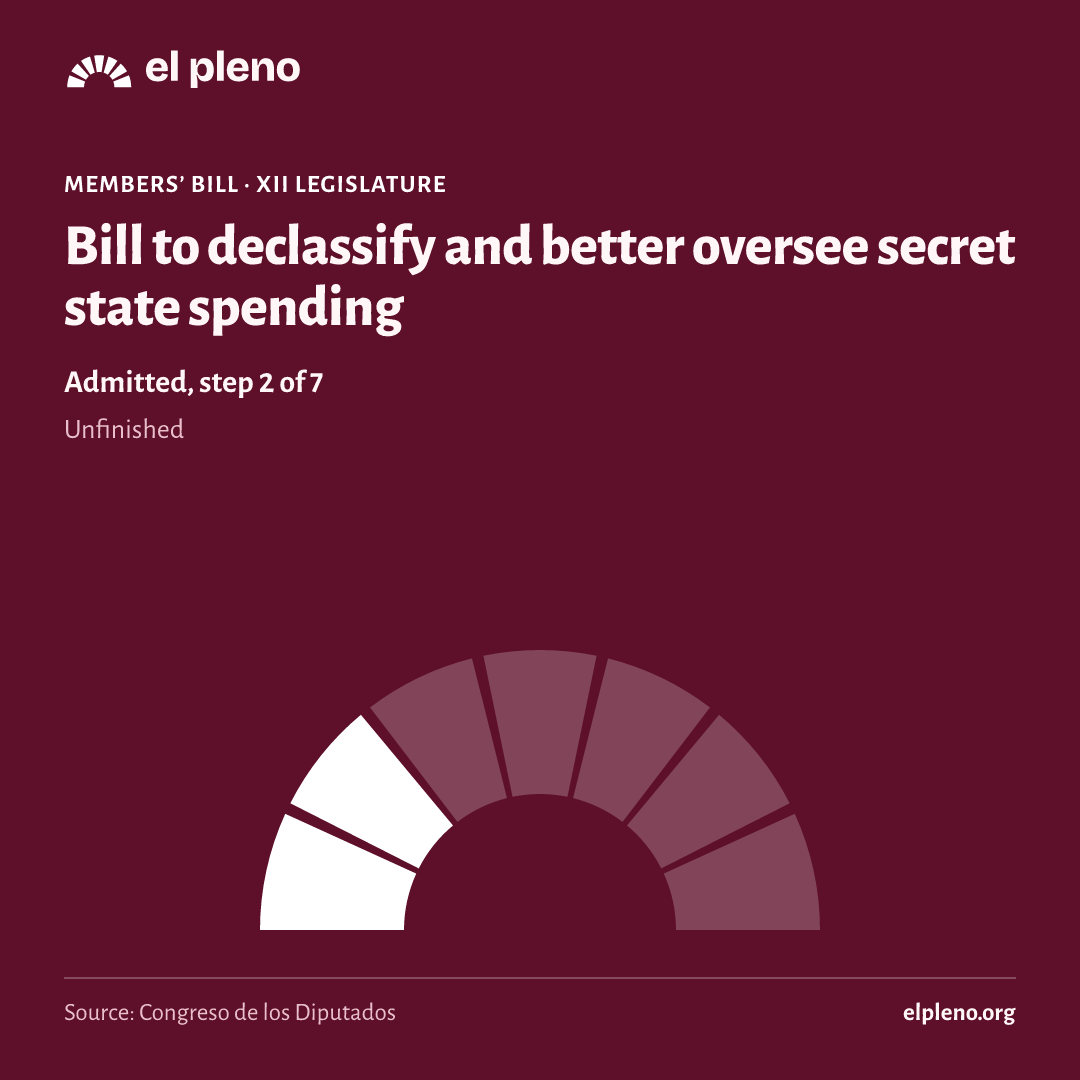
Bill to declassify and better oversee secret state spending
It is a members’ bill. Introduced by parliamentary groups, the Senate, regional governments or citizens. It was introduced on 23 February 2017. Introduced by: Grupo Parlamentario Confederal de Unidos Podemos-En Comú Podem-En Marea.
Official title: Private member's bill regulating the use and control of credits intended for reserved expenses.
Source: Congreso de los Diputados, file 122/000076· updated 11 Nov
Automatic summary, not yet reviewed
- The bill would declassify information on reserved spending automatically after 10 years, although a parliamentary committee could extend the secrecy by 10 more years if disclosure would harm national security.
- It would place these funds under the control of a Congress of Deputies committee chaired by the Speaker of the House, with at least one member from each parliamentary group.
- The committee would have to be set up, at the latest, within thirty working days after the session where the Prime Minister is invested.
- It includes a transitional rule: reserved spending that has already met the deadlines would be declassified when the law takes effect, and the rest would be declassified when their deadlines are met.
Who it affects
- The ministries with reserved spending (Foreign Affairs, Justice, Interior and Defense) and the National Intelligence Center, which would have to account for these funds.: stronger oversight
- The Congress of Deputies, which would oversee this spending through a specific committee.: new oversight role
- The public, who could access declassified reserved spending as public information.: more transparency
Words worth knowing
- Gastos reservados
- Public money the state can spend without detailing what it is used for, for national security or defense reasons.
- Proposición de ley
- A bill introduced by a parliamentary group. It is not a law until Congress and the Senate pass it.
- Desclasificar
- To remove the official secret status from a document or information so it can be made public.
- Sesión de investidura
- The session of Congress where the Prime Minister is elected.
It summarizes the text as it was introduced. It is written by artificial intelligence and may contain mistakes: the official text is what counts. Read the official text · How we make summaries
Where it stands
How far did it get?
It took 2 of 7 steps. It reached Admitted, and today it is unfinished.
- Introduced23 February 2017Someone registers the text in the Congreso.
- Admitted28 February 2017The Bureau of the Congreso accepts it and, for a members’ bill, the plenary decides whether to consider it.
- Amendmentsnot reachedGroups propose changes.
- Committeenot reachedA committee goes through the text in detail.
- Plenarynot reachedAll 350 deputies vote.
- Senatenot reachedThe Senate can pass it, amend it or veto it.
- BOEnot reachedIt is published in the Official State Gazette (BOE) and comes into force.
See the 6 official steps on a timeline
Was there a plenary vote?
We have no plenary vote linked to this law in the Congreso’s data.
What happens next
What happens now?
The legislature ended before it finished. To go on, someone would have to introduce it again in the new Cortes.
It has not been presented again yet.
Presented before in:
- V Legislature, Congreso de los Diputados· Passed How Spain's secret state funds are controlled
- V Legislature, Senate Government bill regulating the use and control of credits earmarked for secret expenditure
Sources
Where does all this come from?
- Congreso de los Diputados, file 122/000076
Official title, type, author, dates and stage.
Retrieved 11 November 2026
- The data comes from the open files of the Congreso, the Senate and the BOE, unaltered.
- Each deputy’s province is the one of their seat on the day of the vote.
- We only say “passed” or “rejected” when the majority needed is certain; otherwise we say which side had more votes.