What it is
Bill to protect and promote all of Spain's official languages
It is a members’ bill. Introduced by parliamentary groups, the Senate, regional governments or citizens. It was introduced on 13 February 2017. Introduced by: Grupo Parlamentario Socialista.
Official title: Organic Private member's bill for the recognition and protection of linguistic plurality in Spain.
Source: Congreso de los Diputados, file 122/000071· updated 11 Nov
Automatic summary, not yet reviewed
- The bill would recognize and protect Spain's linguistic plurality. It would regulate the use of co-official languages, alongside Spanish, in dealings with the State Administration and other institutions, and would also support non-official languages recognized in the Statutes of Autonomy.
- Citizens could use their region's co-official language when dealing with the State Administration. General information and websites of State bodies based in those regions would have to be in Spanish and in the co-official language.
- The bill includes specific rights: choosing the co-official language for the national ID card, passport and driver's license, and choosing the language of distance-negotiated contracts. It would also allow citizens to address the Royal Household in co-official languages.
- The State would guarantee the validity of certificates and accreditations issued by any Spanish public administration, whatever co-official language they are written in, and would promote reform of the legislation on sworn translators.
- The bill proposes measures to promote co-official languages in public companies, cell phones and software, education, culture, state media, the official state gazette (BOE) and the Cervantes Institute. It would also support non-official languages recognized in the Statutes and encourage foreign residents to learn Spain's languages.
- A Council of Spanish Languages would be created, with representation from all ministries and Autonomous Communities, plus an Office for Spanish Languages as a support body. The Council would replace the existing Council of Official Languages of the State Administration, which would be repealed.
Words worth knowing
- Lengua coofficial (co-official language)
- A language that, together with Spanish, is official in an Autonomous Community, as stated by the Constitution and its Statute of Autonomy.
- Administración General del Estado (State Administration)
- The bodies and organizations that report directly to the Spanish Government nationwide.
- Estatuto de Autonomía (Statute of Autonomy)
- The basic rule of each Autonomous Community setting out its institutions and powers.
- Regularización por arraigo
- A procedure allowing foreigners in an irregular situation to obtain residence permission in Spain.
- Traductor jurado (sworn translator)
- An authorized translator whose translations are officially valid before public administrations.
It summarizes the text as it was introduced. It is written by artificial intelligence and may contain mistakes: the official text is what counts. Read the official text · How we make summaries
Where it stands
How far did it get?
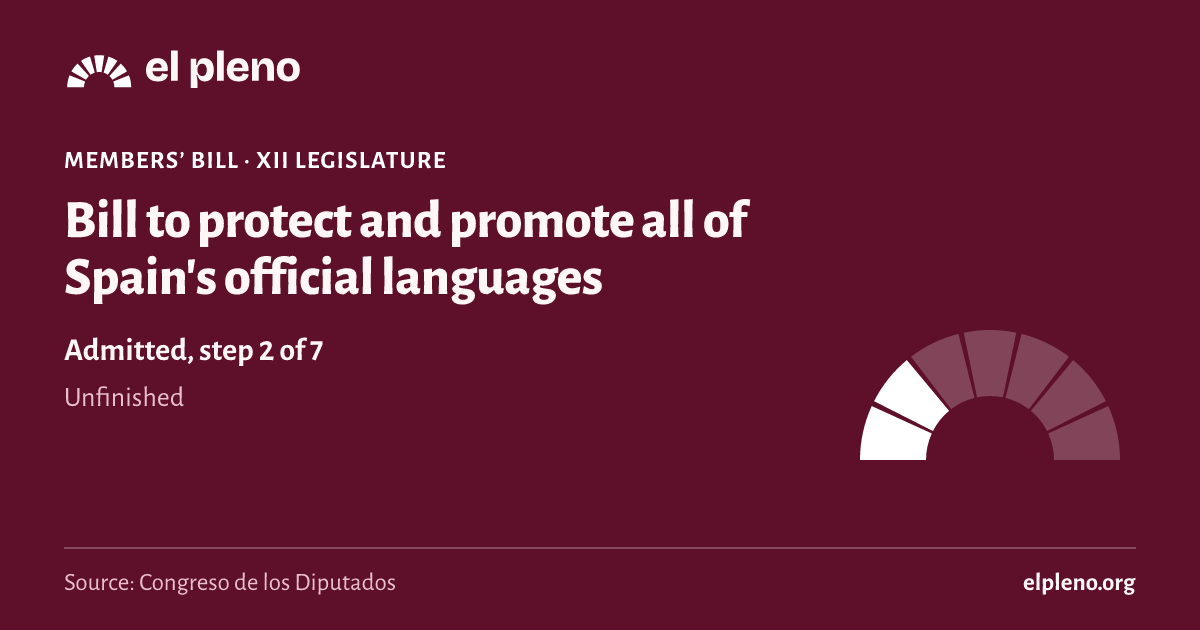
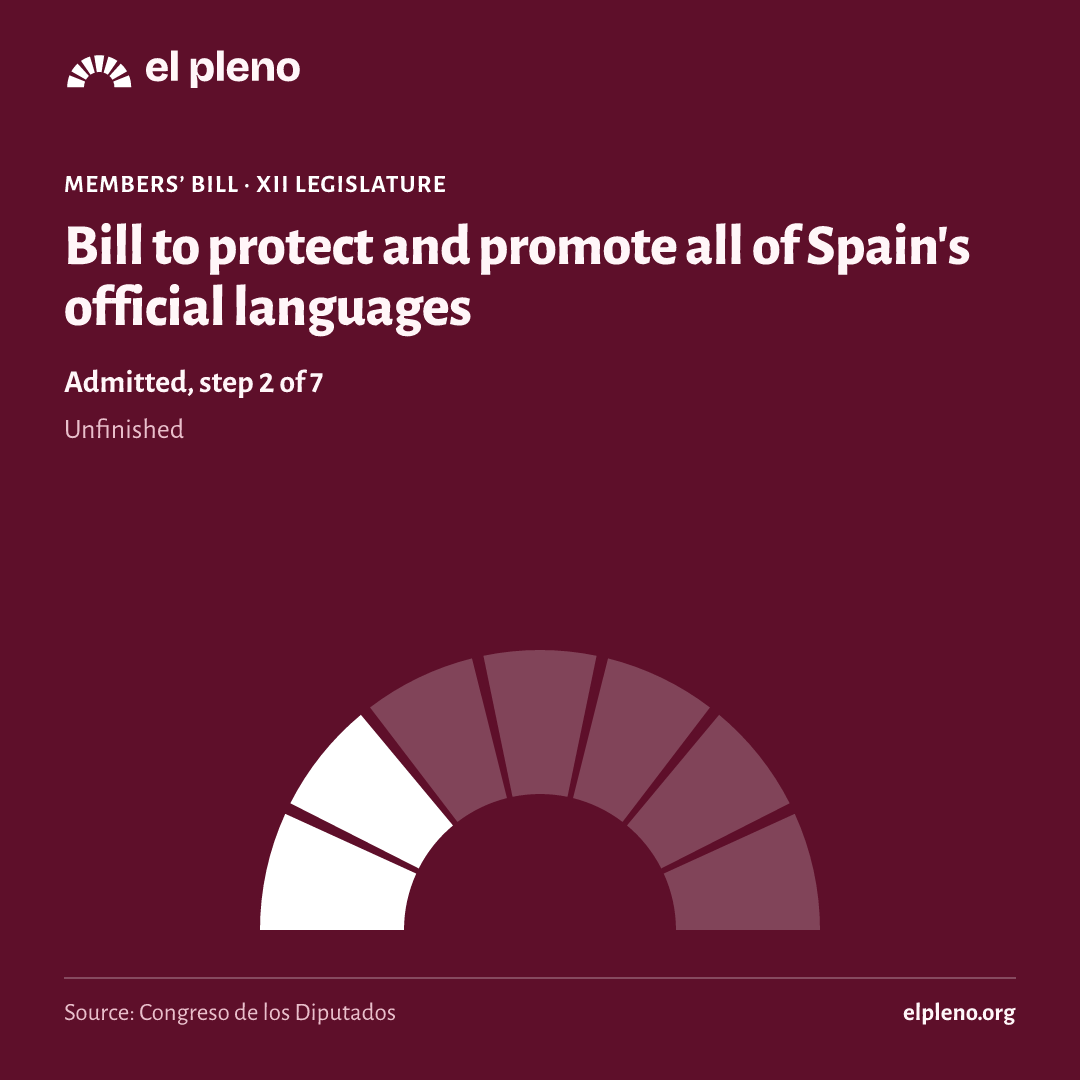
It took 2 of 7 steps. It reached Admitted, and today it is unfinished.
- Introduced13 February 2017Someone registers the text in the Congreso.
- Admitted21 February 2017The Bureau of the Congreso accepts it and, for a members’ bill, the plenary decides whether to consider it.
- Amendmentsnot reachedGroups propose changes.
- Committeenot reachedA committee goes through the text in detail.
- Plenarynot reachedAll 350 deputies vote.
- Senatenot reachedThe Senate can pass it, amend it or veto it.
- BOEnot reachedIt is published in the Official State Gazette (BOE) and comes into force.
See the 6 official steps on a timeline
Was there a plenary vote?
We have no plenary vote linked to this law in the Congreso’s data.
What happens next
What happens now?
The legislature ended before it finished. To go on, someone would have to introduce it again in the new Cortes.
It has not been presented again yet.
Presented before in:
Sources
Where does all this come from?
- Congreso de los Diputados, file 122/000071
Official title, type, author, dates and stage.
Retrieved 11 November 2026
- The data comes from the open files of the Congreso, the Senate and the BOE, unaltered.
- Each deputy’s province is the one of their seat on the day of the vote.
- We only say “passed” or “rejected” when the majority needed is certain; otherwise we say which side had more votes.