What it is
Proposal to legalize the right to euthanasia in Spain
It is a members’ bill. Introduced by parliamentary groups, the Senate, regional governments or citizens. It was introduced on 18 January 2017. Introduced by: Grupo Parlamentario Confederal de Unidos Podemos-En Comú Podem-En Marea.
Official title: Private member's Organic bill on euthanasia.
Source: Congreso de los Diputados, file 122/000060· updated 11 Nov
Automatic summary, not yet reviewed
- The bill would recognize the right of people to request and receive medical help to die, through euthanasia or medically assisted suicide, in public and private healthcare settings, including at home.
- It could be requested by adults (or legally emancipated minors) who are terminally ill or suffer pain they consider intolerable, in writing at least twice, 15 days apart. It could also apply if stated in an advance instructions document.
- Death by euthanasia would be considered equivalent to a natural death for all purposes, including life insurance.
- The responsible physician would have several duties: inform the patient, verify the request is voluntary, obtain a report from a consulting physician, and notify the Evaluation Commission within 4 business days. Denied requests would also have to be reported.
- The service would be included in the basic portfolio of the National Health System. Healthcare staff directly involved could object on grounds of conscience, but public institutions would have to guarantee this does not block access to the right.
- Evaluation commissions would be created in each Autonomous Community, plus a State Monitoring Commission, to oversee compliance and issue annual reports. The Penal Code would also be amended so that causing or cooperating in the death of a person who expressly, unequivocally and repeatedly requested it would not be punishable.
Who it affects
- People with terminal illnesses or suffering they consider intolerable: They could request and receive medical help to die, meeting the requirements in the bill.
- Physicians and nursing staff: They would have specific duties when handling requests, and could object on grounds of conscience.
- Public health services: They would have to guarantee access to the service and include it in their service portfolio.
- Autonomous Communities: They would have to create evaluation commissions and draft access plans within 3 months.
Words worth knowing
- Eutanasia (euthanasia)
- Action by a physician to cause the death, quickly and painlessly, of a person with a serious illness or suffering they consider intolerable.
- Suicidio médicamente asistido (medically assisted suicide)
- The person ends their own life using means provided by a physician, who attends them during the process.
- Objeción de conciencia (conscientious objection)
- An individual right to refuse to do something that goes against one's own moral beliefs.
- Documento de instrucciones previas (advance instructions document)
- A document in which a person states in advance their wishes about care and treatment for when they can no longer express them.
- Cuidados paliativos (palliative care)
- Health care that seeks to relieve the suffering and pain of seriously ill patients, without curing the illness.
It summarizes the text as it was introduced. It is written by artificial intelligence and may contain mistakes: the official text is what counts. Read the official text · How we make summaries
Where it stands
How far did it get?
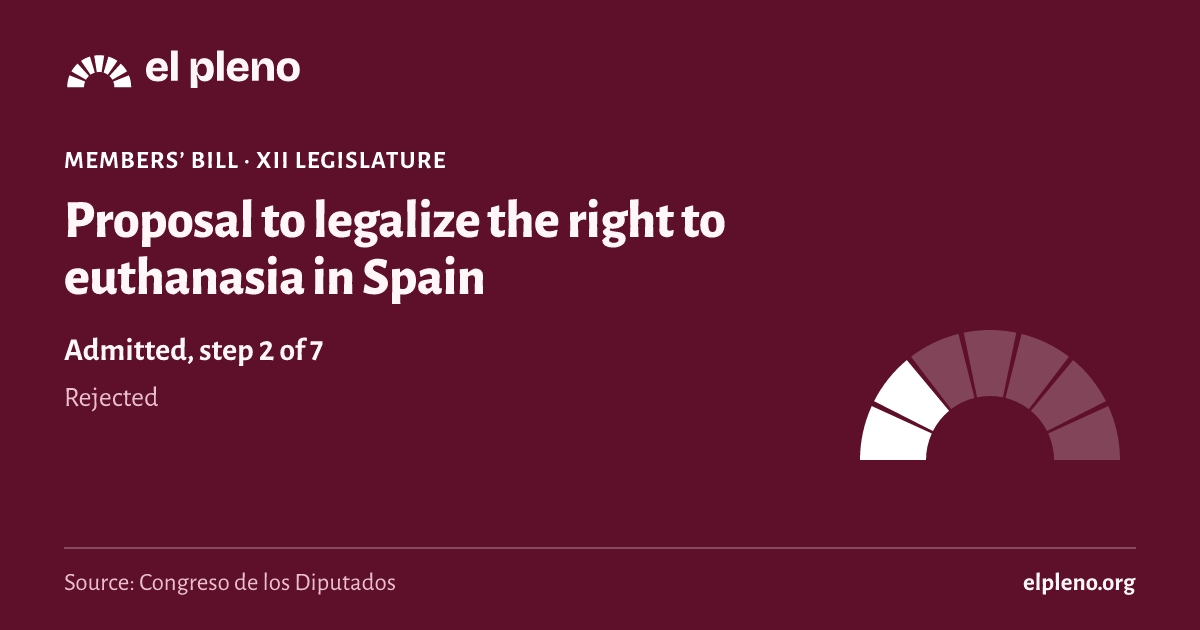
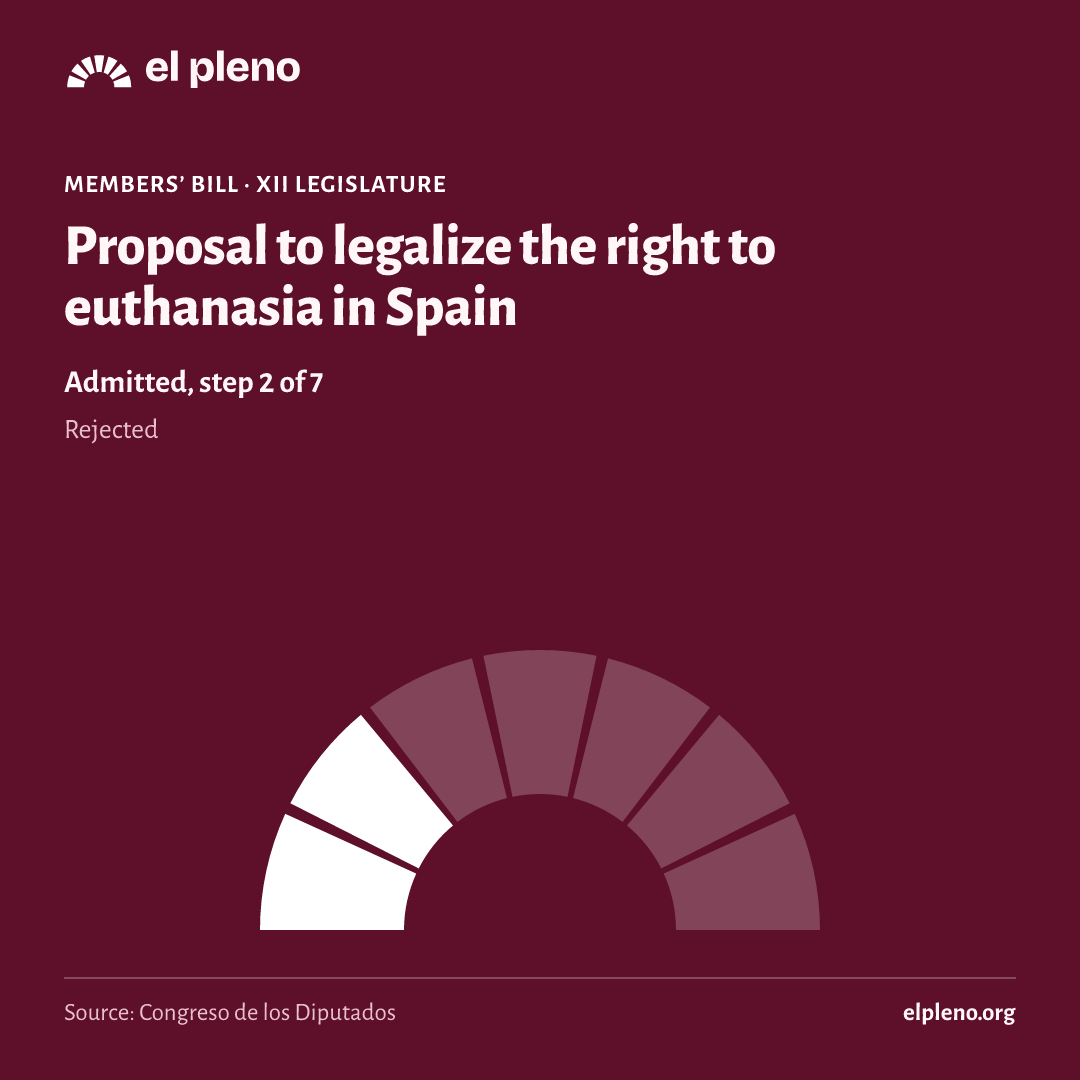
It took 2 of 7 steps. It reached Admitted, and today it is rejected.
- Introduced18 January 2017Someone registers the text in the Congreso.
- Admitted26 January 2017The Bureau of the Congreso accepts it and, for a members’ bill, the plenary decides whether to consider it.
- Amendmentsnot reachedGroups propose changes.
- Committeenot reachedA committee goes through the text in detail.
- Plenarynot reachedAll 350 deputies vote.
- Senatenot reachedThe Senate can pass it, amend it or veto it.
- BOEnot reachedIt is published in the Official State Gazette (BOE) and comes into force.
See the 6 official steps on a timeline
21 March 2017
How did the plenary vote?
Voted on: Private member's organic bill from the Confederal of Unidos Podemos-En Comú Podem-En Marea Parliamentary Group on euthanasia.
Source: Congreso de los Diputados, vote 3 of sitting 38· updated 10 Nov
Each dot is a seat. Tap one, or use the arrow keys, to see who it is.
Your province
How did the deputies from your province vote?
And your senators: the Senate does not link its votes to this law in its open data, so we cannot put them side by side here.
Or see how most of each province voted
- A Coruña More votes against 2 yes · 4 no · 2 abst.
- Albacete More votes against 1 yes · 2 no · 1 abst.
- Alicante/Alacant More votes against 3 yes · 4 no · 4 abst.
- Almería More votes against 0 yes · 3 no · 3 abst.
- Araba/Álava More votes in favour 2 yes · 1 no · 1 abst.
- Asturias More votes against 2 yes · 3 no · 3 abst.
- Ávila More votes against 0 yes · 2 no · 1 abst.
- Badajoz More votes against 1 yes · 3 no · 2 abst.
- Barcelona More votes in favour 14 yes · 4 no · 11 abst.
- Bizkaia More votes in favour 6 yes · 1 no · 1 abst.
- Burgos More votes against 1 yes · 2 no · 1 abst.
- Cáceres More votes against 0 yes · 2 no · 2 abst.
- Cádiz More votes against 2 yes · 3 no · 4 abst.
- Cantabria More votes against 1 yes · 2 no · 2 abst.
- Castellón/Castelló More votes against 1 yes · 2 no · 2 abst.
- Ceuta More votes against 0 yes · 1 no
- Ciudad Real More votes against 0 yes · 3 no · 2 abst.
- Córdoba More votes against 1 yes · 2 no · 3 abst.
- Cuenca More votes against 0 yes · 2 no · 1 abst.
- Gipuzkoa More votes in favour 4 yes · 0 no · 1 abst.
- Girona More votes in favour 3 yes · 0 no · 3 abst.
- Granada More votes against 1 yes · 3 no · 3 abst.
- Guadalajara More votes against 0 yes · 2 no · 1 abst.
- Huelva More votes against 1 yes · 2 no · 2 abst.
- Huesca Tie 1 yes · 1 no · 1 abst.
- Illes Balears More votes against 2 yes · 3 no · 3 abst.
- Jaén More votes against 1 yes · 2 no · 2 abst.
- La Rioja More votes against 1 yes · 2 no · 1 abst.
- Las Palmas More votes against 2 yes · 3 no · 3 abst.
- León More votes against 1 yes · 2 no · 1 abst.
- Lleida More votes in favour 2 yes · 1 no · 1 abst.
- Lugo More votes against 1 yes · 2 no · 1 abst.
- Madrid More votes against 8 yes · 13 no · 13 abst.
- Málaga More votes against 2 yes · 4 no · 5 abst.
- Melilla More votes against 0 yes · 1 no
- Murcia More votes against 1 yes · 5 no · 4 abst.
- Navarra More votes in favour 2 yes · 1 no · 1 abst.
- Ourense More votes against 0 yes · 3 no · 1 abst.
- Palencia More votes against 0 yes · 2 no
- Pontevedra More votes against 2 yes · 3 no · 2 abst.
- Salamanca More votes against 0 yes · 3 no · 1 abst.
- Santa Cruz de Tenerife More votes against 1 yes · 3 no · 2 abst.
- Segovia More votes against 0 yes · 2 no · 1 abst.
- Sevilla Tie 3 yes · 3 no · 5 abst.
- Soria More votes against 0 yes · 1 no · 1 abst.
- Tarragona More votes in favour 2 yes · 1 no · 3 abst.
- Teruel More votes against 0 yes · 2 no · 1 abst.
- Toledo More votes against 1 yes · 3 no · 2 abst.
- Valencia/València More votes against 5 yes · 6 no · 5 abst.
- Valladolid More votes against 1 yes · 2 no · 2 abst.
- Zamora More votes against 0 yes · 2 no · 1 abst.
- Zaragoza More votes against 1 yes · 3 no · 3 abst.
More details: how each group and each province voted
The groups
Who voted in favour and who against?
In favour, most of Vasco (EAJ-PNV), Gcup-ec-em and GER. Against, most of Popular en el Congreso. 7 deputies voted differently from their group.
By province: in 6 most voted in favour; in 24, against.
Coloured by how most of each province’s deputies voted.
- In favour: 6
- Against: 24
- Abstained: 5
- Tie: 17
| Group | Seats | How it voted |
|---|---|---|
| Socialista | 84 | 83 abst. · 1 did not vote |
| Vasco (EAJ-PNV) | 5 | 5 in favour |
| Mixto | 19 | 5 in favour · 2 against · 7 abst. · 5 did not vote |
| Ciudadanos | 32 | 32 abst. |
| Gcup-ec-em | 67 | 67 in favour |
| GER | 9 | 9 in favour |
| Popular en el Congreso | 134 | 130 against · 4 did not vote |
What happens next
What happens now?
It goes no further. A similar one could be introduced later.
Sources
Where does all this come from?
- Congreso de los Diputados, file 122/000060
Official title, type, author, dates and stage.
Retrieved 11 November 2026
- Congreso de los Diputados, vote 3 of sitting 38
The count and every seat’s vote.
Retrieved 10 November 2026
- The data comes from the open files of the Congreso, the Senate and the BOE, unaltered.
- Each deputy’s province is the one of their seat on the day of the vote.
- We only say “passed” or “rejected” when the majority needed is certain; otherwise we say which side had more votes.