What it is
Bill would remove medical exam to marry with disability
It is a members’ bill. Introduced by parliamentary groups, the Senate, regional governments or citizens. It was introduced on 10 January 2017. Introduced by: Grupo Parlamentario Socialista.
Official title: Private member's bill adapting the regulation of the right to marry to the UN Convention on the Rights of Persons with Disabilities.
Source: Congreso de los Diputados, file 122/000057· updated 11 Nov
Automatic summary, not yet reviewed
- The bill is based on the UN Convention on the Rights of Persons with Disabilities, which Spain ratified in 2008. Under it, having a disability can never be a reason to deny someone legal capacity or the right to marry.
- The bill would delete from the Civil Code the paragraph requiring a medical report on fitness to give consent when one spouse has mental, intellectual or sensory impairments.
- It would also remove that same medical report requirement from section 5 of Article 58 of the Civil Registry Law.
- The Government would have three months to send Parliament a bill adapting all laws to Article 12 of the Convention, including the court process for support in making decisions. The law would take effect the day after its publication in the official state gazette.
Who it affects
- People with mental, intellectual or sensory disabilities: They would no longer need a medical report to be able to marry.
- Couples where one partner has such a disability: They could marry without that extra step.
- Judges, notaries and Civil Registry officials: They would stop requesting that medical report when processing a marriage.
- The Government: It would have to send Parliament an adaptation bill within three months.
Words worth knowing
- Capacidad jurídica (legal capacity)
- The ability to do legal acts on your own, such as signing contracts or getting married.
- Dictamen médico (medical report)
- A written report from a doctor answering a specific question.
- Consentimiento matrimonial (marital consent)
- The free agreement each person gives to get married.
- Proposición de ley (bill)
- A draft law introduced by members of Congress that still needs to be debated and passed; it is not a law in force.
It summarizes the text as it was introduced. It is written by artificial intelligence and may contain mistakes: the official text is what counts. Read the official text · How we make summaries
Where it stands
How far did it get?
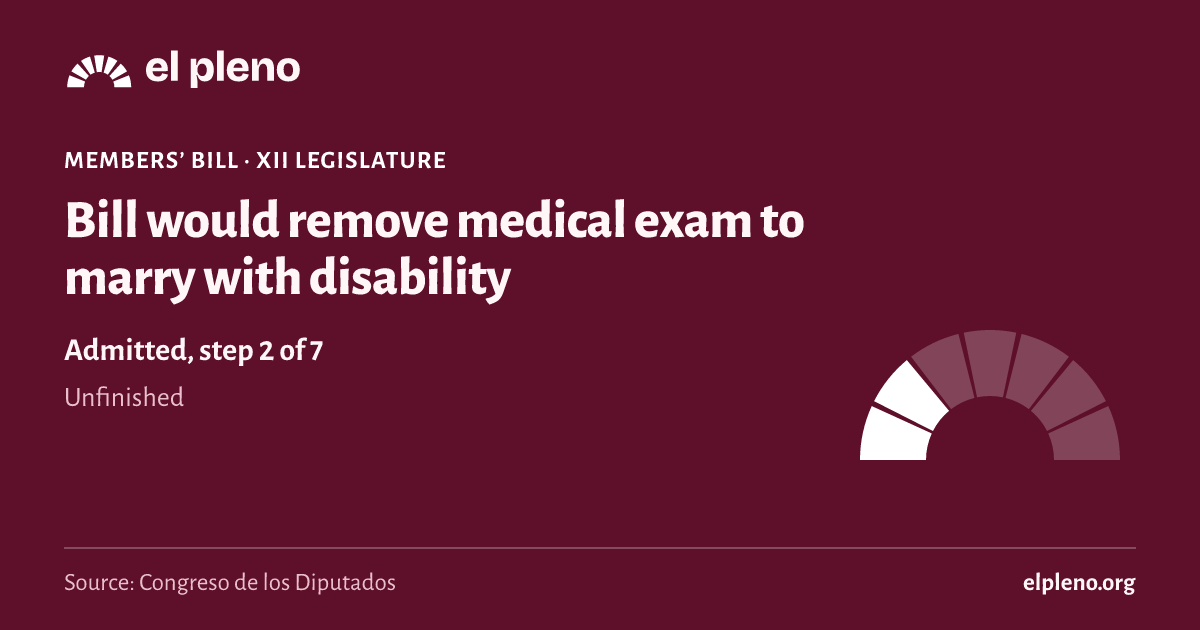
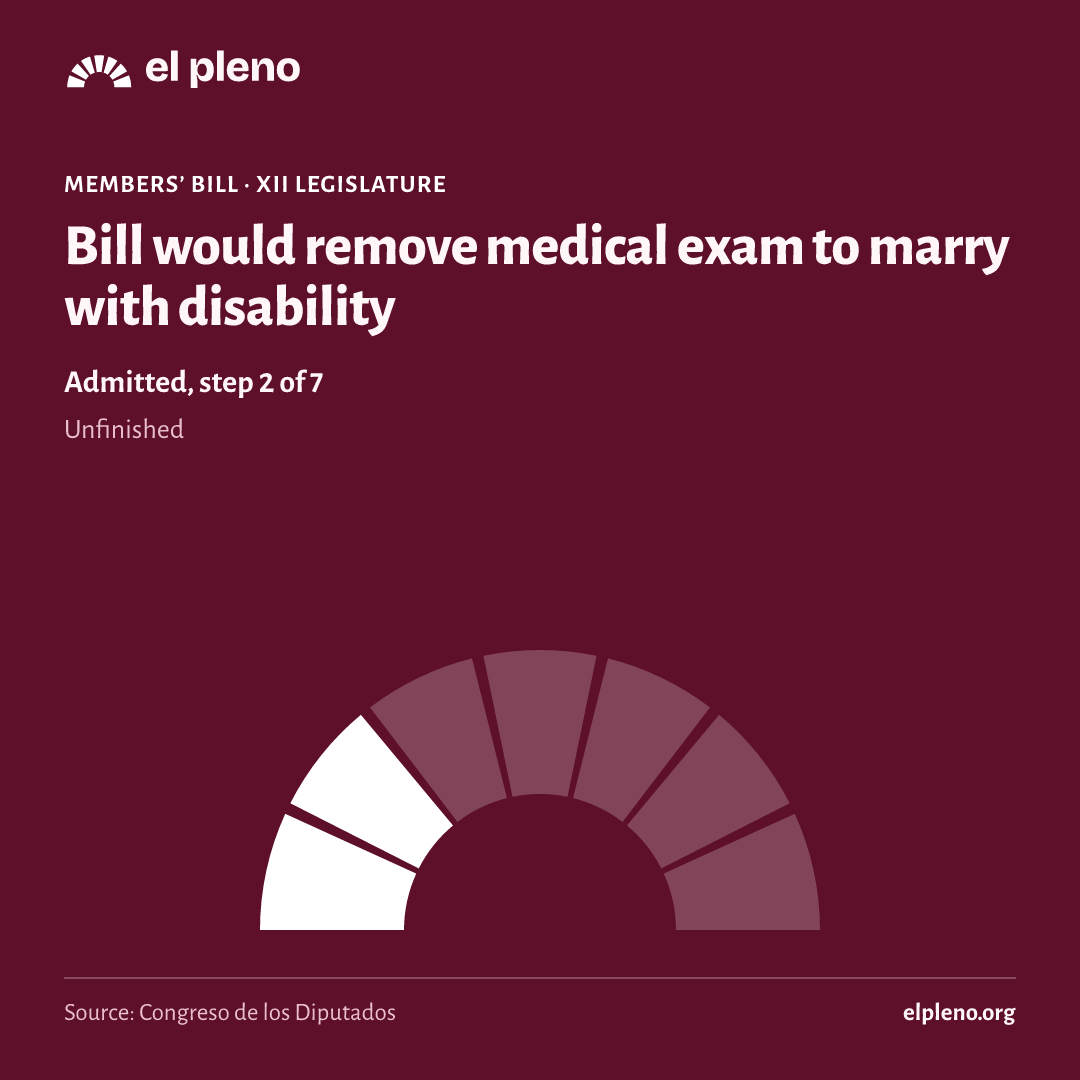
It took 2 of 7 steps. It reached Admitted, and today it is unfinished.
- Introduced10 January 2017Someone registers the text in the Congreso.
- Admitted19 January 2017The Bureau of the Congreso accepts it and, for a members’ bill, the plenary decides whether to consider it.
- Amendmentsnot reachedGroups propose changes.
- Committeenot reachedA committee goes through the text in detail.
- Plenarynot reachedAll 350 deputies vote.
- Senatenot reachedThe Senate can pass it, amend it or veto it.
- BOEnot reachedIt is published in the Official State Gazette (BOE) and comes into force.
See the 6 official steps on a timeline
Was there a plenary vote?
We have no plenary vote linked to this law in the Congreso’s data.
What happens next
What happens now?
The legislature ended before it finished. To go on, someone would have to introduce it again in the new Cortes.
It has not been presented again yet.
Sources
Where does all this come from?
- Congreso de los Diputados, file 122/000057
Official title, type, author, dates and stage.
Retrieved 11 November 2026
- The data comes from the open files of the Congreso, the Senate and the BOE, unaltered.
- Each deputy’s province is the one of their seat on the day of the vote.
- We only say “passed” or “rejected” when the majority needed is certain; otherwise we say which side had more votes.