What it is
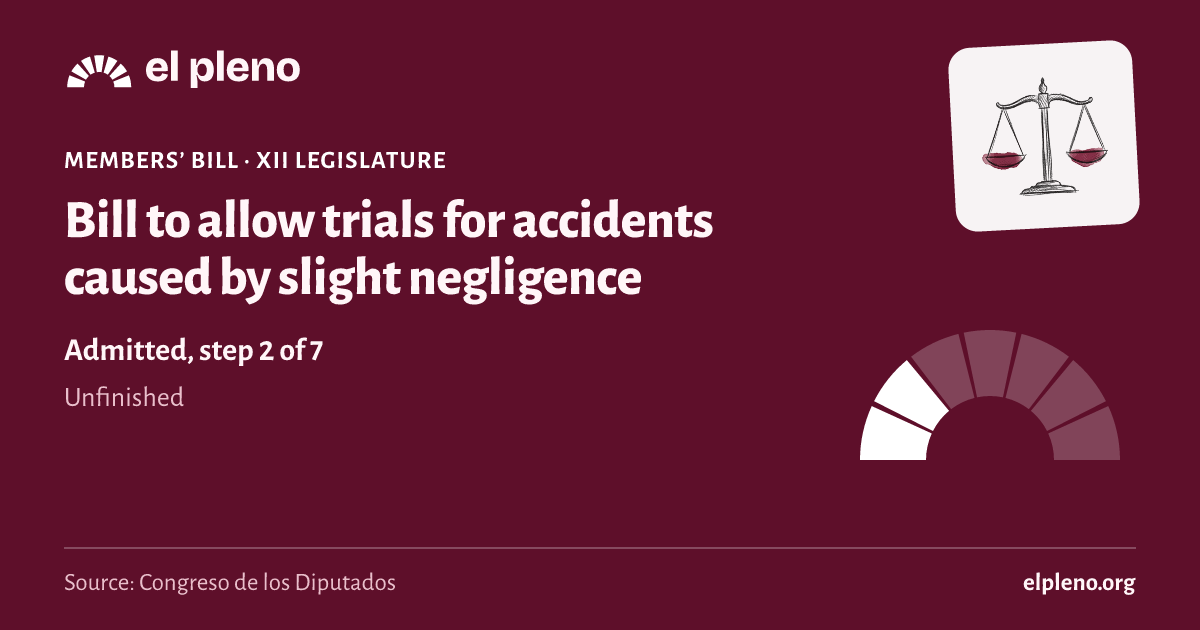
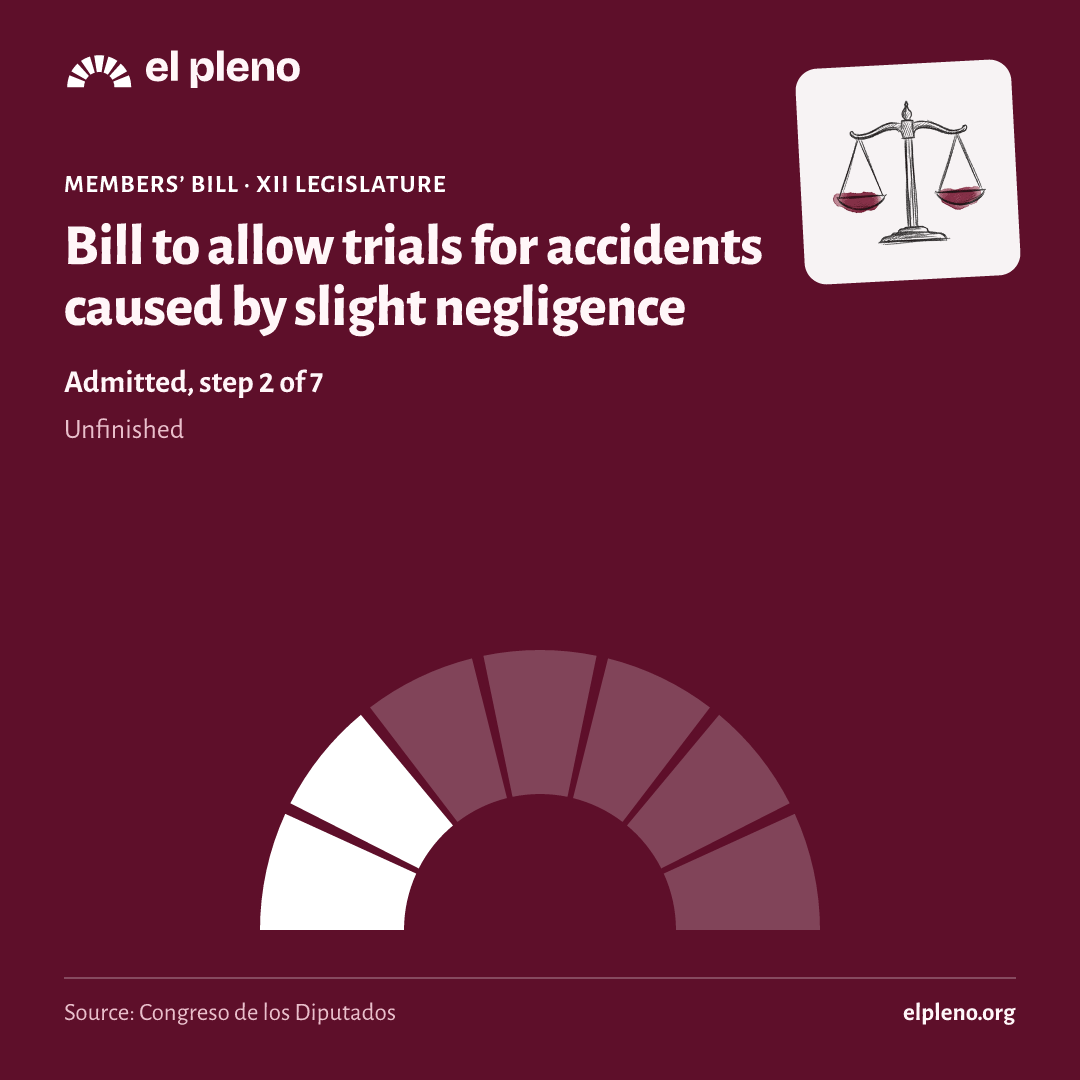
Bill to allow trials for accidents caused by slight negligence
It is a members’ bill. Introduced by parliamentary groups, the Senate, regional governments or citizens. It was introduced on 15 December 2016. Introduced by: Grupo Parlamentario Mixto.
Official title: Organic private member's bill amending the Penal Code to enable the trial of cases of accidents resulting from any type of negligence and to prevent the abandonment of the victim from going unpunished.
Source: Congreso de los Diputados, file 122/000054· updated 11 Nov
Automatic summary, not yet reviewed
- The bill's explanatory section says the 2015 reform decriminalized most accidents caused by slight negligence, so road accident victims may get no criminal punishment for the driver and must sue in civil court, with higher costs and risks for them.
- It also notes that when the victim dies instantly, a driver who flees cannot be charged with failure to render aid, because case law holds that no help was possible.
- The bill would add a section to the Criminal Code punishing anyone who causes another person's death through slight negligence with a fine of up to three months. If a motor vehicle or moped was used, the court could also impose a driving ban of three months to one year.
- It would punish drivers who flee the scene of an accident: a fine of six to 12 months if there is only property damage, six to 12 months in prison if there are injuries, and 12 to 24 months in prison if someone dies.
Who it affects
- Traffic accident victims and their families, who could bring the case to criminal trial even for slight negligence.: benefit
- Drivers who cause death through slight negligence, who could face a fine and a driving ban.: new penalty
- Drivers who flee the scene of an accident, who could face fines or prison depending on the outcome.: new penalty
- Insurance companies, because victims could claim again in criminal court instead of only in civil court.: indirect impact
Words worth knowing
- Imprudencia leve (slight negligence)
- Lack of care that is not reckless, for example running a red light.
- Omisión del deber de socorro (failure to render aid)
- The crime of not helping someone who needs assistance when you can help.
- Vía civil (civil court)
- A lawsuit to claim money or compensation, different from criminal court, which can impose penalties.
- Tentativa (attempt)
- Trying to commit a crime even if it is not completed.
- Proposición de Ley Orgánica (Organic Bill)
- A text proposing to change a law, submitted to Congress and not yet passed.
It summarizes the text as it was introduced. It is written by artificial intelligence and may contain mistakes: the official text is what counts. Read the official text · How we make summaries
Where it stands
How far did it get?
It took 2 of 7 steps. It reached Admitted, and today it is unfinished.
- Introduced15 December 2016Someone registers the text in the Congreso.
- Admitted20 December 2016The Bureau of the Congreso accepts it and, for a members’ bill, the plenary decides whether to consider it.
- Amendmentsnot reachedGroups propose changes.
- Committeenot reachedA committee goes through the text in detail.
- Plenarynot reachedAll 350 deputies vote.
- Senatenot reachedThe Senate can pass it, amend it or veto it.
- BOEnot reachedIt is published in the Official State Gazette (BOE) and comes into force.
See the 6 official steps on a timeline
Was there a plenary vote?
We have no plenary vote linked to this law in the Congreso’s data.
What happens next
What happens now?
The legislature ended before it finished. To go on, someone would have to introduce it again in the new Cortes.
It has not been presented again yet.
Sources
Where does all this come from?
- Congreso de los Diputados, file 122/000054
Official title, type, author, dates and stage.
Retrieved 11 November 2026
- The data comes from the open files of the Congreso, the Senate and the BOE, unaltered.
- Each deputy’s province is the one of their seat on the day of the vote.
- We only say “passed” or “rejected” when the majority needed is certain; otherwise we say which side had more votes.