What it is
Proposal for an independent body to vet top officials
It is a members’ bill. Introduced by parliamentary groups, the Senate, regional governments or citizens. It was introduced on 14 December 2016. Introduced by: Grupo Parlamentario Ciudadanos.
Official title: Private member's bill to guarantee the independence of appointments in regulatory bodies.
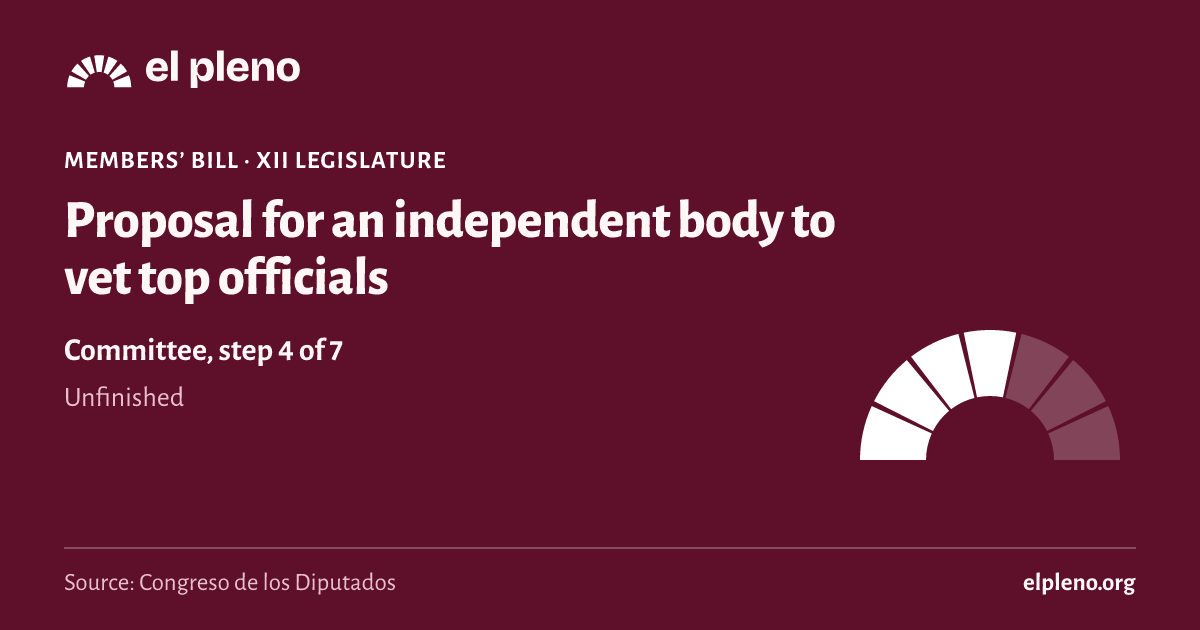
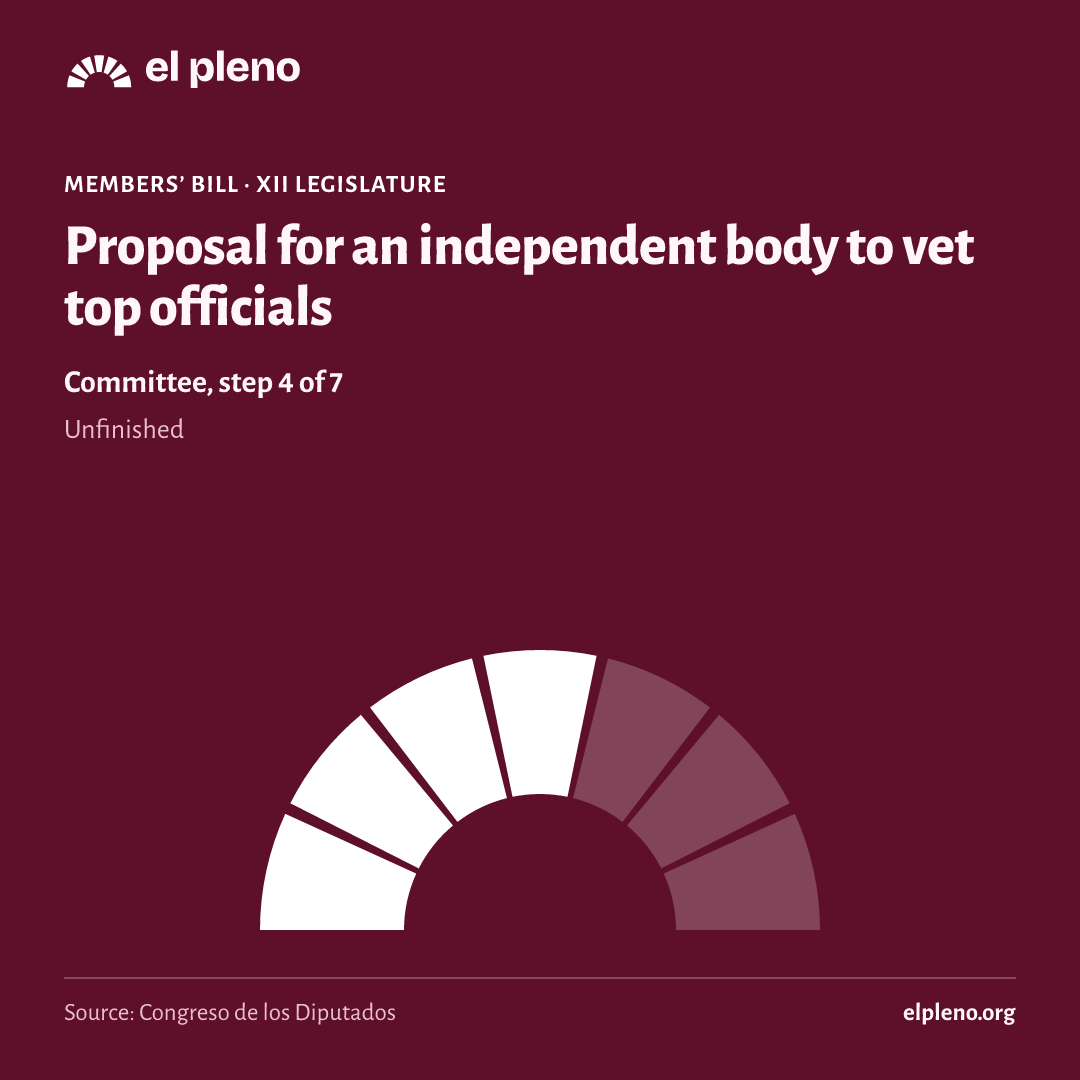
Source: Congreso de los Diputados, file 122/000053· updated 11 Nov
Automatic summary, not yet reviewed
- The bill aims to stop the Government from appointing heads of regulatory bodies based on political loyalty. It argues that, today, the appointing authority itself decides whether a candidate is suitable.
- The bill would create an Independent State Appointments Commission. It would issue a prior report on the suitability, merit, capacity and independence of candidates who must appear before Congress before being appointed.
- The Commission would have seven members with technical profiles, such as a Supreme Court judge, who would chair it, or a university professor. Members would be chosen by lottery and renewed every two years, with no extension.
- The Commission's favorable report would not be needed if the proposing body had previously asked it to run a public selection of three to five suitable candidates, from which it would pick the nominee.
Who it affects
- Government: The Government would need the Commission's report before proposing candidates for senior positions.
- Candidates for senior positions: Candidates for the listed positions (Council of State, regulatory bodies, Economic and Social Council, EFE agency and the Spanish Data Protection Agency) would have to pass the prior report and appear before Congress.
- Congress of Deputies (Congreso de los Diputados): Congress committees would examine the candidates and issue an opinion on their suitability or possible conflicts of interest.
Words worth knowing
- Organismo regulador (regulatory body)
- A public body that oversees and sets rules for a sector, such as energy or financial markets.
- Idoneidad (suitability)
- That a person meets the honesty, training and experience requirements needed for a position.
- Alto cargo (senior official)
- A person holding a top responsibility post in the State Administration.
- Comparecencia (appearance)
- A person appearing before a parliamentary committee to answer questions.
It summarizes the text as it was introduced. It is written by artificial intelligence and may contain mistakes: the official text is what counts. Read the official text · How we make summaries
Where it stands
How far did it get?
It took 4 of 7 steps. It reached Committee, and today it is unfinished.
- Introduced14 December 2016Someone registers the text in the Congreso.
- Admitted20 December 2016The Bureau of the Congreso accepts it and, for a members’ bill, the plenary decides whether to consider it.
- Amendments13 October 2017Groups propose changes.
- Committee14 February 2018A committee goes through the text in detail.
- Plenarynot reachedAll 350 deputies vote.
- Senatenot reachedThe Senate can pass it, amend it or veto it.
- BOEnot reachedIt is published in the Official State Gazette (BOE) and comes into force.
See the 10 official steps on a timeline
28 September 2017
How did the plenary vote?
Voted on: Private member's bill by the Ciudadanos Parliamentary Group, to guarantee the independence of appointments in regulatory bodies.
Source: Congreso de los Diputados, vote 1 of sitting 75· updated 10 Nov
Each dot is a seat. Tap one, or use the arrow keys, to see who it is.
Your province
How did the deputies from your province vote?
And your senators: the Senate does not link its votes to this law in its open data, so we cannot put them side by side here.
Or see how most of each province voted
- A Coruña More votes in favour 8 yes · 0 no
- Albacete More votes in favour 4 yes · 0 no
- Alicante/Alacant More votes in favour 12 yes · 0 no
- Almería More votes in favour 6 yes · 0 no
- Araba/Álava More votes in favour 3 yes · 1 no
- Asturias More votes in favour 8 yes · 0 no
- Ávila More votes in favour 3 yes · 0 no
- Badajoz More votes in favour 6 yes · 0 no
- Barcelona More votes in favour 21 yes · 0 no · 9 abst.
- Bizkaia More votes in favour 5 yes · 2 no
- Burgos More votes in favour 4 yes · 0 no
- Cáceres More votes in favour 4 yes · 0 no
- Cádiz More votes in favour 9 yes · 0 no
- Cantabria More votes in favour 5 yes · 0 no
- Castellón/Castelló More votes in favour 5 yes · 0 no
- Ceuta More votes in favour 1 yes · 0 no
- Ciudad Real More votes in favour 5 yes · 0 no
- Córdoba More votes in favour 6 yes · 0 no
- Cuenca More votes in favour 3 yes · 0 no
- Gipuzkoa More votes in favour 4 yes · 2 no
- Girona More votes in favour 2 yes · 0 no · 4 abst.
- Granada More votes in favour 7 yes · 0 no
- Guadalajara More votes in favour 3 yes · 0 no
- Huelva More votes in favour 5 yes · 0 no
- Huesca More votes in favour 3 yes · 0 no
- Illes Balears More votes in favour 8 yes · 0 no
- Jaén More votes in favour 5 yes · 0 no
- La Rioja More votes in favour 4 yes · 0 no
- Las Palmas More votes in favour 8 yes · 0 no
- León More votes in favour 4 yes · 0 no
- Lleida More votes in favour 2 yes · 0 no · 2 abst.
- Lugo More votes in favour 4 yes · 0 no
- Madrid More votes in favour 35 yes · 0 no
- Málaga More votes in favour 11 yes · 0 no
- Melilla More votes in favour 1 yes · 0 no
- Murcia More votes in favour 10 yes · 0 no
- Navarra More votes in favour 5 yes · 0 no
- Ourense More votes in favour 4 yes · 0 no
- Palencia More votes in favour 3 yes · 0 no
- Pontevedra More votes in favour 7 yes · 0 no
- Salamanca More votes in favour 4 yes · 0 no
- Santa Cruz de Tenerife More votes in favour 7 yes · 0 no
- Segovia More votes in favour 3 yes · 0 no
- Sevilla More votes in favour 11 yes · 0 no
- Soria More votes in favour 2 yes · 0 no
- Tarragona More votes in favour 4 yes · 0 no · 1 abst.
- Teruel More votes in favour 3 yes · 0 no
- Toledo More votes in favour 6 yes · 0 no
- Valencia/València More votes in favour 16 yes · 0 no
- Valladolid More votes in favour 5 yes · 0 no
- Zamora More votes in favour 3 yes · 0 no
- Zaragoza More votes in favour 7 yes · 0 no
More details: how each group and each province voted
The groups
Who voted in favour and who against?
In favour, most of Socialista, Mixto, Ciudadanos, Gcup-ec-em and Popular en el Congreso. Against, most of Vasco (EAJ-PNV). 7 deputies voted differently from their group.
By province: in 50 most voted in favour; in 0, against.
Coloured by how most of each province’s deputies voted.
- In favour: 50
- Against: 0
- Abstained: 1
- Tie: 1
| Group | Seats | How it voted |
|---|---|---|
| Socialista | 84 | 84 in favour |
| Vasco (EAJ-PNV) | 5 | 5 against |
| Mixto | 19 | 10 in favour · 7 abst. · 2 did not vote |
| Ciudadanos | 32 | 32 in favour |
| Gcup-ec-em | 67 | 66 in favour · 1 did not vote |
| GER | 9 | 9 abst. |
| Popular en el Congreso | 134 | 132 in favour · 2 did not vote |
What happens next
What happens now?
The legislature ended before it finished. To go on, someone would have to introduce it again in the new Cortes.
It has not been presented again yet.
Sources
Where does all this come from?
- Congreso de los Diputados, file 122/000053
Official title, type, author, dates and stage.
Retrieved 11 November 2026
- Congreso de los Diputados, vote 1 of sitting 75
The count and every seat’s vote.
Retrieved 10 November 2026
- The data comes from the open files of the Congreso, the Senate and the BOE, unaltered.
- Each deputy’s province is the one of their seat on the day of the vote.
- We only say “passed” or “rejected” when the majority needed is certain; otherwise we say which side had more votes.