What it is
Bill to cut the cultural VAT rate to 4%
It is a members’ bill. Introduced by parliamentary groups, the Senate, regional governments or citizens. It was introduced on 11 November 2016. Introduced by: Grupo Parlamentario Socialista.
Official title: Private member's bill amending Law 37/1992, of December 28, on Value Added Tax, regarding the tax rate applicable to cultural activities.
Source: Congreso de los Diputados, file 122/000045· updated 11 Nov
Automatic summary, not yet reviewed
- The bill would bring back the reduced VAT rate for cultural activities such as cinema, theater and music. These moved to the general 21% rate in September 2012, and the authors say this hurts access to culture and damages the sector.
- The VAT Law would be amended to apply the reduced rate to tickets for cultural venues and shows: theaters, movie theaters, exhibitions, circuses, concerts, libraries, museums, galleries, zoos and amusement parks, among others. It would also cover services by performers, artists, directors and technicians working for film producers and organizers of theater and music productions.
- The Government would have to ask the European Union for authorization to apply the super-reduced 4% rate to culture, while seeking an EU-wide cultural VAT with rates below 10%. It would also promote keeping the VAT on books at 4% and extending it to e-books.
- The law, if passed, would enter into force on January 1, 2017.
Who it affects
- People who attend cultural activities: They would pay less VAT on tickets for movies, theater, concerts, museums and other cultural venues and shows.
- Artists, performers, directors and technicians: Their services to film producers and organizers of theater and music productions would be covered by the reduced rate.
- Cultural sector companies and organizations: The tax burden on their activities would fall, which the authors see as good for the sector's growth.
- Publishers and booksellers: The VAT on books would stay at 4%, and the same rate would be pushed for e-books.
Words worth knowing
- IVA
- Value Added Tax (VAT): a percentage added to the price of almost everything you buy or hire.
- Tipo reducido
- Reduced rate: a lower VAT percentage than the general one, applied to certain priority products.
- Tipo súper reducido
- Super-reduced rate: the lowest VAT percentage, in this case 4%.
- Exposición de motivos
- Statement of reasons: the opening part of a bill explaining why it is proposed.
- Proposición de ley
- A bill introduced by a parliamentary group; it is not a law until passed.
It summarizes the text as it was introduced. It is written by artificial intelligence and may contain mistakes: the official text is what counts. Read the official text · How we make summaries
Where it stands
How far did it get?
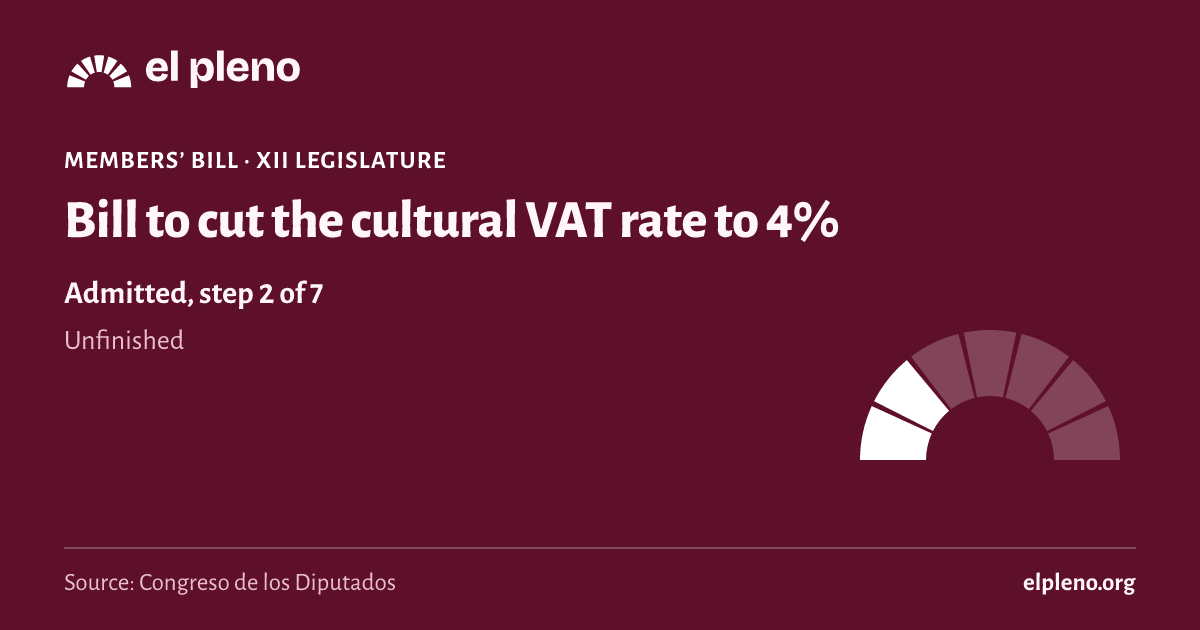
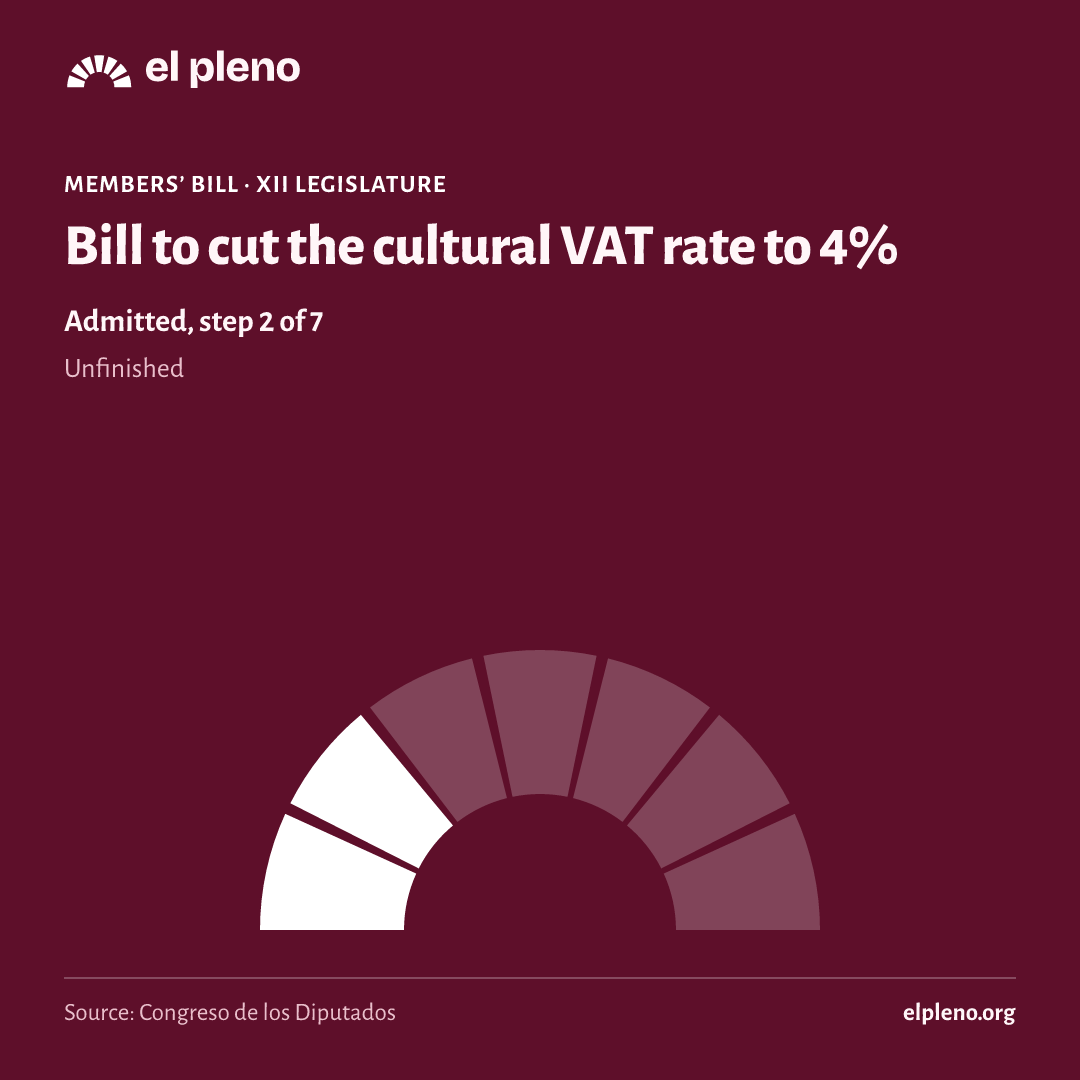
It took 2 of 7 steps. It reached Admitted, and today it is unfinished.
- Introduced11 November 2016Someone registers the text in the Congreso.
- Admitted15 November 2016The Bureau of the Congreso accepts it and, for a members’ bill, the plenary decides whether to consider it.
- Amendmentsnot reachedGroups propose changes.
- Committeenot reachedA committee goes through the text in detail.
- Plenarynot reachedAll 350 deputies vote.
- Senatenot reachedThe Senate can pass it, amend it or veto it.
- BOEnot reachedIt is published in the Official State Gazette (BOE) and comes into force.
See the 6 official steps on a timeline
Was there a plenary vote?
We have no plenary vote linked to this law in the Congreso’s data.
What happens next
What happens now?
The legislature ended before it finished. To go on, someone would have to introduce it again in the new Cortes.
It has not been presented again yet.
Sources
Where does all this come from?
- Congreso de los Diputados, file 122/000045
Official title, type, author, dates and stage.
Retrieved 11 November 2026
- The data comes from the open files of the Congreso, the Senate and the BOE, unaltered.
- Each deputy’s province is the one of their seat on the day of the vote.
- We only say “passed” or “rejected” when the majority needed is certain; otherwise we say which side had more votes.