What it is
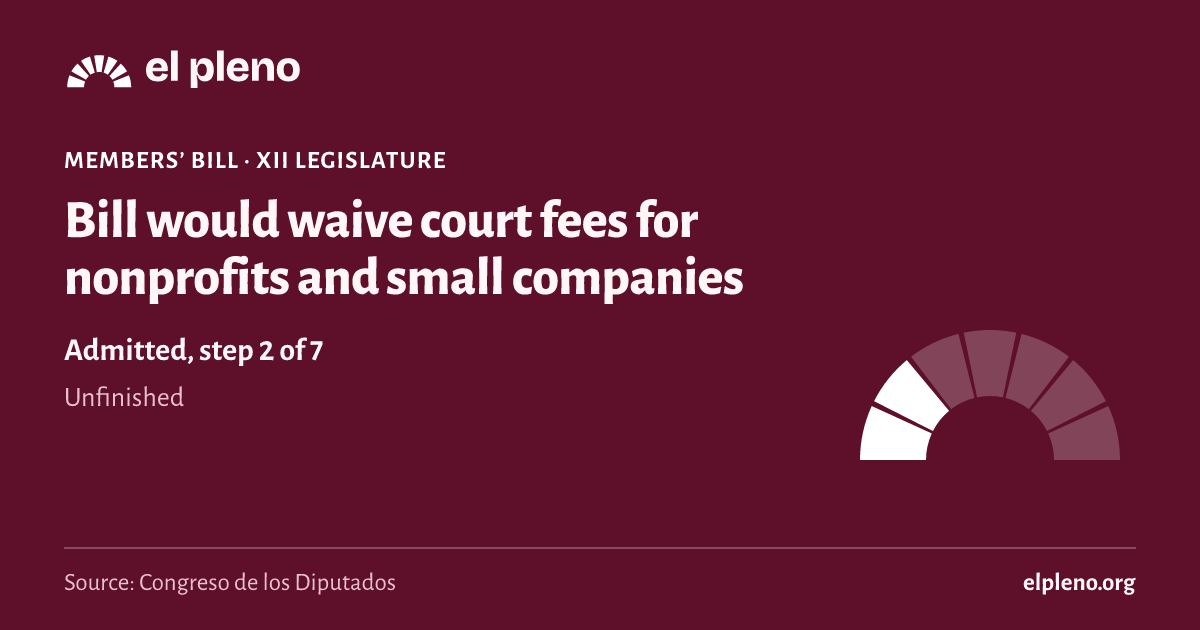
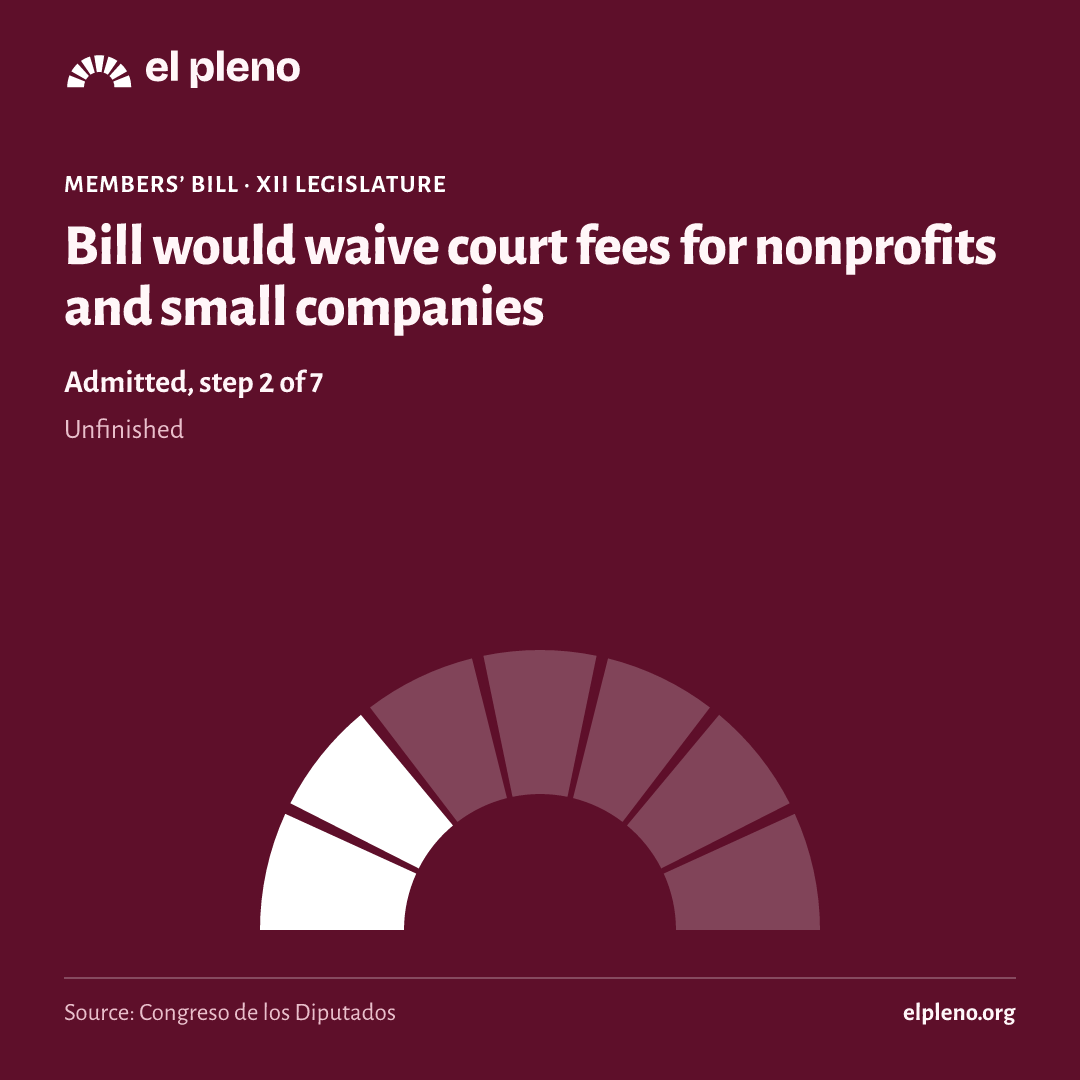
Bill would waive court fees for nonprofits and small companies
It is a members’ bill. Introduced by parliamentary groups, the Senate, regional governments or citizens. It was introduced on 26 September 2016. Introduced by: Grupo Parlamentario Mixto.
Official title: Private member's bill amending the court fee regime established by Law 10/2012, of November 20, to exempt entities that are fully or partially exempt from the Corporate Tax, especially non-profit entities, and taxpayers considered to be small entities in accordance with the regulations governing the Corporate Tax.
Source: Congreso de los Diputados, file 122/000030· updated 11 Nov
Automatic summary, not yet reviewed
- The bill would exempt from court fees nonprofit entities that have chosen the special tax regime of Law 49/2002 and entities fully or partially exempt from Corporate income tax The personal income tax (IRPF in Spain): what people pay on what they earn from work, business or savings..
- It would also exempt taxpayers considered small entities under Corporate Income Tax rules, because without the exemption many cannot access the courts since their economic capacity is not taken into account.
- To do this, it amends Article 4 of Law 10/2012, adding those two groups to the list of exempt parties, alongside individuals, who are already exempt.
- The explanatory statement criticizes Law 10/2012 for reinstating court fees across the board, in high amounts, without considering the economic capacity of those who go to court.
Who it affects
- Nonprofit entities under the special tax regime of Law 49/2002: They would no longer pay court fees.
- Entities fully or partially exempt from Corporate Income Tax: They would no longer pay court fees.
- Small entities under Corporate Income Tax rules: They would no longer pay court fees.
- Individuals: Already exempt and would remain so; the bill does not change anything for them.
Words worth knowing
- Tasas judiciales (court fees)
- Money that must be paid to start certain court proceedings.
- Impuesto sobre Sociedades (Corporate Income Tax)
- Tax paid by companies and other entities on their profits.
- Entidad de reducida dimensión (small entity)
- A small company allowed to pay Corporate Income Tax under favorable rules.
- Sujeto pasivo (taxpayer)
- The person or entity legally required to pay a tax or fee.
- income tax
- The personal income tax (IRPF in Spain): what people pay on what they earn from work, business or savings.
It summarizes the text as it was introduced. It is written by artificial intelligence and may contain mistakes: the official text is what counts. Read the official text · How we make summaries
Where it stands
How far did it get?
It took 2 of 7 steps. It reached Admitted, and today it is unfinished.
- Introduced26 September 2016Someone registers the text in the Congreso.
- Admitted4 October 2016The Bureau of the Congreso accepts it and, for a members’ bill, the plenary decides whether to consider it.
- Amendmentsnot reachedGroups propose changes.
- Committeenot reachedA committee goes through the text in detail.
- Plenarynot reachedAll 350 deputies vote.
- Senatenot reachedThe Senate can pass it, amend it or veto it.
- BOEnot reachedIt is published in the Official State Gazette (BOE) and comes into force.
See the 6 official steps on a timeline
Was there a plenary vote?
We have no plenary vote linked to this law in the Congreso’s data.
What happens next
What happens now?
The legislature ended before it finished. To go on, someone would have to introduce it again in the new Cortes.
It has not been presented again yet.
Sources
Where does all this come from?
- Congreso de los Diputados, file 122/000030
Official title, type, author, dates and stage.
Retrieved 11 November 2026
- The data comes from the open files of the Congreso, the Senate and the BOE, unaltered.
- Each deputy’s province is the one of their seat on the day of the vote.
- We only say “passed” or “rejected” when the majority needed is certain; otherwise we say which side had more votes.