What it is
Bill to expand the universal jurisdiction of Spanish courts
It is a members’ bill. Introduced by parliamentary groups, the Senate, regional governments or citizens. It was introduced on 8 August 2016. Introduced by: Grupo Parlamentario Socialista.
Official title: Private member's bill amending Organic Law 1/2014, of March 13, amending Organic Law 6/1985, of July 1, on the Judiciary, regarding universal jurisdiction (Organic).
Source: Congreso de los Diputados, file 122/000016· updated 11 Nov
Automatic summary, not yet reviewed
- The bill, introduced by the Socialist Parliamentary Group, seeks to repeal organic law A law on fundamental rights, the electoral system or other matters the Constitution reserves. It needs an absolute majority in the Congreso: 176 votes. 1/2014, which limited so-called universal jurisdiction, meaning the ability of Spanish courts to try serious crimes committed outside Spain.
- It proposes amending Article 23 of the Organic Law on the Judiciary so that Spanish courts can hear cases about crimes committed abroad by Spaniards or by foreigners who later acquired Spanish nationality, under certain conditions: the act must be punishable where it was committed, there must be a complaint or criminal charge, and the offender must not have already been tried or sentenced abroad.
- The bill expands the list of crimes Spanish courts could pursue even when committed abroad: genocide, terrorism, torture, piracy, drug trafficking, sexual offenses against minors, human trafficking, corruption, forced disappearance and others. To try them, it would be enough for the suspected offenders to be in Spain, for there to be Spanish victims, or for there to be a relevant connection with Spain, provided no other competent country has started an effective investigation.
- The law would enter into force on the same day it is published in the Official State Gazette (Boletín Oficial del Estado).
Who it affects
- Victims of serious human rights crimes committed outside Spain.: They could file complaints or criminal charges in Spain even if the acts happened abroad.
- People suspected of those crimes who are in Spain.: They could be investigated and tried by Spanish courts.
- Spanish judges and courts.: They would regain jurisdiction over crimes committed outside Spanish territory.
- Victims of gender violence and female genital mutilation.: Their protection would be easier, since some requirements set by the 2014 law would be removed.
Words worth knowing
- Justicia universal (universal jurisdiction)
- A principle that lets a country's courts try very serious crimes committed in other countries, even if neither the victim nor the offender is from that country.
- Lesa humanidad (crimes against humanity)
- Very serious crimes committed on a massive or systematic scale against civilians, such as murder or deportation.
- Genocidio (genocide)
- The crime of deliberately killing or destroying a human group because of its nationality, ethnicity, race or religion.
- Querella (criminal charge)
- A document by which a person asks a judge to open a criminal case and act against someone.
- Sobreseimiento (dismissal of proceedings)
- A judge's decision to end a criminal case.
- organic law
- A law on fundamental rights, the electoral system or other matters the Constitution reserves. It needs an absolute majority in the Congreso: 176 votes.
It summarizes the text as it was introduced. It is written by artificial intelligence and may contain mistakes: the official text is what counts. Read the official text · How we make summaries
Where it stands
How far did it get?
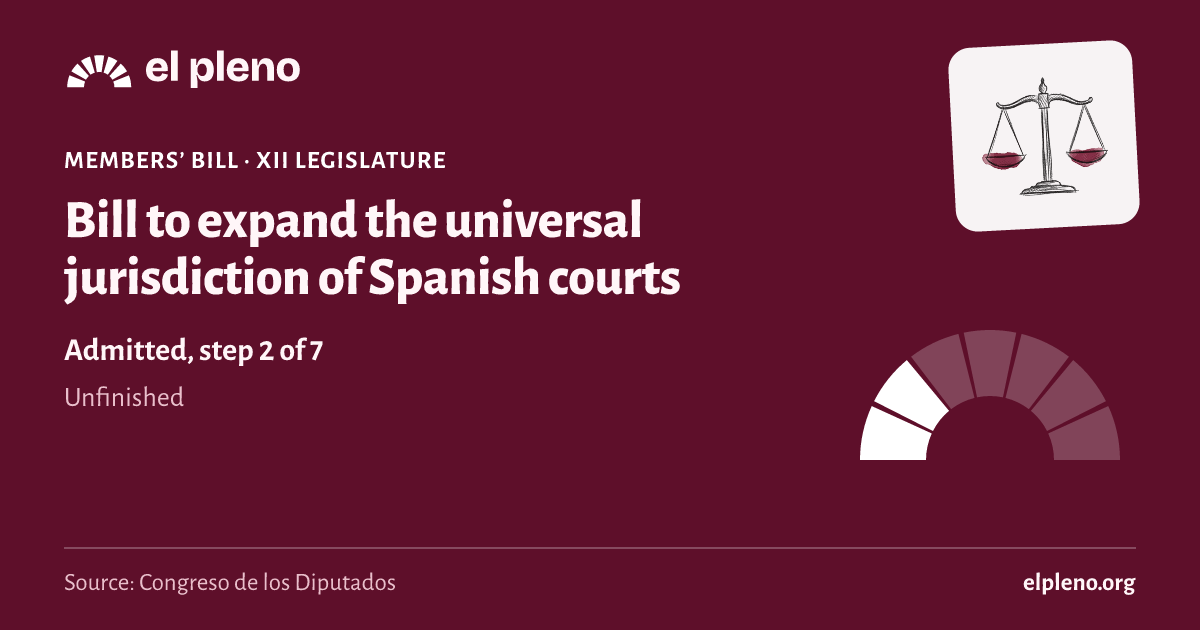
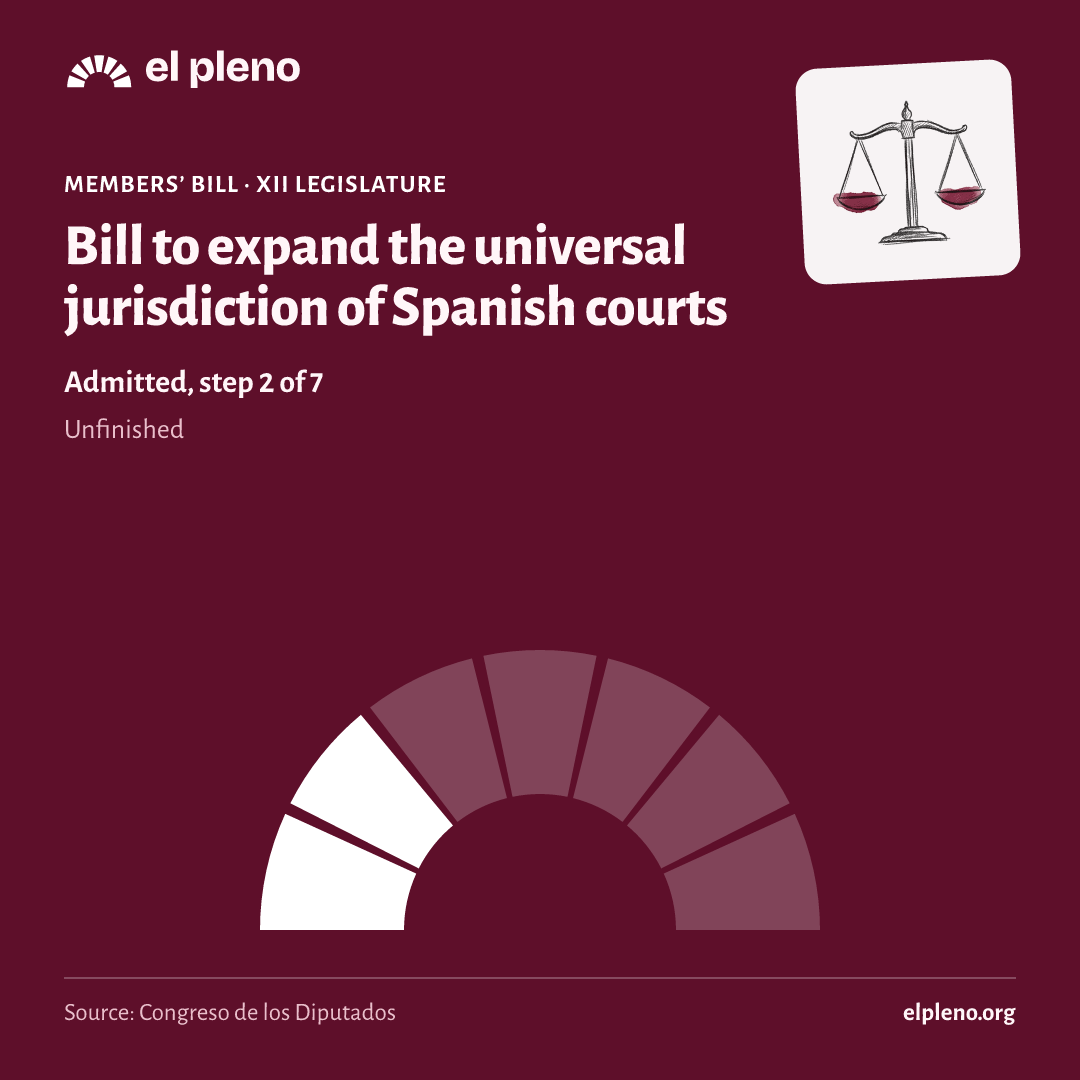
It took 2 of 7 steps. It reached Admitted, and today it is unfinished.
- Introduced8 August 2016Someone registers the text in the Congreso.
- Admitted6 September 2016The Bureau of the Congreso accepts it and, for a members’ bill, the plenary decides whether to consider it.
- Amendmentsnot reachedGroups propose changes.
- Committeenot reachedA committee goes through the text in detail.
- Plenarynot reachedAll 350 deputies vote.
- Senatenot reachedThe Senate can pass it, amend it or veto it.
- BOEnot reachedIt is published in the Official State Gazette (BOE) and comes into force.
See the 6 official steps on a timeline
Was there a plenary vote?
We have no plenary vote linked to this law in the Congreso’s data.
What happens next
What happens now?
The legislature ended before it finished. To go on, someone would have to introduce it again in the new Cortes.
It has not been presented again yet.
Sources
Where does all this come from?
- Congreso de los Diputados, file 122/000016
Official title, type, author, dates and stage.
Retrieved 11 November 2026
- The data comes from the open files of the Congreso, the Senate and the BOE, unaltered.
- Each deputy’s province is the one of their seat on the day of the vote.
- We only say “passed” or “rejected” when the majority needed is certain; otherwise we say which side had more votes.