What it is
Bill would raise pensions and improve self-employed protections
It is a government bill. Introduced by the Government. It was introduced on 22 January 2019. Introduced by: Gobierno.
Official title: Government bill for the revaluation of public pensions and other urgent measures in social, labor, and employment matters (originating from Royal Decree-Law 28/2018, of December 28).
Source: Congreso de los Diputados, file 121/000047· updated 11 Nov
Automatic summary, not yet reviewed
- The bill would raise contributory Social Security and State passive classes pensions by 1.6% in 2019, instead of the 0.25% that the previous legal formula would produce, and sets the maximum public pension at €2,659.41 per month.
- Minimum pensions, non-contributory pensions and SOVI pensions would rise by 3% in 2019 over the new 2018 minimum amounts.
- People who received a pension adjusted in 2018 would get, before April 1, 2019, a single payment covering the difference between what they received and what they would have gotten with the 1.7% CPI increase.
- The maximum Social Security contribution base would be set at €4,070.10 per month for 2019, a 7% increase, while self-employed minimum bases would rise only 1.25%, to €944.40 per month.
- Self-employed workers would be required to contribute to all contingencies, including work-related ones and cessation of activity, whose benefit would be managed by a mutua and whose maximum duration would double to 24 months.
- Temporary contracts of five days or less would carry a 40% surcharge on the employer's contribution, but each day worked would count as 1.4 contribution days for accessing benefits.
- Collective agreements could again set mandatory retirement ages, provided this is tied to employment policy goals such as generational replacement or hiring unemployed people.
- Seasonal farm workers in Málaga, Sevilla and Cádiz, affected by the October 2018 torrential rains, could access unemployment benefits or the agricultural income with only 20 days of contributions.
Who it affects
- Pensioners and public benefit recipients: Their pension would rise by 1.6% or 3% depending on the type, and they would get a single payment before April 1, 2019.
- Self-employed workers: They would contribute to all contingencies on a mandatory basis, with new bases and rates, and get better coverage for cessation of activity and sick leave.
- Employers: They would pay higher contributions for very short temporary contracts and face a 7% higher contribution cap.
- Domestic workers and farm workers: They would get new contribution base scales and quota reductions; farm workers in affected areas could access benefits sooner.
- Trainees and interns: They would be included in Social Security as assimilated to employees, even if their internship is unpaid.
Words worth knowing
- Revalorización
- Annual increase of pensions so they keep their value against rising prices.
- Base de cotización
- The amount on which Social Security contributions, and later some benefits, are calculated.
- Cese de actividad
- Situation of a self-employed person who stops their activity; it carries a benefit similar to unemployment pay.
- Mutua colaboradora
- A private entity that works with Social Security managing benefits such as workplace accidents or sick leave.
- Convenio colectivo
- Agreement between employers and unions setting working conditions for a sector or company.
It summarizes the text as it was introduced. It is written by artificial intelligence and may contain mistakes: the official text is what counts. Read the official text · How we make summaries
Where it stands
How far did it get?
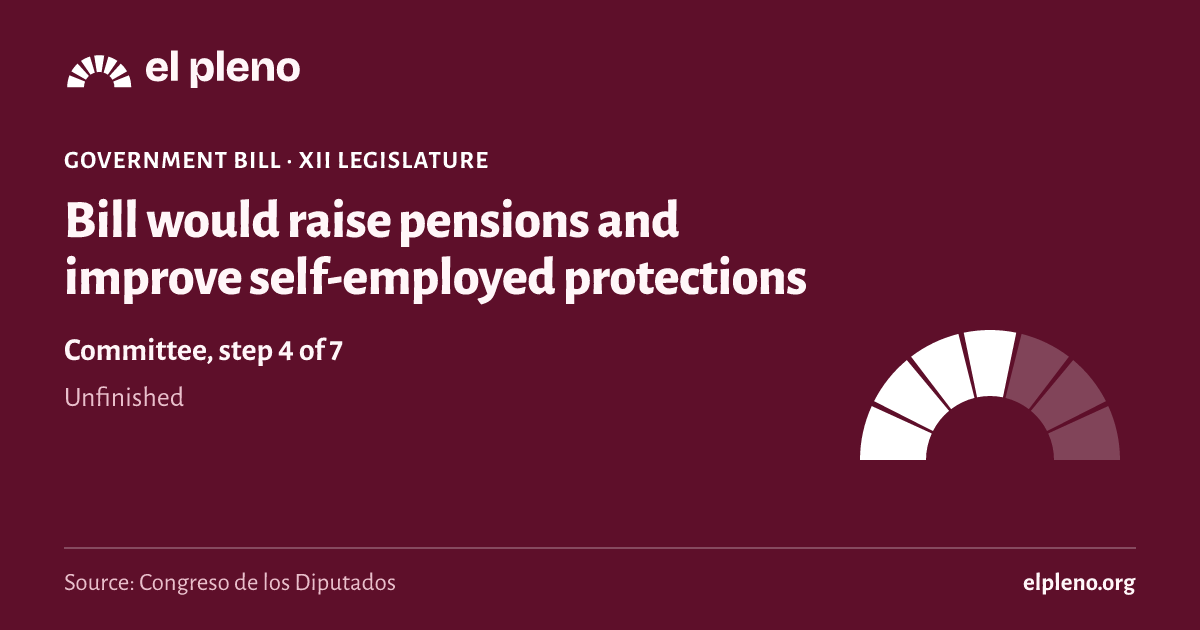
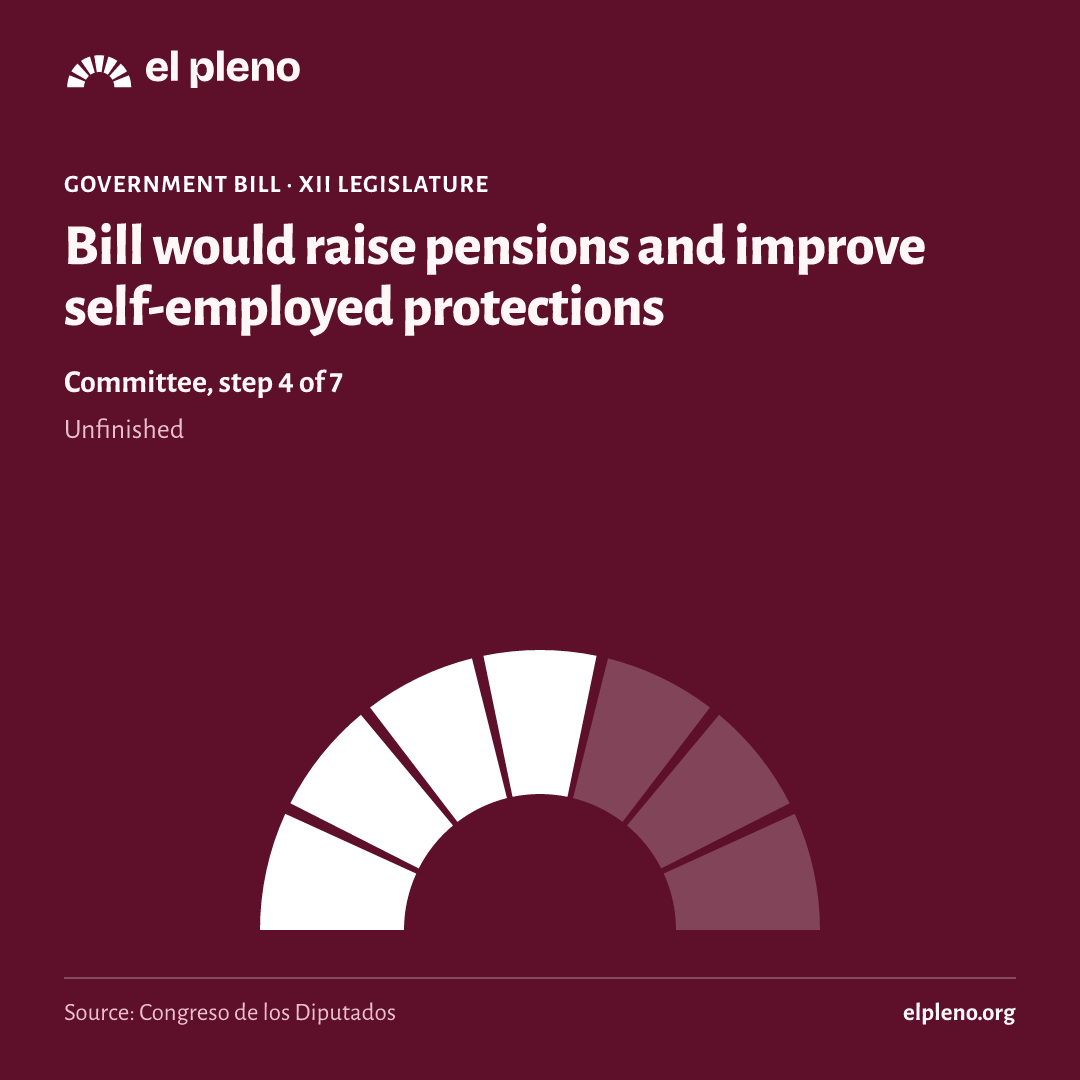
It took 4 of 7 steps. It reached Committee, and today it is unfinished.
- Introduced22 January 2019Someone registers the text in the Congreso.
- Admitted5 February 2019The Bureau of the Congreso accepts it and, for a members’ bill, the plenary decides whether to consider it.
- Amendments8 February 2019Groups propose changes.
- Committee23 February 2019A committee goes through the text in detail.
- Plenarynot reachedAll 350 deputies vote.
- Senatenot reachedThe Senate can pass it, amend it or veto it.
- BOEnot reachedIt is published in the Official State Gazette (BOE) and comes into force.
See the 6 official steps on a timeline
Was there a plenary vote?
We have no plenary vote linked to this law in the Congreso’s data.
What happens next
What happens now?
The legislature ended before it finished. To go on, someone would have to introduce it again in the new Cortes.
It has not been presented again yet.
Sources
Where does all this come from?
- Congreso de los Diputados, file 121/000047
Official title, type, author, dates and stage.
Retrieved 11 November 2026
- The data comes from the open files of the Congreso, the Senate and the BOE, unaltered.
- Each deputy’s province is the one of their seat on the day of the vote.
- We only say “passed” or “rejected” when the majority needed is certain; otherwise we say which side had more votes.