What it is
New rules for anyone selling insurance in Spain
It is a government bill. Introduced by the Government. It was introduced on 11 May 2018. Introduced by: Gobierno.
Official title: Government bill on the distribution of private insurance and reinsurance.
Source: Congreso de los Diputados, file 121/000022· updated 11 Nov
Automatic summary, not yet reviewed
- The bill would regulate the entire insurance distribution chain, not just intermediation: also insurers selling their own products directly and those selling insurance on an ancillary basis, such as travel agencies or car rental companies.
- Anyone wanting to act as an insurance intermediary or reinsurance broker would have to register first with an administrative register kept by the Directorate General for Insurance and Pension Funds. Insurers would not register there, but some of their responsible persons would.
- The bill distinguishes two classes of intermediaries: insurance agents, who work for one or more insurers under an agency contract, and insurance brokers, who are independent and must provide objective, personalized advice.
- Banks and credit institutions selling insurance through their networks would act as bancassurance operators, with their own registration, training and advertising requirements.
- Before signing an insurance contract, the distributor would have to explain its identity, whether it gives advice, how it is paid and which insurers it represents. For non-life insurance, a pre-contract information document would set out cover, exclusions and costs.
- For insurance-based investment products, a stricter regime would apply: avoiding conflicts of interest, disclosing all costs, and checking whether the product fits the customer's profile and risk tolerance.
- The bill strengthens the penalty regime, with fines that can reach 5 percent of annual turnover for insurance-based investment products, and provides for publishing final penalties for serious and very serious breaches in the Official State Gazette.
- Customers would have the right to have their complaints heard and resolved, and insurers and brokers could appoint an independent customer ombudsman whose decisions in the customer's favor would bind them.
Who it affects
- People who buy or plan to buy insurance: They would receive more information before signing, including costs and how the distributor is paid, and would have channels to complain.
- Insurance intermediaries, agents and brokers: They would have to register with the administrative register, pass training courses and meet new information and conduct obligations.
- Insurance and reinsurance companies: They would be included as distributors and would take on internal registration, training and oversight duties for their employees and agents.
- Banks and credit institutions selling insurance: They would act as bancassurance operators with specific registration and network training requirements.
- Companies selling insurance as a side activity, such as travel agencies: They could become ancillary insurance intermediaries, though some would be exempt if they meet certain premium limits.
Words worth knowing
- Mediador de seguros (insurance intermediary)
- A person or company that, for payment, advises on, proposes or helps arrange insurance, without being an insurer or its employee.
- Corredor de seguros (insurance broker)
- An independent intermediary who offers objective, personalized advice by comparing products from several insurers.
- Operador de banca-seguros (bancassurance operator)
- A bank or credit institution that sells insurance through its own branch network.
- Producto de inversión basado en seguros (insurance-based investment product)
- An insurance product whose final value depends, wholly or partly, on how financial markets perform.
- Libre prestación de servicios (freedom to provide services)
- A regime allowing an intermediary from another European Union country to operate in Spain without establishing itself there.
It summarizes the text as it was introduced. It is written by artificial intelligence and may contain mistakes: the official text is what counts. Read the official text · How we make summaries
Where it stands
How far did it get?
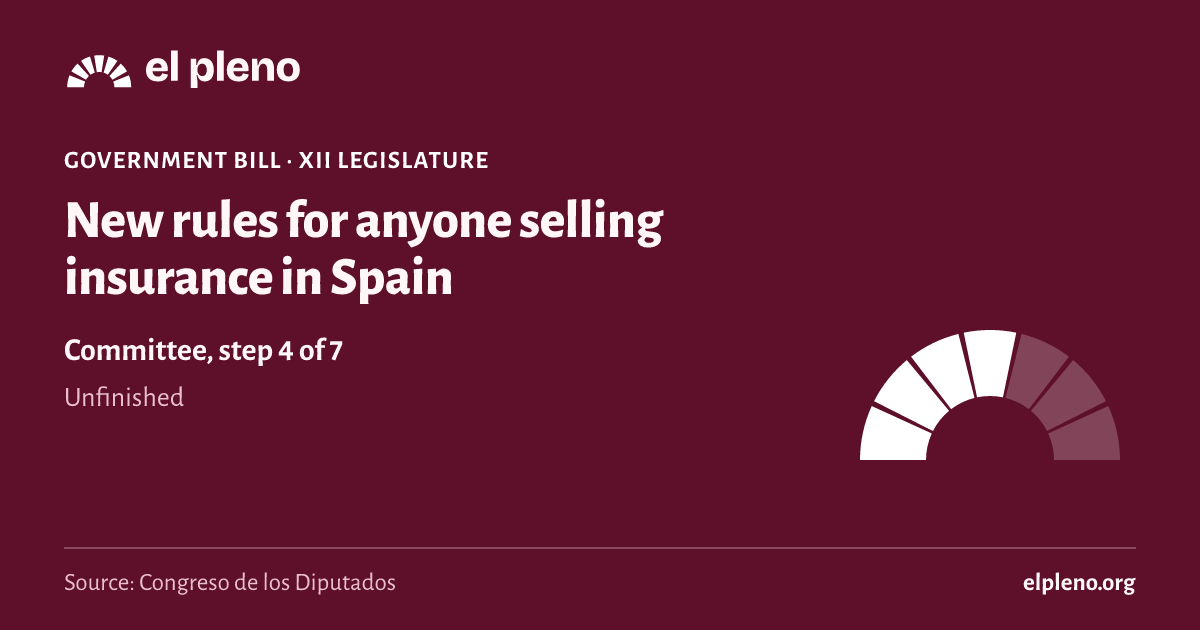
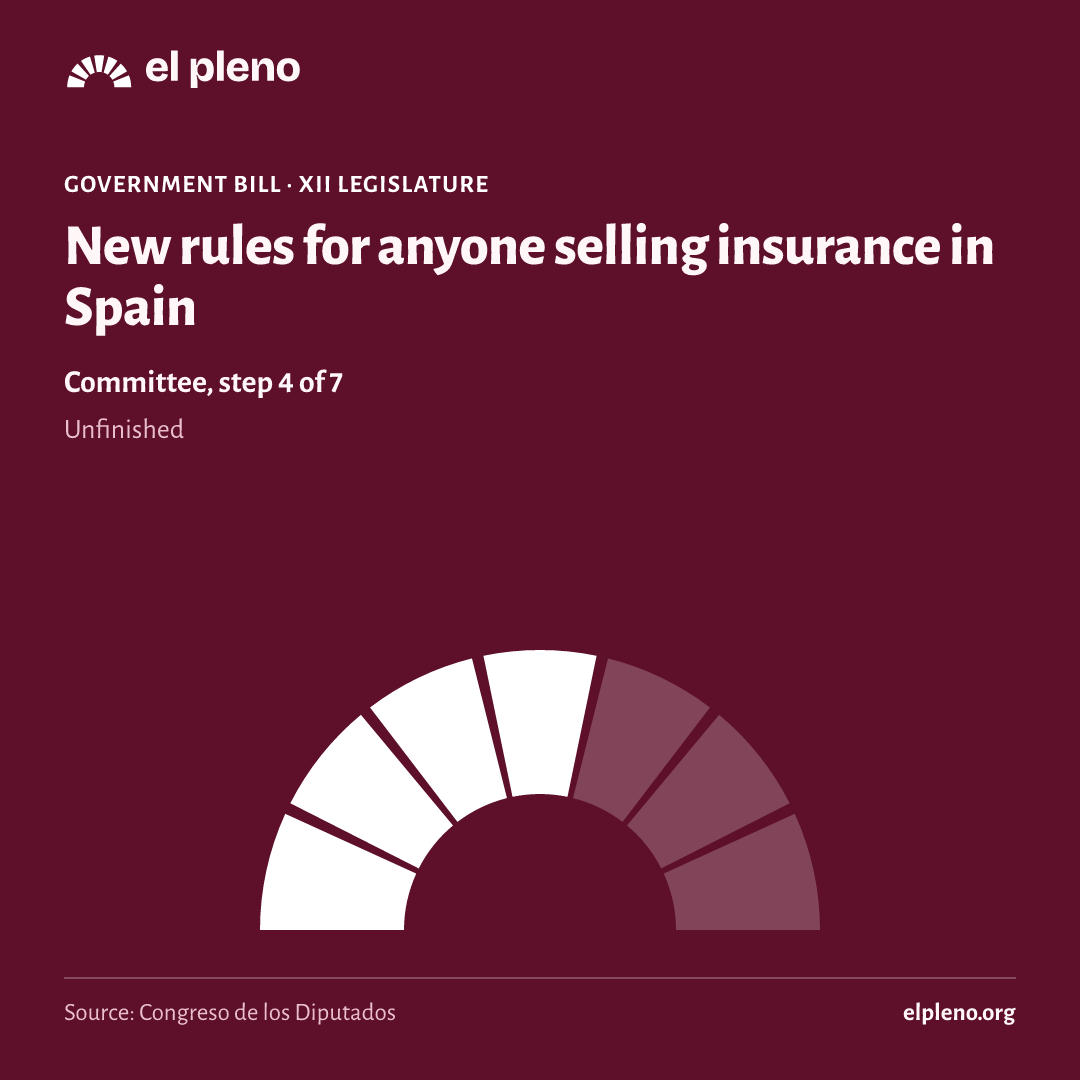
It took 4 of 7 steps. It reached Committee, and today it is unfinished.
- Introduced11 May 2018Someone registers the text in the Congreso.
- Admitted17 May 2018The Bureau of the Congreso accepts it and, for a members’ bill, the plenary decides whether to consider it.
- Amendments21 May 2018Groups propose changes.
- Committee19 September 2018A committee goes through the text in detail.
- Plenarynot reachedAll 350 deputies vote.
- Senatenot reachedThe Senate can pass it, amend it or veto it.
- BOEnot reachedIt is published in the Official State Gazette (BOE) and comes into force.
See the 7 official steps on a timeline
Was there a plenary vote?
We have no plenary vote linked to this law in the Congreso’s data.
What happens next
What happens now?
The legislature ended before it finished. To go on, someone would have to introduce it again in the new Cortes.
It has not been presented again yet.
Sources
Where does all this come from?
- Congreso de los Diputados, file 121/000022
Official title, type, author, dates and stage.
Retrieved 11 November 2026
- The data comes from the open files of the Congreso, the Senate and the BOE, unaltered.
- Each deputy’s province is the one of their seat on the day of the vote.
- We only say “passed” or “rejected” when the majority needed is certain; otherwise we say which side had more votes.