What it is
Proposal to ban donations to political parties
It is a members’ bill. Introduced by parliamentary groups, the Senate, regional governments or citizens. It was introduced on 19 April 2016. Introduced by: Grupo Parlamentario Mixto.
Official title: Private member's bill for an Organic Law amending Organic Law 8/2007, of July 4, on the Financing of Political Parties.
Source: Congreso de los Diputados, file 122/000034· updated 11 Nov
Automatic summary, not yet reviewed
- The Mixed Parliamentary Group, at the request of two lawmakers from UPN, proposes amending the Law on the Financing of Political Parties. It argues current rules are not enough to prevent opaque practices.
- The bill would ban parties from accepting or receiving any donation, in cash or in kind, directly or indirectly. It would also ban third parties from paying party expenses and banks from forgiving party debts.
- Member dues and contributions could not exceed 6,000 euros a year, and those over 3,000 euros would have to be reported to the Court of Accounts. Donations from foreign individuals and from foreign governments or public companies would be banned. Dues would have to be paid into exclusive bank accounts by direct debit or named deposit.
- Parties could not carry out commercial activities. Their income would be exempt from Corporate income tax The personal income tax (IRPF in Spain): what people pay on what they earn from work, business or savings., except for non-exempt income, which would be taxed at 25%. Membership dues would be deductible from personal income tax up to 600 euros a year.
- Accounting duties would be tightened: parties would have to keep detailed books, send their annual accounts to the Court of Accounts by June 30 of the following year, and publish on their websites their balance sheet, outstanding loans, subsidies and bequests over 25,000 euros.
- Offenses would be classified as very serious, serious or minor, with statute of limitation periods of five, three and two years. Foundations linked to parties would be subject to oversight and strict donation rules. The title on tax rules would be passed as an ordinary law, not an organic law A law on fundamental rights, the electoral system or other matters the Constitution reserves. It needs an absolute majority in the Congreso: 176 votes..
Words worth knowing
- Tribunal de Cuentas (Court of Accounts)
- Public body that audits and oversees the accounts of institutions and political parties.
- Condonación de deuda (debt forgiveness)
- When a bank cancels all or part of the money owed to it.
- Impuesto sobre Sociedades (Corporate Income Tax)
- Tax paid by companies and entities on their profits.
- Ley orgánica (organic law)
- A type of Spanish law reserved for major matters, requiring special majorities in Congress; other laws are ordinary laws.
- organic law
- A law on fundamental rights, the electoral system or other matters the Constitution reserves. It needs an absolute majority in the Congreso: 176 votes.
- income tax
- The personal income tax (IRPF in Spain): what people pay on what they earn from work, business or savings.
It summarizes the text as it was introduced. It is written by artificial intelligence and may contain mistakes: the official text is what counts. Read the official text · How we make summaries
Where it stands
How far did it get?
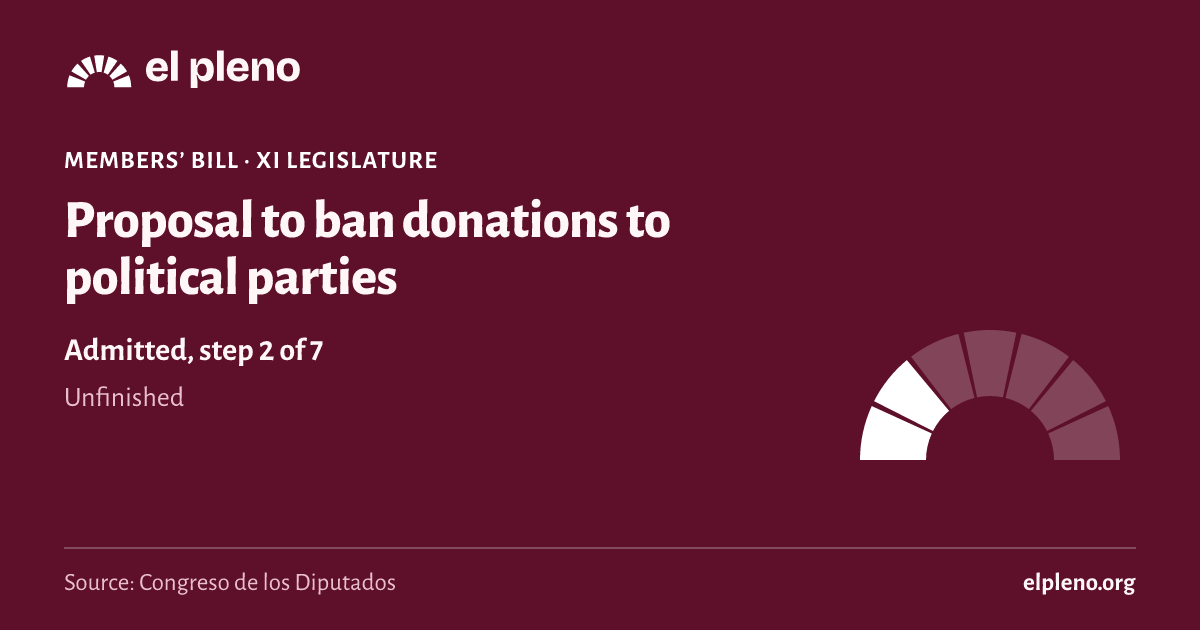
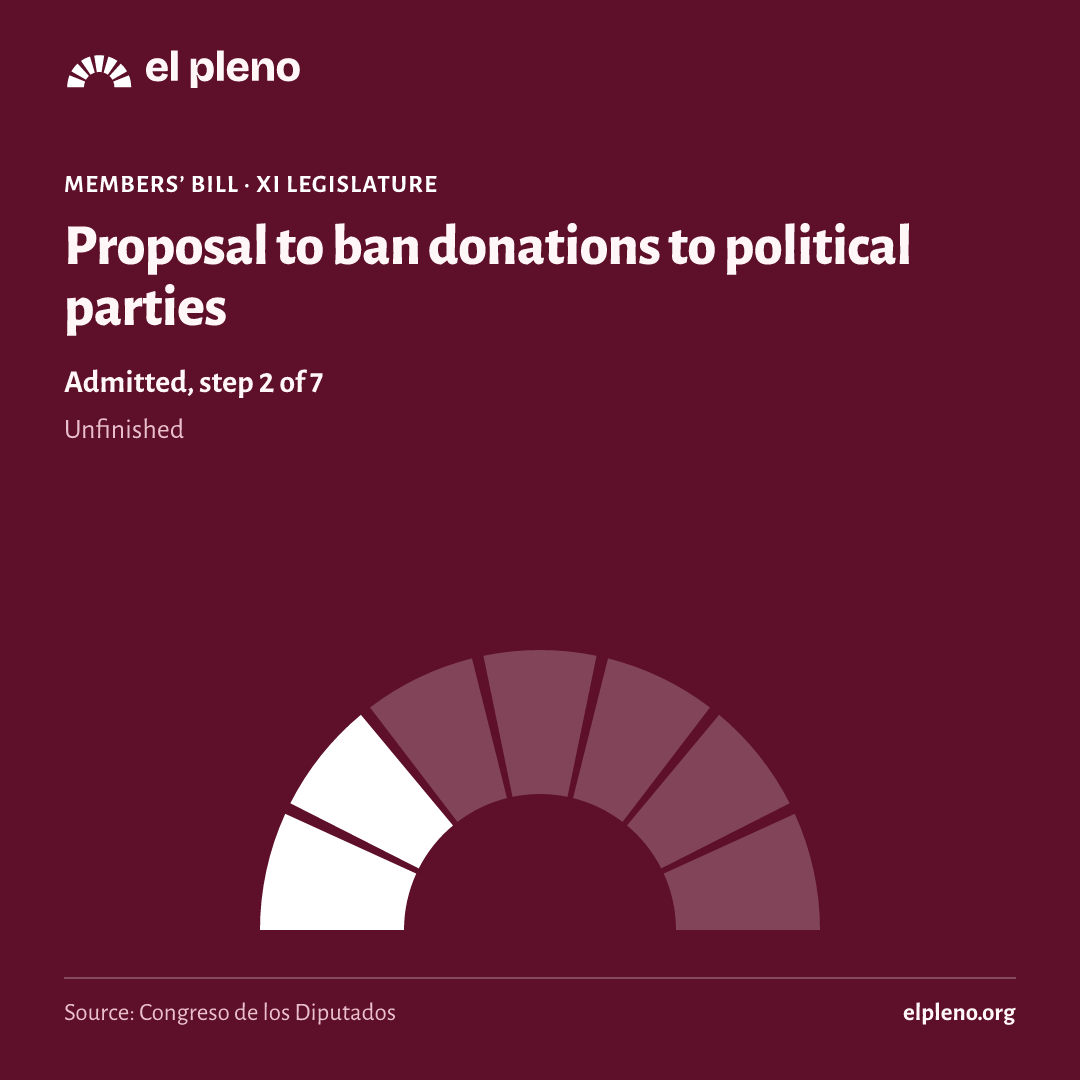
It took 2 of 7 steps. It reached Admitted, and today it is unfinished.
- Introduced19 April 2016Someone registers the text in the Congreso.
- Admitted27 April 2016The Bureau of the Congreso accepts it and, for a members’ bill, the plenary decides whether to consider it.
- Amendmentsnot reachedGroups propose changes.
- Committeenot reachedA committee goes through the text in detail.
- Plenarynot reachedAll 350 deputies vote.
- Senatenot reachedThe Senate can pass it, amend it or veto it.
- BOEnot reachedIt is published in the Official State Gazette (BOE) and comes into force.
See the 5 official steps on a timeline
Was there a plenary vote?
We have no plenary vote linked to this law in the Congreso’s data.
What happens next
What happens now?
The legislature ended before it finished. To go on, someone would have to introduce it again in the new Cortes.
It was presented again:
- XII Legislature, Congreso de los Diputados· Unfinished Proposal to ban donations to political parties
Sources
Where does all this come from?
- Congreso de los Diputados, file 122/000034
Official title, type, author, dates and stage.
Retrieved 11 November 2026
- The data comes from the open files of the Congreso, the Senate and the BOE, unaltered.
- Each deputy’s province is the one of their seat on the day of the vote.
- We only say “passed” or “rejected” when the majority needed is certain; otherwise we say which side had more votes.