What it is
Bill to fine companies that pay suppliers late
It is a members’ bill. Introduced by parliamentary groups, the Senate, regional governments or citizens. It was introduced on 14 April 2016. Introduced by: Grupo Parlamentario Catalán (Democràcia i Llibertat).
Official title: Private member's bill amending Law 3/2004, of 29 December, establishing measures to combat late payment in commercial transactions, in order to regulate a regime of infringements and sanctions.
Source: Congreso de los Diputados, file 122/000032· updated 11 Nov
Automatic summary, not yet reviewed
- The bill would add a new title to Law 3/2004 with a system of infractions and penalties for breaching payment terms between companies. Infractions would be classified as minor, serious, or very serious.
- The bill proposes fines of up to €6,000 for minor infractions, €6,000 to €30,000 for serious ones, and €30,001 to €900,000 for very serious ones. After a third repeat offense of a very serious infraction, the Autonomous Communities could temporarily close the company for up to one year.
- The Autonomous Communities would be responsible for imposing penalties, and fines would be scaled based on factors such as profit gained, intent, or repeat offenses. Authorities could publish penalties for serious or very serious infractions when doing so is advisable.
- Infractions would expire after one year (minor), two years (serious), or four years (very serious). The bill also provides fine discounts during the first years, 100% in the first six months, if the company immediately corrects the cause of the infraction.
Who it affects
- Companies that pay suppliers after legal deadlines: They could face fines and, for repeated very serious offenses, temporary closure.
- Small and medium-sized supplier companies: They would be the main beneficiaries, as creditors of payment debts.
- Autonomous Communities (Comunidades Autónomas): They would have the power to inspect and penalize infractions.
Words worth knowing
- Prescripción (statute of limitations)
- The maximum time to pursue an infraction or penalty; after that period, it can no longer be enforced.
- Reincidencia (repeat offense)
- Committing another infraction of the same nature within one year, when this has been declared by a final ruling.
- Morosidad (late payment)
- The delay or non-payment of debts, here referring to payments between companies.
It summarizes the text as it was introduced. It is written by artificial intelligence and may contain mistakes: the official text is what counts. Read the official text · How we make summaries
Where it stands
How far did it get?
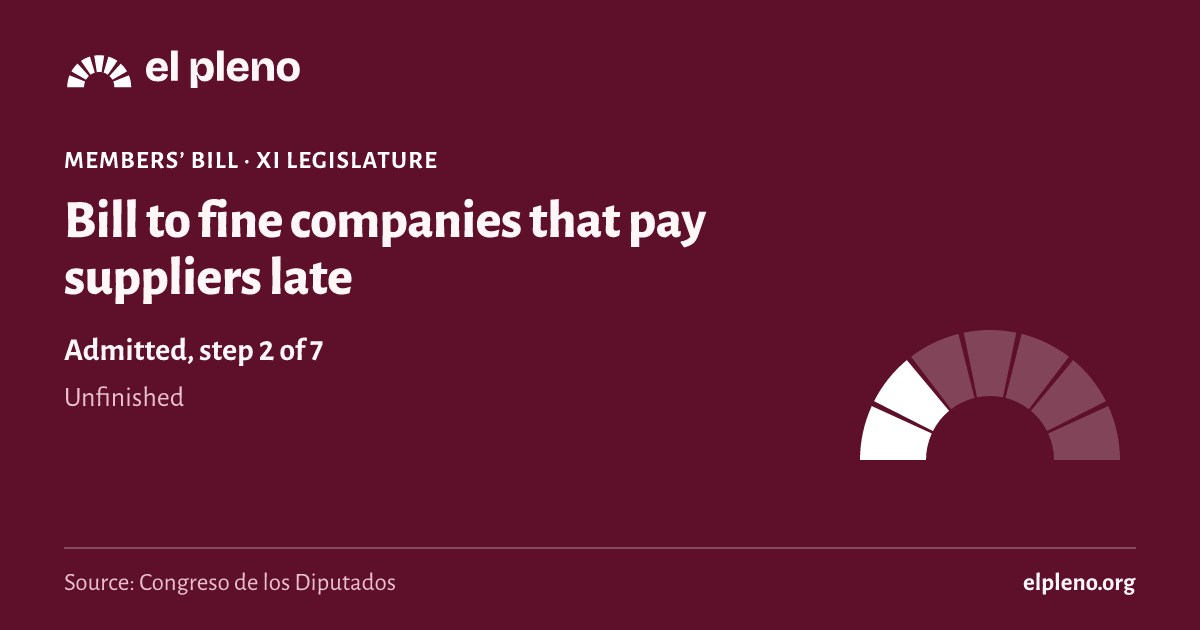
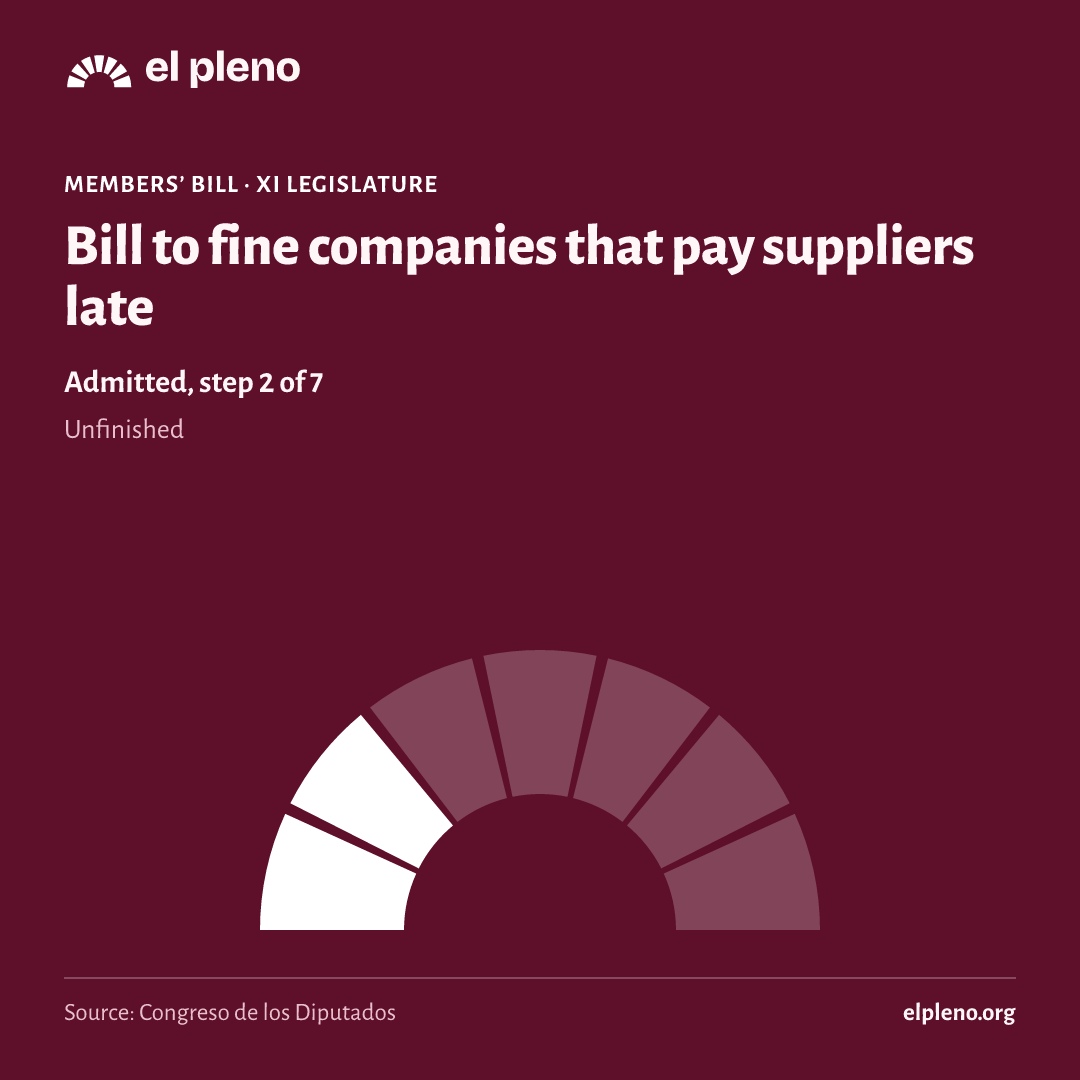
It took 2 of 7 steps. It reached Admitted, and today it is unfinished.
- Introduced14 April 2016Someone registers the text in the Congreso.
- Admitted19 April 2016The Bureau of the Congreso accepts it and, for a members’ bill, the plenary decides whether to consider it.
- Amendmentsnot reachedGroups propose changes.
- Committeenot reachedA committee goes through the text in detail.
- Plenarynot reachedAll 350 deputies vote.
- Senatenot reachedThe Senate can pass it, amend it or veto it.
- BOEnot reachedIt is published in the Official State Gazette (BOE) and comes into force.
See the 5 official steps on a timeline
Was there a plenary vote?
We have no plenary vote linked to this law in the Congreso’s data.
What happens next
What happens now?
The legislature ended before it finished. To go on, someone would have to introduce it again in the new Cortes.
It has not been presented again yet.
Sources
Where does all this come from?
- Congreso de los Diputados, file 122/000032
Official title, type, author, dates and stage.
Retrieved 11 November 2026
- The data comes from the open files of the Congreso, the Senate and the BOE, unaltered.
- Each deputy’s province is the one of their seat on the day of the vote.
- We only say “passed” or “rejected” when the majority needed is certain; otherwise we say which side had more votes.