What it is
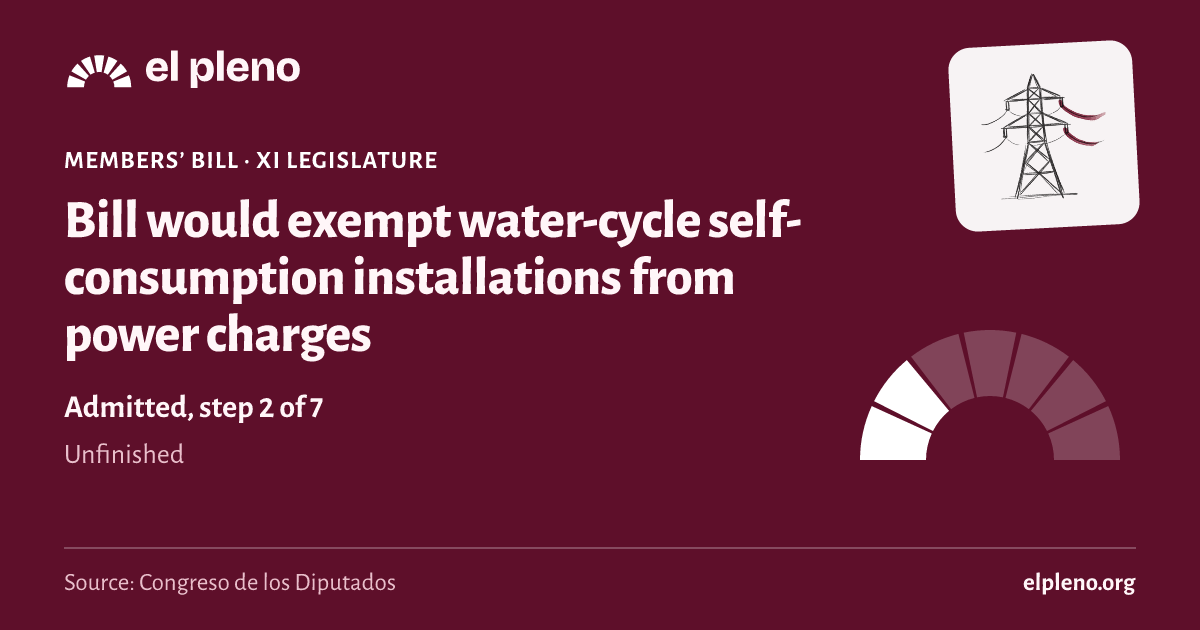
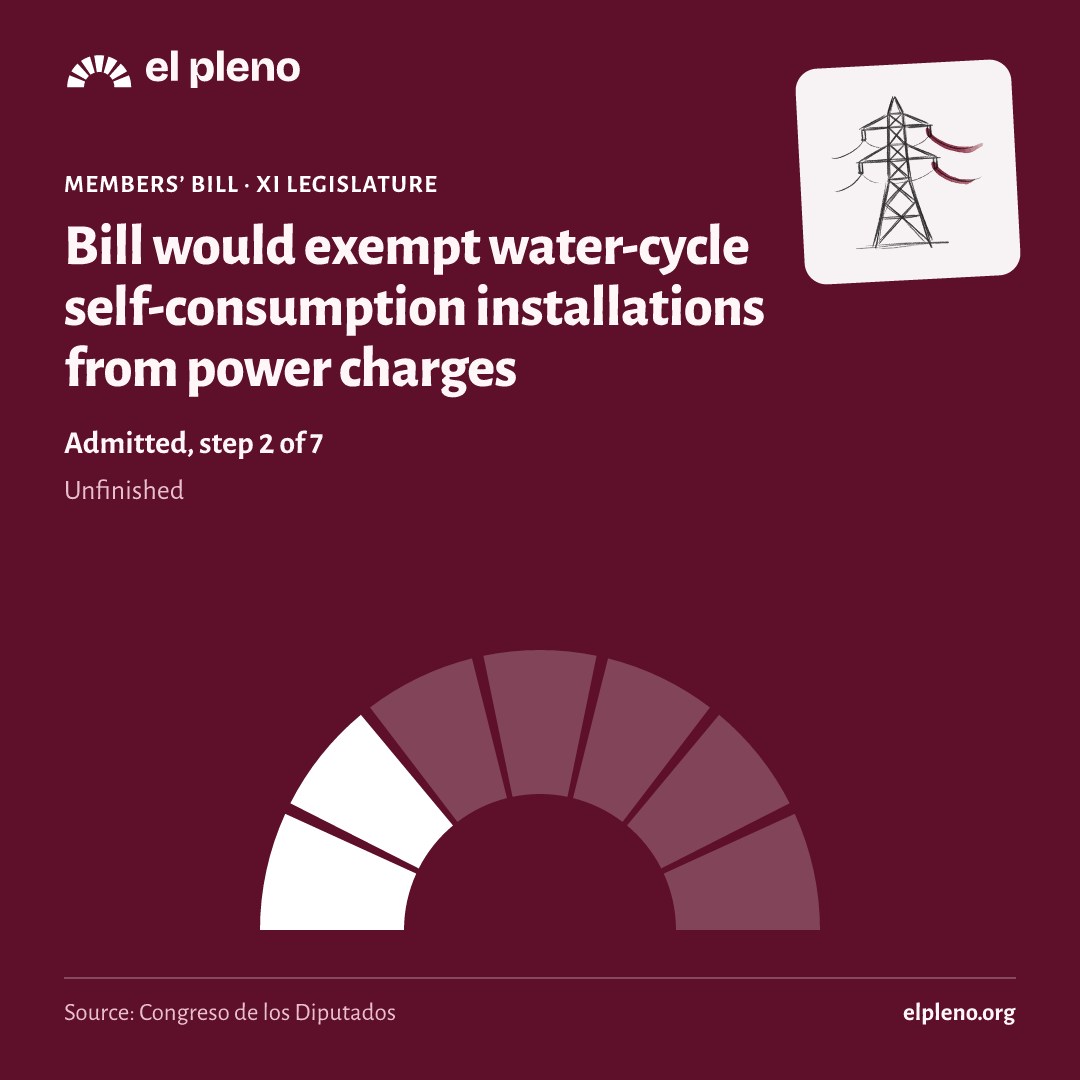
Bill would exempt water-cycle self-consumption installations from power charges
It is a members’ bill. Introduced by parliamentary groups, the Senate, regional governments or citizens. It was introduced on 30 March 2016. Introduced by: Grupo Parlamentario Ciudadanos.
Official title: Private member's bill amending Law 24/2013, of December 26, on the electricity sector, to exempt installations operating under a self-consumption regime linked to the water cycle until December 31, 2019.
Source: Congreso de los Diputados, file 122/000027· updated 11 Nov
Automatic summary, not yet reviewed
- The bill would amend the ninth transitional provision of Law 24/2013 on the electricity sector to exempt water-cycle self-consumption installations already in service from the application of Article 9 (the self-consumption regime) until December 31, 2019.
- The text explains that seawater desalination plants in the Canary Islands run on renewable self-consumption and are the main source of drinking water and irrigation water, especially in the eastern islands.
- According to the explanatory statement, imposing self-consumption costs would raise water prices by 10 to 30 percent and hurt the competitiveness of Canary Island farming, so the goal is to allow time to adapt to the new framework.
- The Government would be empowered to issue any necessary implementing rules, and the law would take effect the day after its publication in the Official State Gazette (Boletín Oficial del Estado).
Who it affects
- Water-cycle self-consumption installations already in service: They would be exempt from paying self-consumption system costs until December 31, 2019.
- Desalination plants in the Canary Islands: They would be the main beneficiaries, avoiding higher prices for drinking and irrigation water.
- Farmers in the eastern Canary Islands: They would avoid higher irrigation water costs that would hurt their competitiveness.
- Cogeneration installations and consumers covered by Royal Decree 1955/2000: They keep the existing transitional exemptions until December 31, 2019.
Words worth knowing
- Autoconsumo eléctrico (electricity self-consumption)
- When a person or facility generates its own electricity and uses it, instead of buying it all from the grid.
- Peajes de acceso (grid access tolls)
- Charges paid for using the electricity networks.
- Desalación (desalination)
- The process of removing salt from seawater to make it usable as fresh water.
- Cogeneración (cogeneration)
- A facility that produces both electricity and useful heat at the same time.
- Disposición transitoria (transitional provision)
- A part of a law that governs how it applies to existing situations during an adjustment period.
It summarizes the text as it was introduced. It is written by artificial intelligence and may contain mistakes: the official text is what counts. Read the official text · How we make summaries
Where it stands
How far did it get?
It took 2 of 7 steps. It reached Admitted, and today it is unfinished.
- Introduced30 March 2016Someone registers the text in the Congreso.
- Admitted5 April 2016The Bureau of the Congreso accepts it and, for a members’ bill, the plenary decides whether to consider it.
- Amendmentsnot reachedGroups propose changes.
- Committeenot reachedA committee goes through the text in detail.
- Plenarynot reachedAll 350 deputies vote.
- Senatenot reachedThe Senate can pass it, amend it or veto it.
- BOEnot reachedIt is published in the Official State Gazette (BOE) and comes into force.
See the 5 official steps on a timeline
Was there a plenary vote?
We have no plenary vote linked to this law in the Congreso’s data.
What happens next
What happens now?
The legislature ended before it finished. To go on, someone would have to introduce it again in the new Cortes.
It has not been presented again yet.
Sources
Where does all this come from?
- Congreso de los Diputados, file 122/000027
Official title, type, author, dates and stage.
Retrieved 11 November 2026
- The data comes from the open files of the Congreso, the Senate and the BOE, unaltered.
- Each deputy’s province is the one of their seat on the day of the vote.
- We only say “passed” or “rejected” when the majority needed is certain; otherwise we say which side had more votes.