What it is
Proposal to stop treating bullfighting as cultural heritage
It is a members’ bill. Introduced by parliamentary groups, the Senate, regional governments or citizens. It was introduced on 18 March 2016. Introduced by: Grupo Parlamentario de Esquerra Republicana.
Official title: Private member's bill for an Organic Law on the repeal of bullfighting as cultural heritage.
Source: Congreso de los Diputados, file 122/000023· updated 11 Nov
Automatic summary, not yet reviewed
- The bill would declare that bullfighting is not a cultural asset or cultural heritage, and would repeal Law 18/2013, which regulated it as cultural heritage.
- It would ban all public aid and subsidies for bullfights and for breeding fighting bulls, including spending on promotion and advertising. It would also have the Government push to exclude bull breeders from European Union aid under the Common Agricultural Policy.
- Public authorities would limit minors' exposure to bullfighting events and prevent their promotion among minors. To do this, the audiovisual law would be amended to ban broadcasting bullfights on free-to-air television, and the state television law would ban producing or scheduling them.
- The Criminal Code would be amended to punish people who abuse animals in unauthorized shows and those who cause the animal's death at shows, even if the shows are legally authorized.
Who it affects
- Bullfighting organizers and bull breeders: They would lose all public aid and subsidies from the State.
- Minors: Public authorities would limit their exposure to bullfighting events and its promotion among them.
- State television and radio broadcasters: They could not produce, schedule, or include bullfighting shows in their programs.
- Bullfighters and show organizers: They could face criminal penalties if they cause the animal's death, even at authorized shows.
Words worth knowing
- Proposición de ley
- A bill introduced by a parliamentary group so it can become law. It is not an approved law yet.
- Ley orgánica
- A type of Spanish law that requires special majorities in Congress and is reserved for major matters, such as the Criminal Code.
- Política Agraria Común
- Common Agricultural Policy: the European Union's farm aid program.
- Disposición derogatoria
- The part of a law that says which earlier rules stop having effect.
It summarizes the text as it was introduced. It is written by artificial intelligence and may contain mistakes: the official text is what counts. Read the official text · How we make summaries
Where it stands
How far did it get?
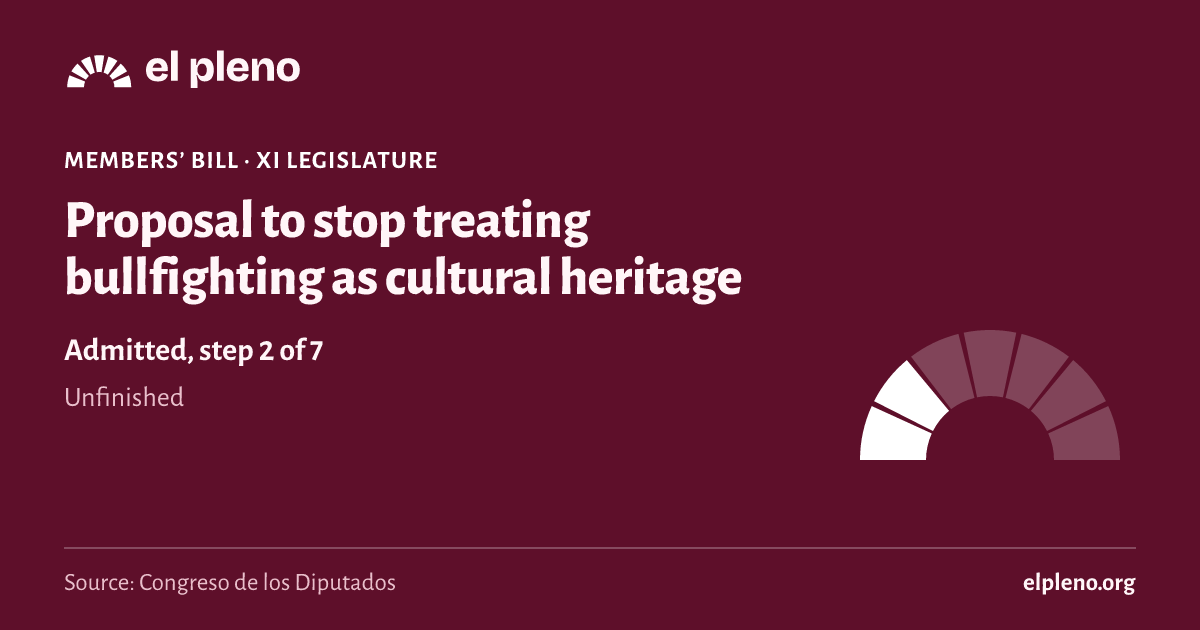
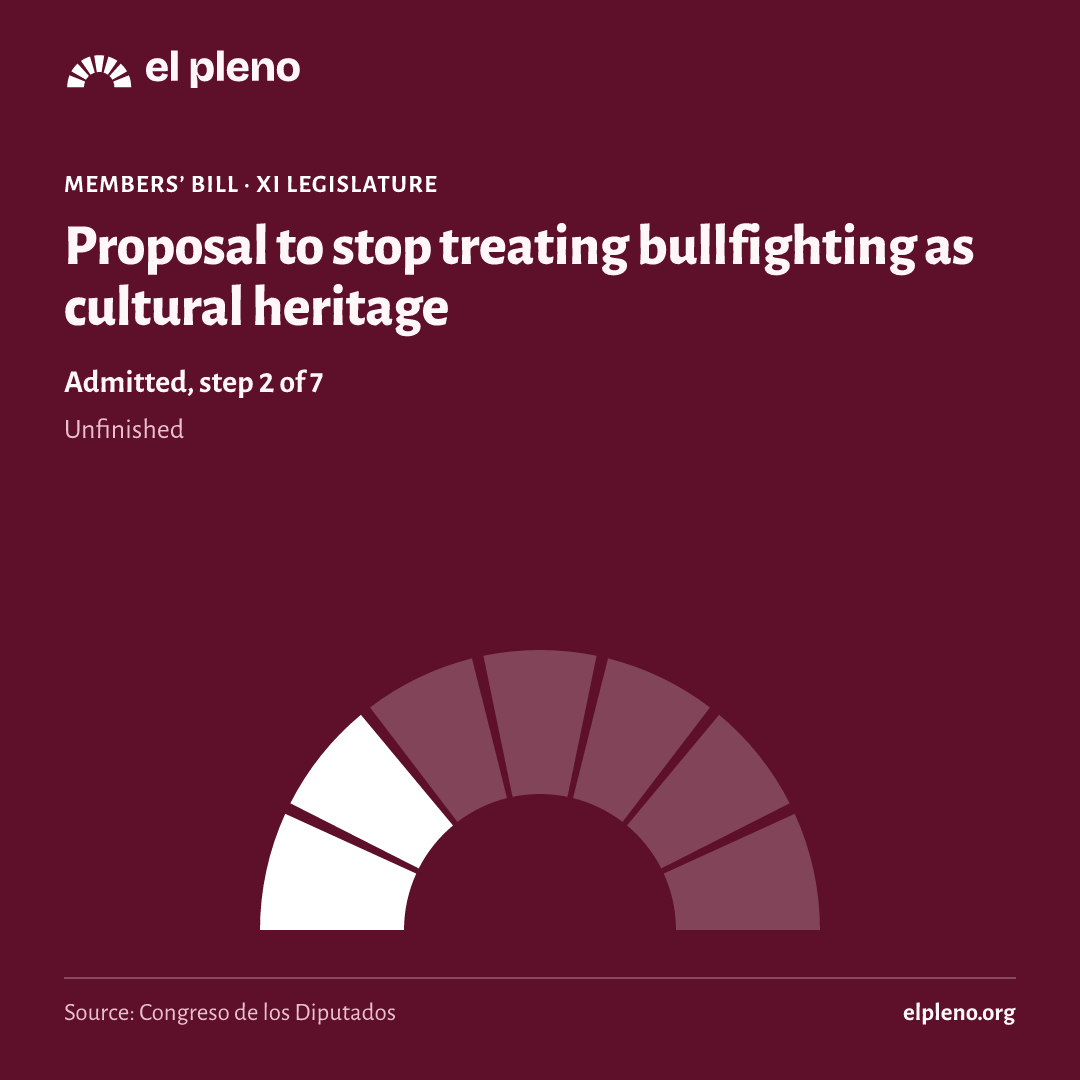
It took 2 of 7 steps. It reached Admitted, and today it is unfinished.
- Introduced18 March 2016Someone registers the text in the Congreso.
- Admitted29 March 2016The Bureau of the Congreso accepts it and, for a members’ bill, the plenary decides whether to consider it.
- Amendmentsnot reachedGroups propose changes.
- Committeenot reachedA committee goes through the text in detail.
- Plenarynot reachedAll 350 deputies vote.
- Senatenot reachedThe Senate can pass it, amend it or veto it.
- BOEnot reachedIt is published in the Official State Gazette (BOE) and comes into force.
See the 5 official steps on a timeline
Was there a plenary vote?
We have no plenary vote linked to this law in the Congreso’s data.
What happens next
What happens now?
The legislature ended before it finished. To go on, someone would have to introduce it again in the new Cortes.
It has not been presented again yet.
Sources
Where does all this come from?
- Congreso de los Diputados, file 122/000023
Official title, type, author, dates and stage.
Retrieved 11 November 2026
- The data comes from the open files of the Congreso, the Senate and the BOE, unaltered.
- Each deputy’s province is the one of their seat on the day of the vote.
- We only say “passed” or “rejected” when the majority needed is certain; otherwise we say which side had more votes.