What it is
Bill to equalize conditions for subcontracted workers
It is a members’ bill. Introduced by parliamentary groups, the Senate, regional governments or citizens. It was introduced on 16 March 2016. Introduced by: Grupo Parlamentario Socialista.
Official title: Private member's bill amending Article 42.1 of the Workers' Statute to guarantee equality in the working conditions of subcontracted workers.
Source: Congreso de los Diputados, file 122/000020· updated 11 Nov
Automatic summary, not yet reviewed
- The bill would amend Article 42.1 of the Workers' Statute to define when a subcontracted work or service falls within the company's own activity: when it matches its main or core activities and the contractor provides workers performing tasks directly related to them.
- In those cases, contractors and subcontractors would have to guarantee affected workers, while assigned to the contract, the essential conditions of the collective agreement applying to the main company, or the conditions they would have if hired directly by it.
- Essential conditions would include pay and salary amounts, hiring conditions, working time and rest, equality, protection of maternity, breastfeeding and paternity, and protection against workplace risks.
- The explanatory statement justifies the reform with three goals: giving legal certainty to subcontracting, preventing unfair competition between companies in the same sector, and ensuring workers in the same sector have the same pay and working conditions.
Who it affects
- Workers hired through contracts and subcontracts: They would be guaranteed the same essential conditions as workers at the main company.
- Contractors and subcontractors: They would have to guarantee those essential conditions to workers assigned to the contract.
- Main companies that outsource services: They could no longer cut labor costs by subcontracting their own activity under worse conditions.
Words worth knowing
- Subcontratación (subcontracting)
- When a company hires another company to carry out part of its work or services.
- Estatuto de los Trabajadores (Workers' Statute)
- Spain's main law on labor rights and duties.
- Convenio colectivo (collective agreement)
- An agreement setting wages and working conditions for a sector or a company.
- Exposición de motivos (explanatory statement)
- The opening part of a bill explaining why it is proposed and what it aims to do.
- Proposición de ley (bill)
- A text introduced by members of Congress to become law; it is not yet approved.
It summarizes the text as it was introduced. It is written by artificial intelligence and may contain mistakes: the official text is what counts. Read the official text · How we make summaries
Where it stands
How far did it get?
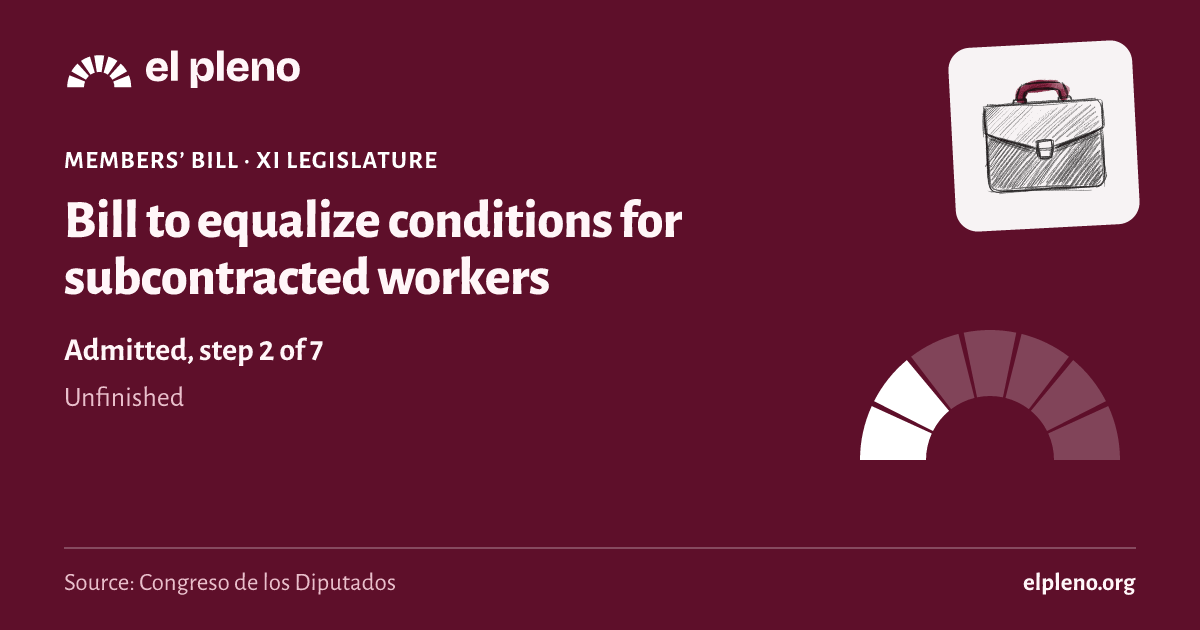
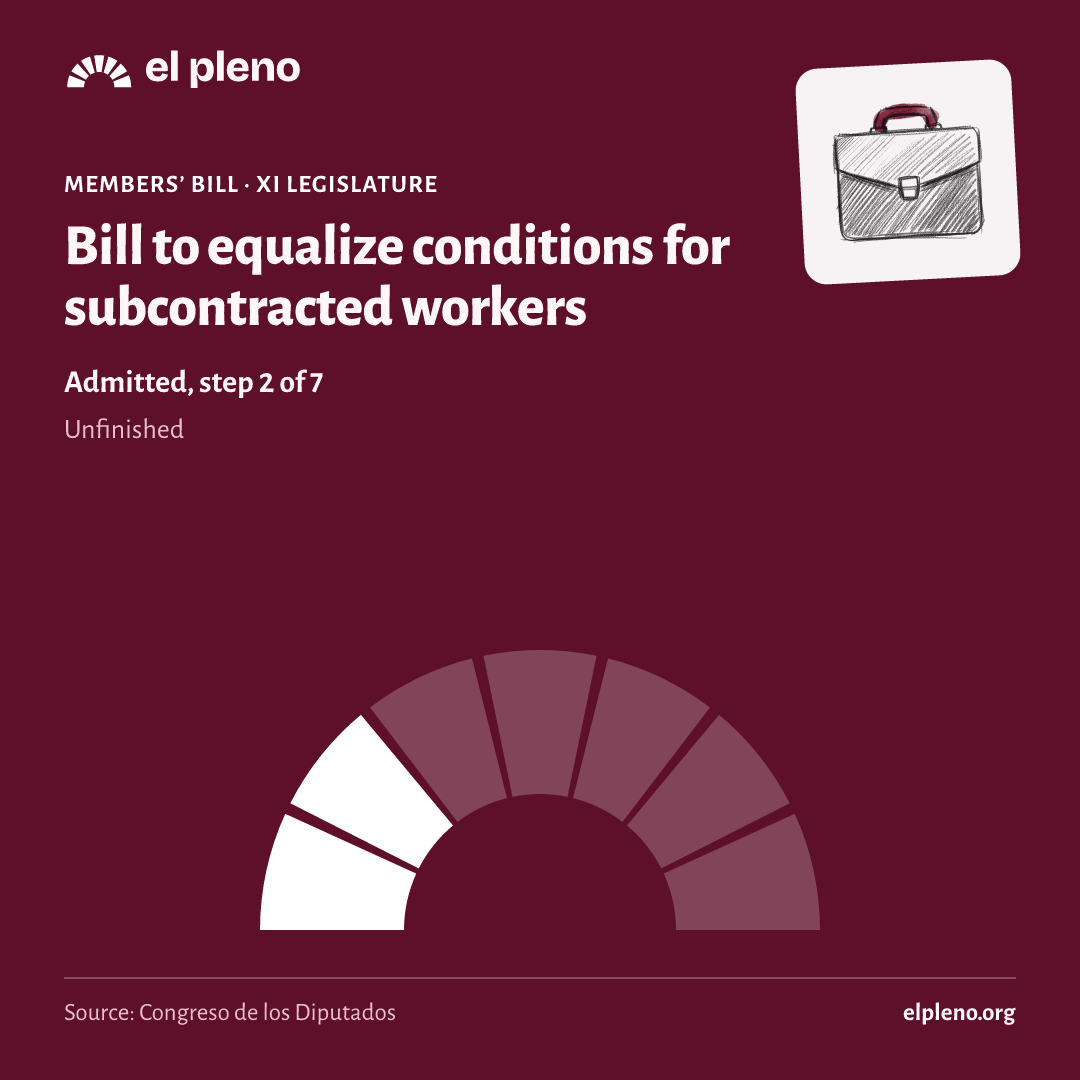
It took 2 of 7 steps. It reached Admitted, and today it is unfinished.
- Introduced16 March 2016Someone registers the text in the Congreso.
- Admitted29 March 2016The Bureau of the Congreso accepts it and, for a members’ bill, the plenary decides whether to consider it.
- Amendmentsnot reachedGroups propose changes.
- Committeenot reachedA committee goes through the text in detail.
- Plenarynot reachedAll 350 deputies vote.
- Senatenot reachedThe Senate can pass it, amend it or veto it.
- BOEnot reachedIt is published in the Official State Gazette (BOE) and comes into force.
See the 5 official steps on a timeline
Was there a plenary vote?
We have no plenary vote linked to this law in the Congreso’s data.
What happens next
What happens now?
The legislature ended before it finished. To go on, someone would have to introduce it again in the new Cortes.
It was presented again:
- XII Legislature, Congreso de los Diputados· Unfinished Bill to equalize conditions for subcontracted workers
Presented before in:
- X Legislature, Congreso de los Diputados· Rejected Private member's bill amending Article 42.1 of the Workers' Statute to guarantee equality in the working conditions of subcontracted workers.
Sources
Where does all this come from?
- Congreso de los Diputados, file 122/000020
Official title, type, author, dates and stage.
Retrieved 11 November 2026
- The data comes from the open files of the Congreso, the Senate and the BOE, unaltered.
- Each deputy’s province is the one of their seat on the day of the vote.
- We only say “passed” or “rejected” when the majority needed is certain; otherwise we say which side had more votes.