What it is
Bill would force checks on payments to public works subcontractors
It is a members’ bill. Introduced by parliamentary groups, the Senate, regional governments or citizens. It was introduced on 11 March 2016. Introduced by: Grupo Parlamentario de Esquerra Republicana.
Official title: Private member's bill amending Royal Legislative Decree 3/2011, of November 14, approving the consolidated text of the Public Sector Contracts Law, to control the payment deadlines of contractors awarded public works to their suppliers and subcontractors.
Source: Congreso de los Diputados, file 122/000017· updated 11 Nov
Automatic summary, not yet reviewed
- The bill would amend Article 228 bis of the Public Sector Contracts Law so that public administrations and other contracting bodies would be required (previously they could do so only voluntarily) to check that awarded contractors pay their subcontractors and suppliers within the legal deadlines.
- Contractors would have to give the contracting body, on request, a detailed list of subcontractors and suppliers with their payment conditions, and later prove they paid on time. These obligations would be included in tender notices and contract documents, and breaking them would allow penalties to be imposed.
- Main contractors would have to send a certificate proving they meet the legal payment deadlines. It would have to be issued by a multisector business association at state or regional level, or by the Multisectoral Platform against Late Payment.
- In the explanatory statement, the bill justifies the measure with data from the Multisectoral Platform against Late Payment: non-financial Ibex 35 companies pay on average after 171 days, and construction companies after 291 days, compared with the legal limit of 60 days.
Who it affects
- Awarded contractors of public works: They would have to justify their payments and submit a compliance certificate.
- Subcontractors and suppliers: They would be better protected against late payments.
- Public administrations and public contracting bodies: They would be required to check contractors' payments.
- SMEs and self-employed workers serving large contractors: They are the group the bill aims to protect.
Words worth knowing
- Contratista adjudicatario
- Company awarded a public contract, for example a public works project.
- Subcontratista o suministrador
- Company or self-employed worker working for the main contractor, providing part of the work or materials.
- Pliego de condiciones
- Document setting out the conditions that bidders for a public contract must meet.
- Penalidades
- Financial penalties that can be imposed if contract conditions are not met.
- Texto refundido
- A single, consolidated version of a law that gathers all its previous amendments.
It summarizes the text as it was introduced. It is written by artificial intelligence and may contain mistakes: the official text is what counts. Read the official text · How we make summaries
Where it stands
How far did it get?
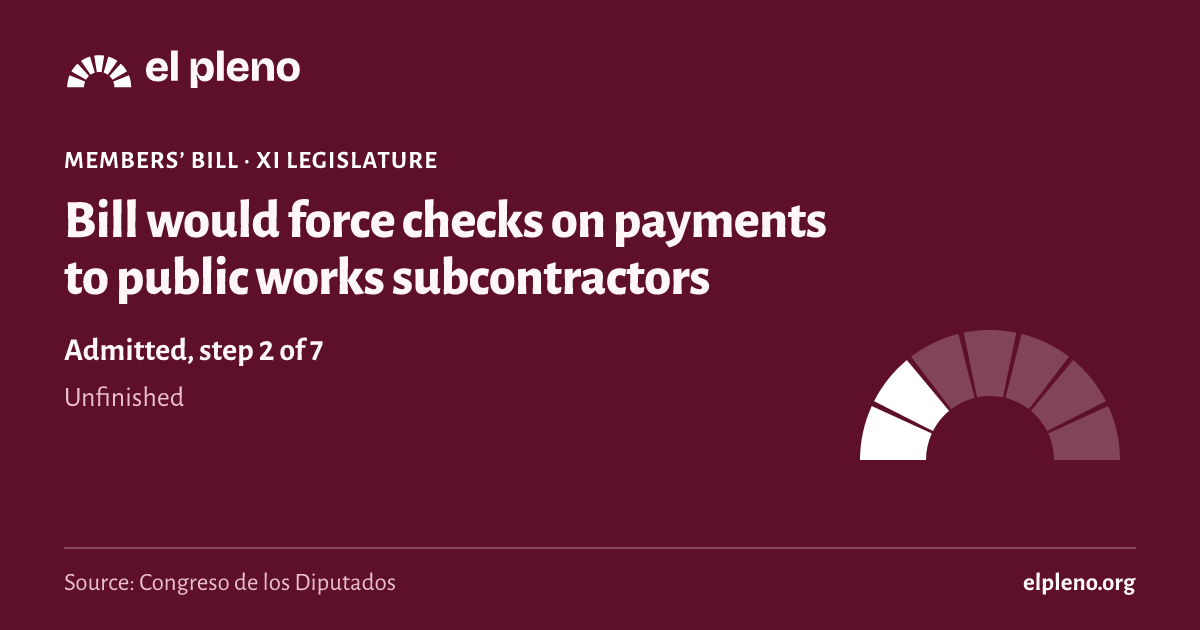
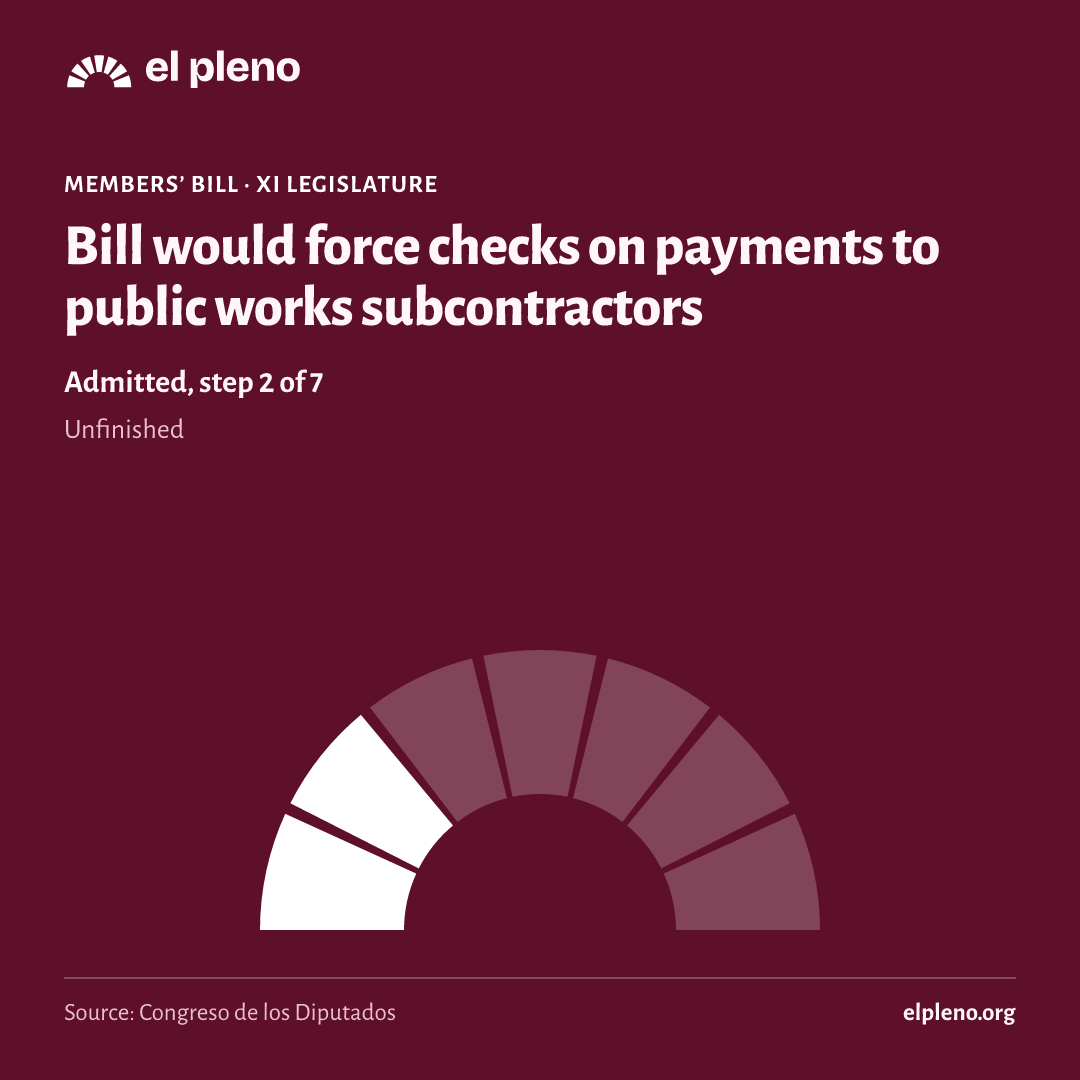
It took 2 of 7 steps. It reached Admitted, and today it is unfinished.
- Introduced11 March 2016Someone registers the text in the Congreso.
- Admitted15 March 2016The Bureau of the Congreso accepts it and, for a members’ bill, the plenary decides whether to consider it.
- Amendmentsnot reachedGroups propose changes.
- Committeenot reachedA committee goes through the text in detail.
- Plenarynot reachedAll 350 deputies vote.
- Senatenot reachedThe Senate can pass it, amend it or veto it.
- BOEnot reachedIt is published in the Official State Gazette (BOE) and comes into force.
See the 6 official steps on a timeline
Was there a plenary vote?
We have no plenary vote linked to this law in the Congreso’s data.
What happens next
What happens now?
The legislature ended before it finished. To go on, someone would have to introduce it again in the new Cortes.
It has not been presented again yet.
Sources
Where does all this come from?
- Congreso de los Diputados, file 122/000017
Official title, type, author, dates and stage.
Retrieved 11 November 2026
- The data comes from the open files of the Congreso, the Senate and the BOE, unaltered.
- Each deputy’s province is the one of their seat on the day of the vote.
- We only say “passed” or “rejected” when the majority needed is certain; otherwise we say which side had more votes.