What it is
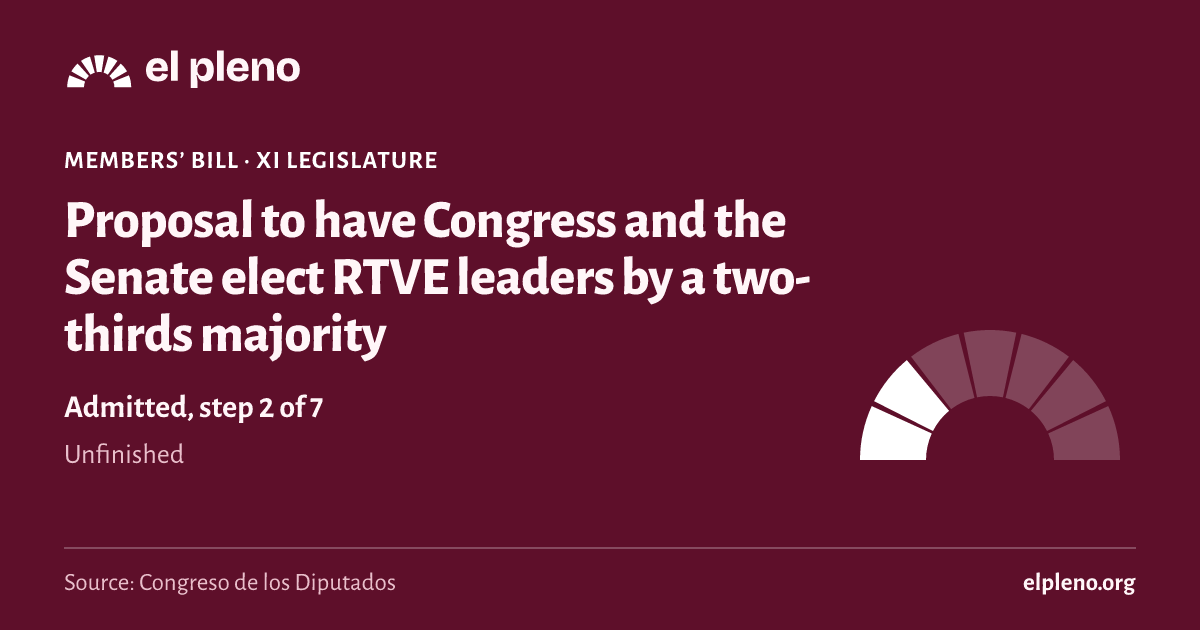
Proposal to have Congress and the Senate elect RTVE leaders by a two-thirds majority
It is a members’ bill. Introduced by parliamentary groups, the Senate, regional governments or citizens. It was introduced on 14 January 2016. Introduced by: Grupo Parlamentario Socialista.
Official title: Private member's bill on the amendment of Law 17/2006, of June 5, on state-owned radio and television, to restore the independence of the RTVE Corporation and pluralism in the parliamentary election of its bodies.
Source: Congreso de los Diputados, file 122/000004· updated 11 Nov
Automatic summary, not yet reviewed
- The bill would have RTVE's Board of Directors elected again by the Cortes Generales The Spanish Parliament as a whole: the Congress of Deputies and the Senate together. (Spanish Parliament): eight members by the Congress of Deputies and four by the Senate, with a two-thirds majority. Two of those chosen by the Congress would be proposed by the most representative statewide unions.
- The Board of Directors would have twelve members, individuals with professional qualifications and experience, seeking an even balance between men and women.
- The Congress of Deputies would pick the Chair of RTVE from among the twelve elected board members, also by a two-thirds majority. Candidates would first have to appear at a public hearing before the Congress and the Senate.
- If passed, a new Board of Directors and a new Chair would be elected immediately to adjust the board's size. The law would take effect the day after its publication in the Official State Gazette.
Words worth knowing
- Proposición de ley
- A bill introduced by a parliamentary group rather than by the Government. It is still being processed, so it is not an approved law yet.
- Cortes Generales
- The Spanish Parliament as a whole: the Congress of Deputies and the Senate together.
- Mayoría de dos tercios (two-thirds majority)
- A requirement that at least two out of three members of the chamber vote in favor, so the governing party cannot decide alone.
- Consejo Asesor (Advisory Council)
- An RTVE body that advises the corporation; the bill would set its membership at fifteen.
It summarizes the text as it was introduced. It is written by artificial intelligence and may contain mistakes: the official text is what counts. Read the official text · How we make summaries
Where it stands
How far did it get?
It took 2 of 7 steps. It reached Admitted, and today it is unfinished.
- Introduced14 January 2016Someone registers the text in the Congreso.
- Admitted2 February 2016The Bureau of the Congreso accepts it and, for a members’ bill, the plenary decides whether to consider it.
- Amendmentsnot reachedGroups propose changes.
- Committeenot reachedA committee goes through the text in detail.
- Plenarynot reachedAll 350 deputies vote.
- Senatenot reachedThe Senate can pass it, amend it or veto it.
- BOEnot reachedIt is published in the Official State Gazette (BOE) and comes into force.
See the 6 official steps on a timeline
Was there a plenary vote?
We have no plenary vote linked to this law in the Congreso’s data.
What happens next
What happens now?
The legislature ended before it finished. To go on, someone would have to introduce it again in the new Cortes.
It was presented again:
- XII Legislature, Congreso de los Diputados· Passed· nearly the same title New way to choose RTVE's governing board
Presented before in:
- X Legislature, Congreso de los Diputados· Rejected Proposal to have Congress and the Senate elect RTVE's leaders by a two-thirds majority
Sources
Where does all this come from?
- Congreso de los Diputados, file 122/000004
Official title, type, author, dates and stage.
Retrieved 11 November 2026
- The data comes from the open files of the Congreso, the Senate and the BOE, unaltered.
- Each deputy’s province is the one of their seat on the day of the vote.
- We only say “passed” or “rejected” when the majority needed is certain; otherwise we say which side had more votes.