What it is
Proposal to tighten the vehicle registration tax on diesel cars
It is a members’ bill. Introduced by parliamentary groups, the Senate, regional governments or citizens. It was introduced on 7 October 2015. Introduced by: Grupo Parlamentario Catalán de Convergència i d'Unió.
Official title: Private member's bill amending Law 38/1992, of December 28, on Special Taxes, to modify the vehicle registration tax, with the aim of reducing vehicle pollutant emissions and improving air quality in large cities.
Source: Congreso de los Diputados, file 122/000216· updated 11 Nov
Automatic summary, not yet reviewed
- The bill aims to cut vehicle pollution and improve air quality in large Spanish cities. It argues that diesel vehicles emit high levels of nitrogen oxides and that most of them currently enjoy a full exemption from the registration tax.
- The bill would reorganize vehicle categories by their CO2 emissions, with thresholds of 100, 140 and 180 g/km. It would also define what counts as a quad-type vehicle and a personal watercraft.
- Diesel cars would only get the reduced rate if an official certificate shows their real-world nitrogen oxide emissions do not exceed the EURO limits by more than 30%. If they fail, the tax would rise by 50%, or a 3.5% rate would apply in the cleanest category.
- The money collected through the tax would go primarily to policies that improve air quality and fight climate change. The law would take effect the day after its publication in the official state gazette (BOE).
Who it affects
- People buying a diesel car: Would pay a higher registration tax on diesel cars that do not meet the emissions limits.
- Vehicle manufacturers and sellers: Would need to certify their vehicles' real NOx emissions with an official homologation certificate.
- Autonomous communities (Comunidades Autónomas): Could set the tax rates; if they do not, the state-proposed rates would apply.
- Residents of large cities: Would benefit from better air quality and policies funded by this tax.
Words worth knowing
- Impuesto de matriculación
- A one-time tax paid when registering a new vehicle so it can be driven.
- Óxidos de nitrógeno (NOx)
- Nitrogen oxides: polluting gases released mainly by diesel engines that harm health and city air.
- Normas EURO
- EURO standards: maximum emission limits that the European Union requires for vehicles.
- Homologación oficial
- Official homologation: a certificate issued by an official body confirming that a vehicle meets the required standards.
- Proposición de ley
- A bill introduced by members of parliament for debate; it is not a law until it is passed and published in the BOE.
It summarizes the text as it was introduced. It is written by artificial intelligence and may contain mistakes: the official text is what counts. Read the official text · How we make summaries
Where it stands
How far did it get?
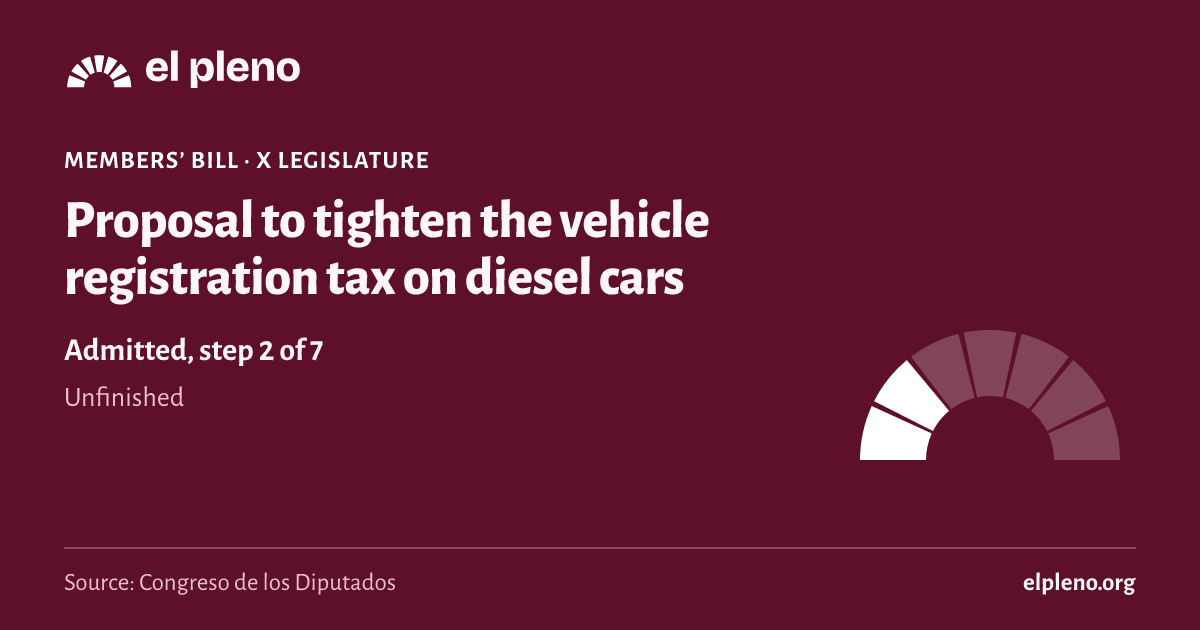
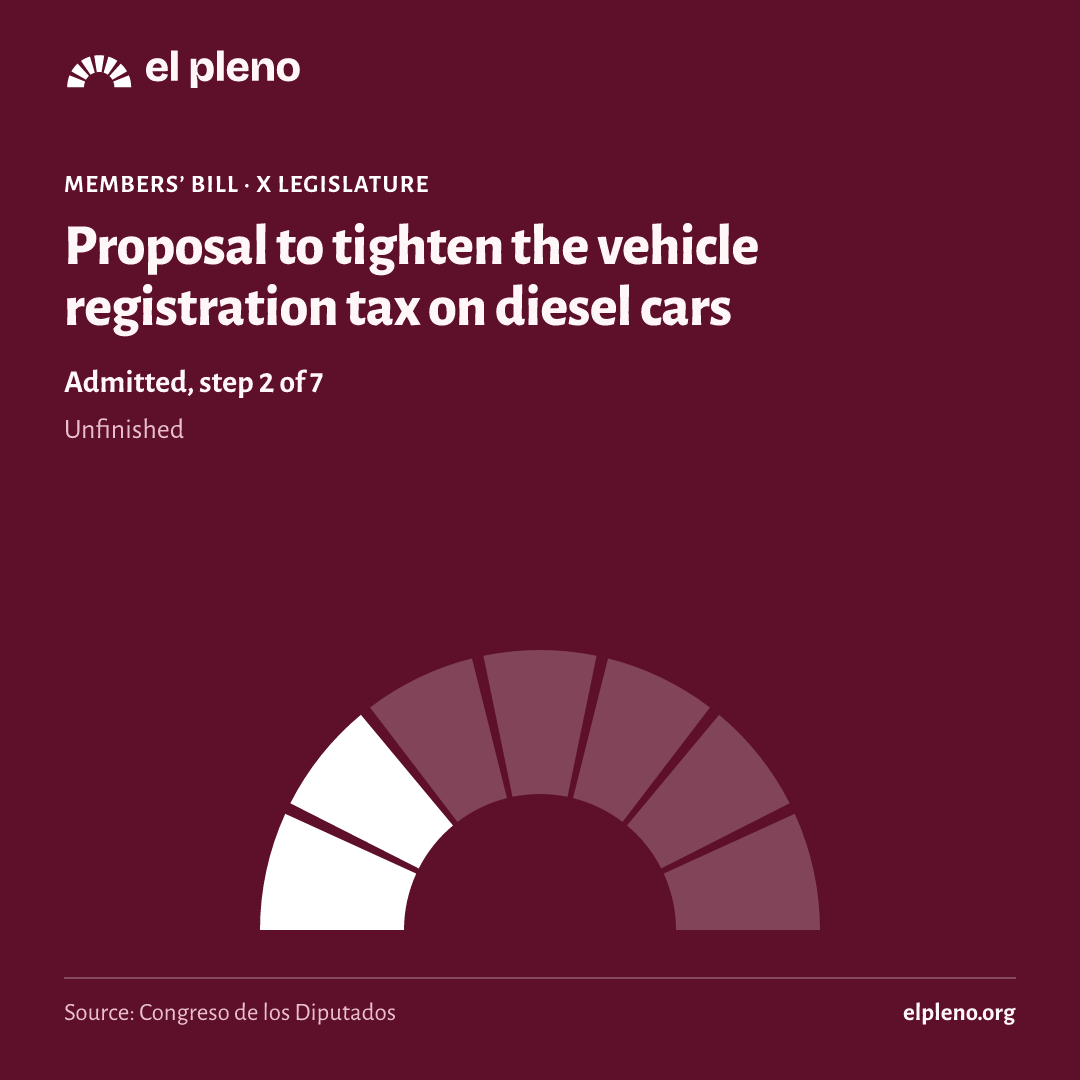
It took 2 of 7 steps. It reached Admitted, and today it is unfinished.
- Introduced7 October 2015Someone registers the text in the Congreso.
- Admitted13 October 2015The Bureau of the Congreso accepts it and, for a members’ bill, the plenary decides whether to consider it.
- Amendmentsnot reachedGroups propose changes.
- Committeenot reachedA committee goes through the text in detail.
- Plenarynot reachedAll 350 deputies vote.
- Senatenot reachedThe Senate can pass it, amend it or veto it.
- BOEnot reachedIt is published in the Official State Gazette (BOE) and comes into force.
See the 5 official steps on a timeline
Was there a plenary vote?
We have no plenary vote linked to this law in the Congreso’s data.
What happens next
What happens now?
The legislature ended before it finished. To go on, someone would have to introduce it again in the new Cortes.
It has not been presented again yet.
Sources
Where does all this come from?
- Congreso de los Diputados, file 122/000216
Official title, type, author, dates and stage.
Retrieved 11 November 2026
- The data comes from the open files of the Congreso, the Senate and the BOE, unaltered.
- Each deputy’s province is the one of their seat on the day of the vote.
- We only say “passed” or “rejected” when the majority needed is certain; otherwise we say which side had more votes.