What it is
Bill would remove several Basque rail lines from state network
It is a members’ bill. Introduced by parliamentary groups, the Senate, regional governments or citizens. It was introduced on 27 February 2015. Introduced by: Grupo Parlamentario Vasco (EAJ-PNV).
Official title: Private member's bill amending Law 11/2013, of July 26, on measures to support entrepreneurs and stimulate growth and job creation.
Source: Congreso de los Diputados, file 122/000198· updated 11 Nov
Automatic summary, not yet reviewed
- The bill would remove from Annex I of Law 11/2013 six rail lines or sections that run entirely through the Basque Country: lines 720, 722, 724, 726, 782 and 784.
- It would also split off two sections of lines that cross into other regions: the Bilbao La Concordia-Irauregui section of line 780 (Bilbao-Santander) and the Bilbao-Balmaseda section of line 790 (Aranguren-León).
- The bill argues that the Basque Country has exclusive authority over railways in its territory, and that these lines are not essential to the state transport system: they are single-track, narrow-gauge lines with little passenger traffic, used mostly for freight and occasional tourist trains.
- The bill relies on a Constitutional Court ruling (STC 245/2012) saying that a line crossing several regions is not enough reason to include it in the state network; the public interest must also be considered.
Who it affects
- The Ministry of Public Works (Ministerio de Fomento), currently responsible for these lines.: It would stop including them in the general interest rail network.
- The Autonomous Community of the Basque Country, which has exclusive authority over railways in its territory.: It could take over management of the affected lines and sections.
- People who travel or ship freight on these Basque lines.: Management of the lines could change hands to a different administration.
Words worth knowing
- Red Ferroviaria de Interés General
- The set of rail lines the State considers essential for the whole country and manages itself.
- Proposición de ley
- A bill introduced by a parliamentary group. It is not a law until passed by the Congress and the Senate and published in the official gazette (BOE).
- Ancho métrico
- Narrow-gauge track, narrower than standard gauge, used on some historic lines in northern Spain.
- Segregar un tramo
- To split off a section of a line so it is managed differently from the rest.
It summarizes the text as it was introduced. It is written by artificial intelligence and may contain mistakes: the official text is what counts. Read the official text · How we make summaries
Where it stands
How far did it get?
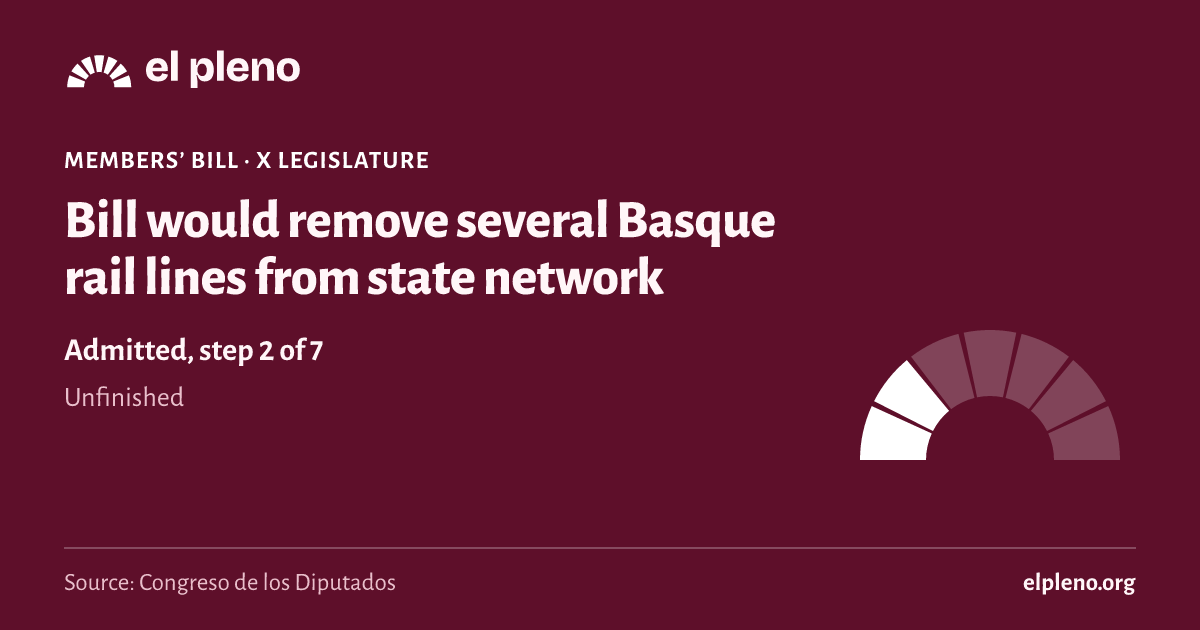
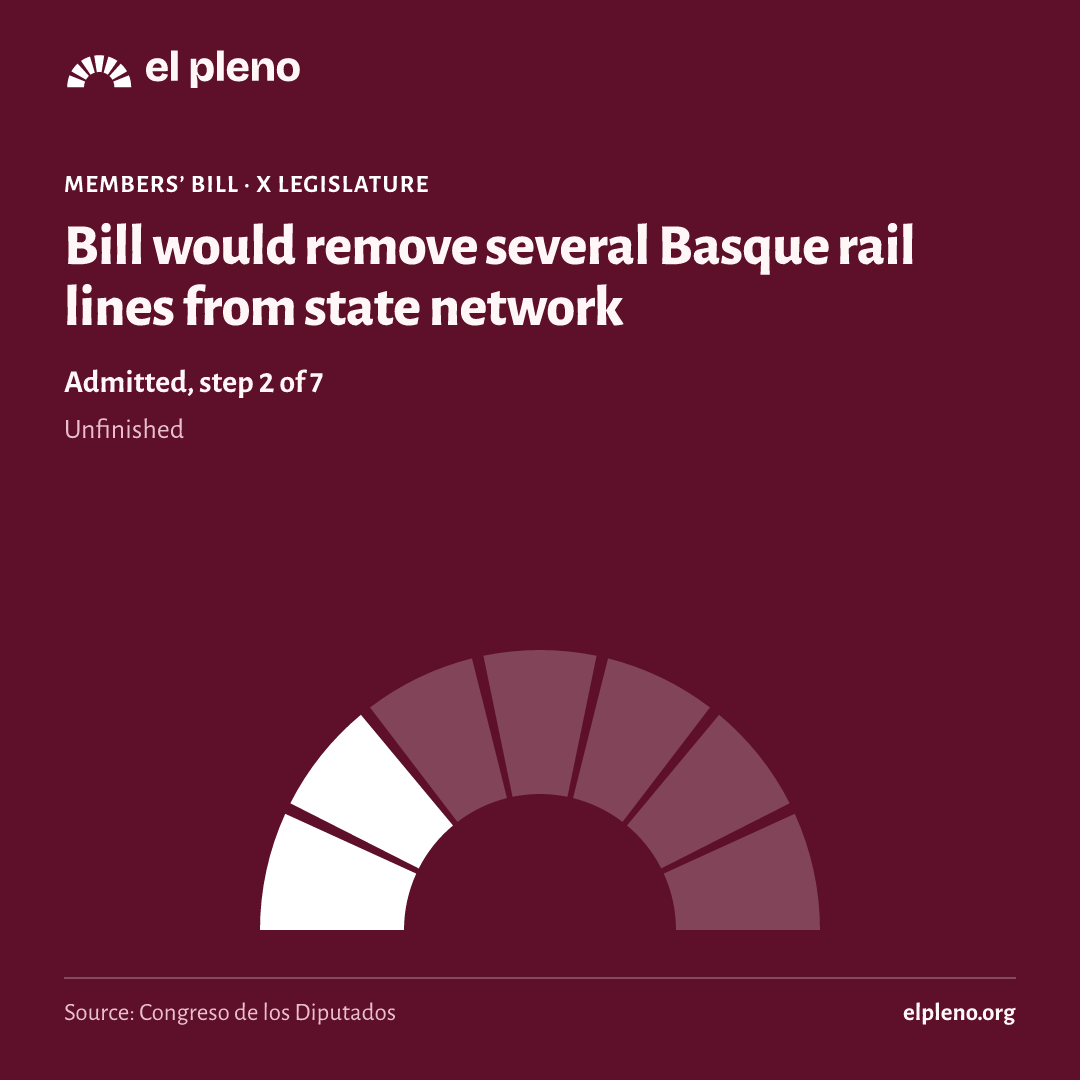
It took 2 of 7 steps. It reached Admitted, and today it is unfinished.
- Introduced27 February 2015Someone registers the text in the Congreso.
- Admitted3 March 2015The Bureau of the Congreso accepts it and, for a members’ bill, the plenary decides whether to consider it.
- Amendmentsnot reachedGroups propose changes.
- Committeenot reachedA committee goes through the text in detail.
- Plenarynot reachedAll 350 deputies vote.
- Senatenot reachedThe Senate can pass it, amend it or veto it.
- BOEnot reachedIt is published in the Official State Gazette (BOE) and comes into force.
See the 6 official steps on a timeline
Was there a plenary vote?
We have no plenary vote linked to this law in the Congreso’s data.
What happens next
What happens now?
The legislature ended before it finished. To go on, someone would have to introduce it again in the new Cortes.
It has not been presented again yet.
Sources
Where does all this come from?
- Congreso de los Diputados, file 122/000198
Official title, type, author, dates and stage.
Retrieved 11 November 2026
- The data comes from the open files of the Congreso, the Senate and the BOE, unaltered.
- Each deputy’s province is the one of their seat on the day of the vote.
- We only say “passed” or “rejected” when the majority needed is certain; otherwise we say which side had more votes.