What it is
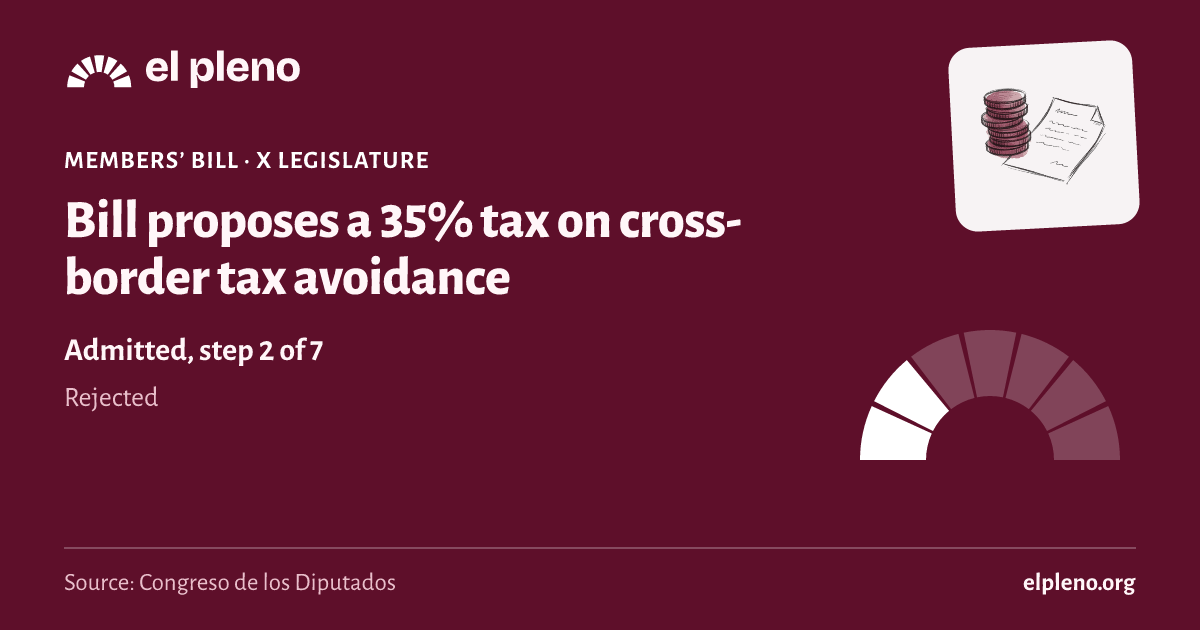
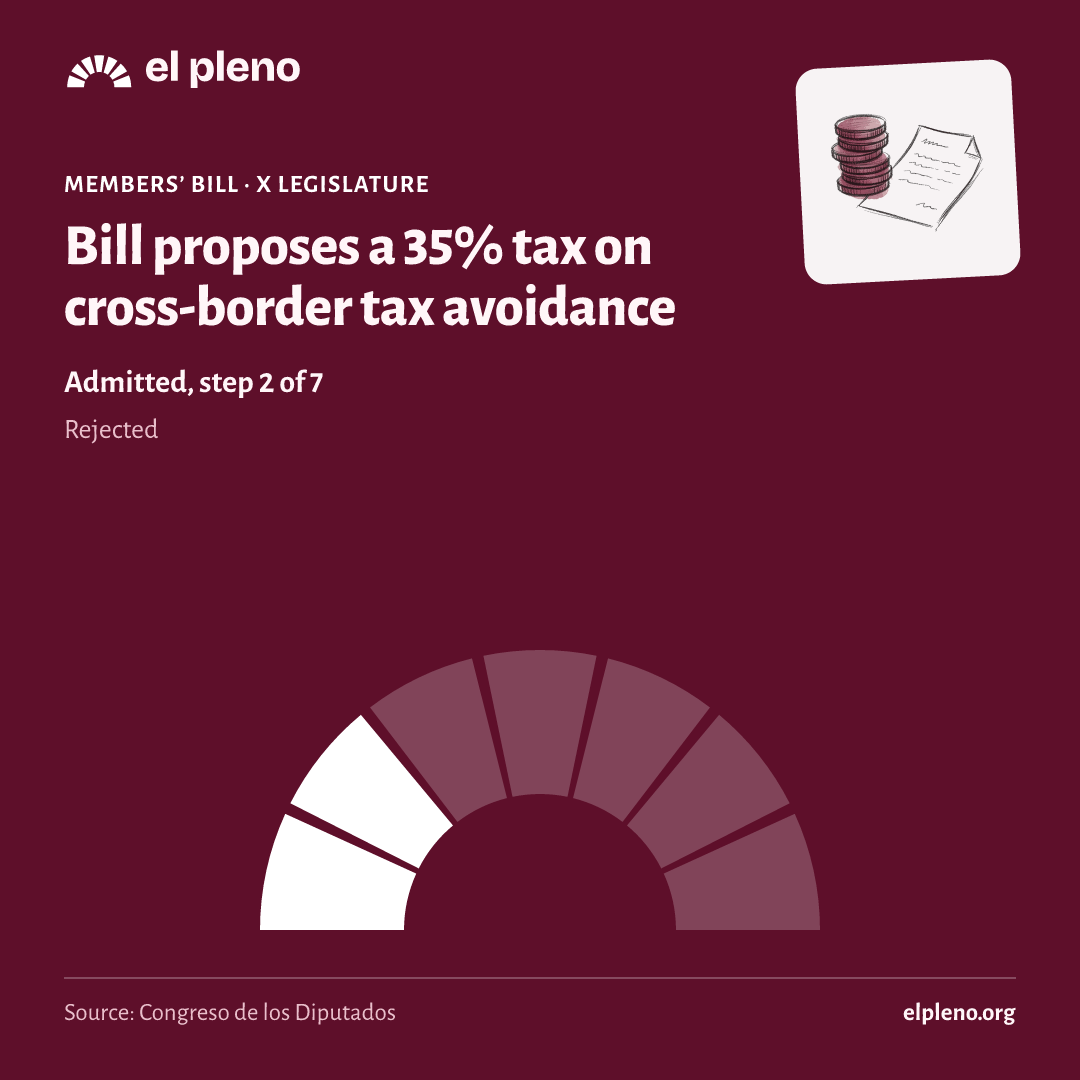
Bill proposes a 35% tax on cross-border tax avoidance
It is a members’ bill. Introduced by parliamentary groups, the Senate, regional governments or citizens. It was introduced on 12 February 2015. Introduced by: Grupo Parlamentario Socialista.
Official title: Private member's bill on the creation of the Tax on the deduction of income in abuse of right and the amendment of Law 58/2003, of 17 December, General Tax Law.
Source: Congreso de los Diputados, file 122/000193· updated 11 Nov
Automatic summary, not yet reviewed
- The bill would create a new tax, the Tax on the Detraction of Income through Abuse of Law, to tax profits that multinationals shift abroad through cross-border tax engineering.
- Before the tax can be charged, the transaction must first be declared a conflict in the application of the tax rule, which requires a favorable report from an advisory committee made up of the Tax Agency and the Directorate General for Taxes.
- The bill would amend the General Tax Law to add a section 4 to Article 15, making that declaration of conflict the taxable event for the new tax.
- The tax would not apply to those who prove the income was already taxed in Spain (personal income tax The personal income tax (IRPF in Spain): what people pay on what they earn from work, business or savings., corporate tax or non-resident income tax) or taxed elsewhere at an effective rate of at least 25%, unless the other jurisdiction is a tax haven or does not exchange information with Spain.
- The tax base would be the income withheld from the Spanish Treasury, with a 35% rate for companies and entities and the top personal income tax rate for individuals. The Tax Agency would issue the assessment and the taxpayer would pay within the general voluntary payment period.
- The tax would accrue when the report declaring the conflict is served on the taxpayer, and late-payment interest would run from the day after the filing deadline for the tax return of the tax that originally would have taxed the income.
Who it affects
- Large multinationals, especially in the digital sector, that use tax structures to shift profits abroad.: They could pay a 35% tax on income withheld from the Spanish Treasury.
- Individuals who carry out transactions declared in conflict.: They would pay the top personal income tax rate on the withheld income.
- Companies and entities related to the party carrying out the transaction.: They would be jointly liable for paying the tax.
- Taxpayers who prove effective taxation in Spain or in another jurisdiction at an effective rate of 25% or higher.: They would not be subject to the tax.
Words worth knowing
- Conflicto en la aplicación de la norma tributaria (conflict in the application of the tax rule)
- An official finding that a transaction was done only to avoid paying taxes, going against the purpose of the law.
- Abuso de derecho (abuse of law)
- Using legal forms in a fraudulent way, following the letter of the law to get a result it was meant to prevent.
- Hecho imponible (taxable event)
- The situation that, under the law, triggers the duty to pay a tax.
- Devengo (accrual)
- The moment the obligation to pay the tax arises.
- Treaty shopping
- Choosing a country or treaty only to pay less tax, taking advantage of double taxation treaties.
- income tax
- The personal income tax (IRPF in Spain): what people pay on what they earn from work, business or savings.
It summarizes the text as it was introduced. It is written by artificial intelligence and may contain mistakes: the official text is what counts. Read the official text · How we make summaries
Where it stands
How far did it get?
It took 2 of 7 steps. It reached Admitted, and today it is rejected.
- Introduced12 February 2015Someone registers the text in the Congreso.
- Admitted17 February 2015The Bureau of the Congreso accepts it and, for a members’ bill, the plenary decides whether to consider it.
- Amendmentsnot reachedGroups propose changes.
- Committeenot reachedA committee goes through the text in detail.
- Plenarynot reachedAll 350 deputies vote.
- Senatenot reachedThe Senate can pass it, amend it or veto it.
- BOEnot reachedIt is published in the Official State Gazette (BOE) and comes into force.
See the 6 official steps on a timeline
9 June 2015
How did the plenary vote?
Voted on: Private member's bill by the Socialists' Parliamentary Group, creating the Tax on the deduction of income in abuse of right and amending Law 58/2003, of 17 December, General Tax Law.
Source: Congreso de los Diputados, vote 2 of sitting 268· updated 10 Nov
Each dot is a seat. Tap one, or use the arrow keys, to see who it is.
Your province
How did the deputies from your province vote?
And your senators: the Senate does not link its votes to this law in its open data, so we cannot put them side by side here.
Or see how most of each province voted
- A Coruña More votes against 3 yes · 5 no
- Albacete More votes against 1 yes · 3 no
- Alicante/Alacant More votes against 3 yes · 8 no
- Almería More votes against 2 yes · 4 no
- Araba/Álava More votes in favour 2 yes · 0 no
- Asturias More votes in favour 5 yes · 3 no
- Ávila More votes against 1 yes · 2 no
- Badajoz More votes against 2 yes · 4 no
- Barcelona More votes in favour 18 yes · 5 no
- Bizkaia More votes in favour 6 yes · 1 no
- Burgos More votes against 1 yes · 3 no
- Cáceres Tie 2 yes · 2 no
- Cádiz More votes against 2 yes · 4 no
- Cantabria More votes against 1 yes · 4 no
- Castellón/Castelló More votes against 2 yes · 3 no
- Ceuta More votes against 0 yes · 1 no
- Ciudad Real More votes against 2 yes · 3 no
- Córdoba Tie 3 yes · 3 no
- Cuenca More votes against 1 yes · 2 no
- Gipuzkoa More votes in favour 5 yes · 1 no
- Girona More votes in favour 2 yes · 1 no
- Granada Tie 3 yes · 3 no
- Guadalajara More votes against 0 yes · 2 no
- Huelva Tie 2 yes · 2 no
- Huesca More votes against 1 yes · 2 no
- Illes Balears More votes against 3 yes · 5 no
- Jaén Tie 3 yes · 3 no
- La Rioja More votes against 1 yes · 2 no
- Las Palmas More votes against 3 yes · 4 no
- León More votes against 2 yes · 3 no
- Lleida More votes in favour 3 yes · 1 no
- Lugo More votes against 1 yes · 3 no
- Madrid More votes against 13 yes · 17 no
- Málaga More votes against 3 yes · 6 no
- Melilla More votes against 0 yes · 1 no
- Murcia More votes against 1 yes · 7 no · 1 abst.
- Navarra More votes in favour 4 yes · 1 no
- Ourense More votes against 1 yes · 3 no
- Palencia More votes against 1 yes · 2 no
- Pontevedra More votes against 2 yes · 3 no
- Salamanca More votes against 1 yes · 3 no
- Santa Cruz de Tenerife More votes against 2 yes · 4 no
- Segovia Tie 1 yes · 1 no
- Sevilla More votes in favour 7 yes · 4 no
- Soria Tie 1 yes · 1 no
- Tarragona Tie 2 yes · 2 no
- Teruel More votes against 1 yes · 2 no
- Toledo More votes against 2 yes · 4 no
- Valencia/València More votes against 6 yes · 10 no
- Valladolid More votes against 2 yes · 3 no
- Zamora More votes against 1 yes · 2 no
- Zaragoza More votes against 2 yes · 4 no
More details: how each group and each province voted
The groups
Who voted in favour and who against?
In favour, most of Socialista, Vasco (EAJ-PNV), Mixto, GC-CiU, GIP and Sin grupo. Against, most of GUPyD and Popular en el Congreso. 2 deputies voted differently from their group.
By province: in 9 most voted in favour; in 35, against.
Coloured by how most of each province’s deputies voted.
- In favour: 9
- Against: 35
- Tie: 8
| Group | Seats | How it voted |
|---|---|---|
| Socialista | 109 | 98 in favour · 11 did not vote |
| Vasco (EAJ-PNV) | 5 | 5 in favour |
| Mixto | 17 | 15 in favour · 2 did not vote |
| GC-CiU | 16 | 8 in favour · 8 did not vote |
| GIP | 11 | 10 in favour · 1 did not vote |
| GUPyD | 5 | 5 against |
| Sin grupo | 2 | 2 in favour |
| Popular en el Congreso | 185 | 1 in favour · 167 against · 1 abst. · 16 did not vote |
What happens next
What happens now?
It goes no further. A similar one could be introduced later.
Sources
Where does all this come from?
- Congreso de los Diputados, file 122/000193
Official title, type, author, dates and stage.
Retrieved 11 November 2026
- Congreso de los Diputados, vote 2 of sitting 268
The count and every seat’s vote.
Retrieved 10 November 2026
- The data comes from the open files of the Congreso, the Senate and the BOE, unaltered.
- Each deputy’s province is the one of their seat on the day of the vote.
- We only say “passed” or “rejected” when the majority needed is certain; otherwise we say which side had more votes.