What it is
More rights to care for a relative with cancer or serious illness
It is a members’ bill. Introduced by parliamentary groups, the Senate, regional governments or citizens. It was introduced on 2 December 2014. Introduced by: Grupo Parlamentario de IU, ICV-EUiA, CHA: La Izquierda Plural.
Official title: Private member's bill on the reform of the Workers' Statute, the Basic Statute of the Public Employee and the General Social Security Law to facilitate work-life balance in cases of family members affected by cancer or any other serious illness.
Source: Congreso de los Diputados, file 122/000179· updated 11 Nov
Automatic summary, not yet reviewed
- The bill would expand who can request a work schedule reduction to care for a minor with cancer or another serious illness: besides parents, also the person with legal guardianship if there are no parents.
- It would also recognize the same right to care for an adult relative: up to the first degree of kinship by blood or marriage and, if there is none, up to the second degree, for a maximum of four years.
- To receive the Social Security benefit, the person must cut their work hours by at least half and provide direct care. Only one beneficiary is allowed per case.
- The benefit would be 100% of the calculating base, proportional to the schedule reduction, and would be paid while care is needed or until the minor turns 18. The law would take effect the day after its publication in the official state gazette.
Who it affects
- Employees who care for a minor with cancer or a serious illness: They could reduce their work hours by at least half and receive a Social Security benefit.
- Legal guardians of sick minors without parents: They would have the same right to schedule reduction and benefit.
- First-degree relatives (and exceptionally second-degree) of a sick person: They could use the same right, limited to four years.
- Public employees: They would have a similar leave with full pay, under their own rule.
Words worth knowing
- Reducción de jornada
- Working fewer hours per day, with a proportionally lower salary.
- Prestación económica
- Money paid by Social Security to replace lost wages.
- Consanguinidad o afinidad
- Consanguinidad means kinship by blood (parents, children, siblings); afinidad means kinship through marriage or a partner.
- Tutela legal
- A court-appointed duty to care for and represent a person when their parents cannot.
- Base reguladora
- The reference amount used to calculate how much a benefit pays.
It summarizes the text as it was introduced. It is written by artificial intelligence and may contain mistakes: the official text is what counts. Read the official text · How we make summaries
Where it stands
How far did it get?
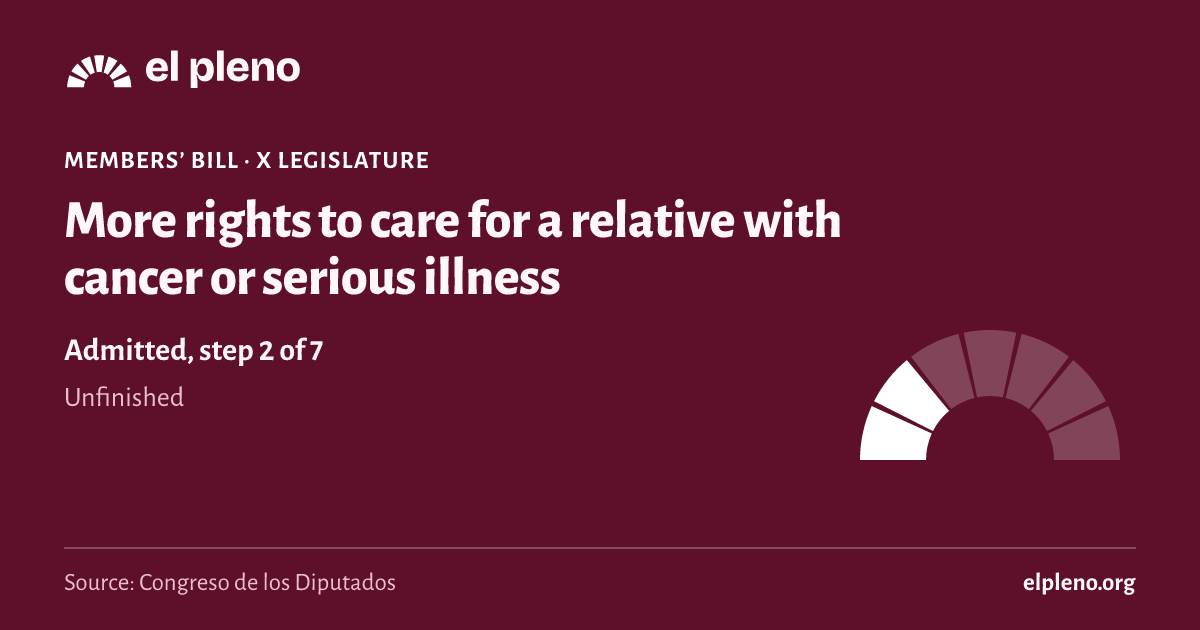
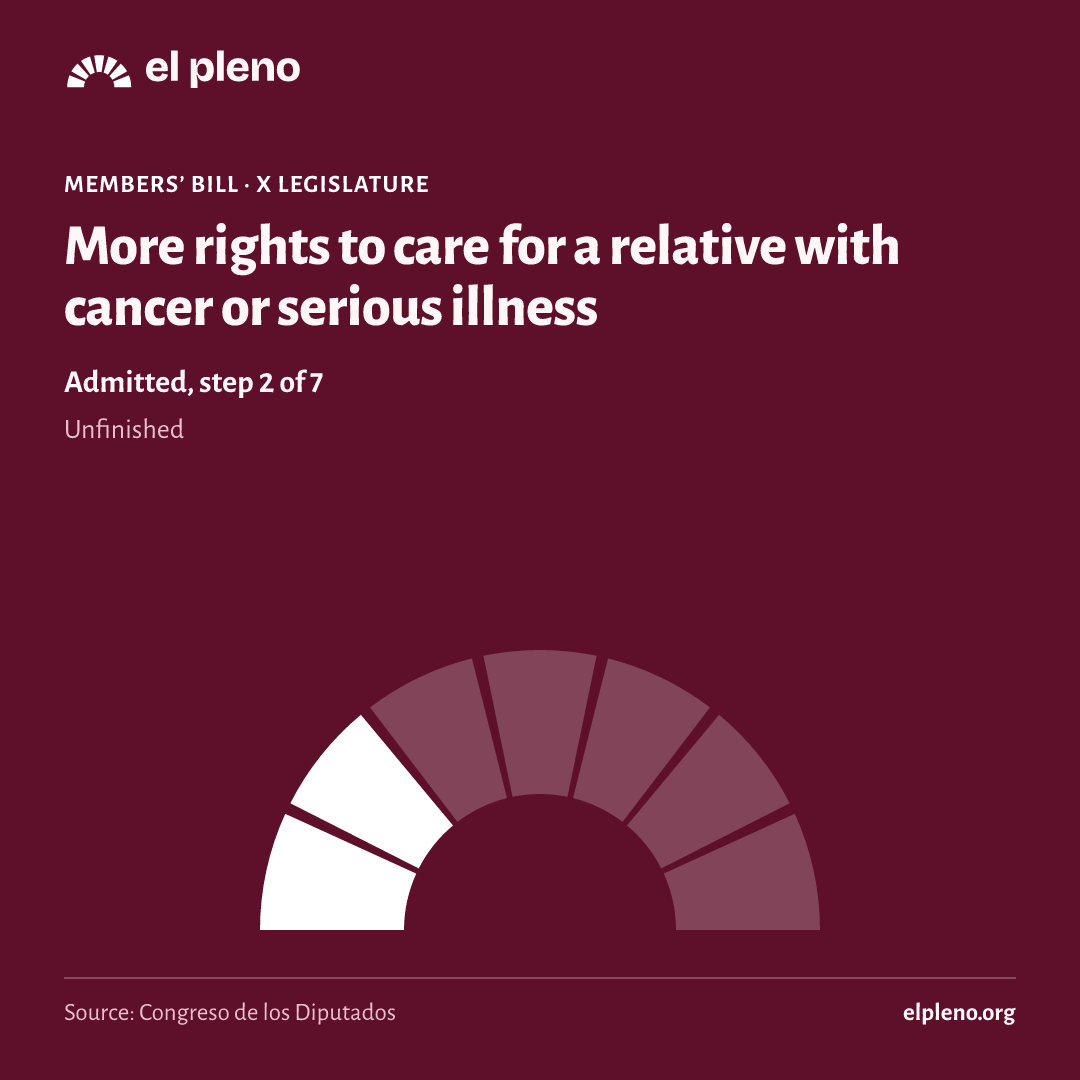
It took 2 of 7 steps. It reached Admitted, and today it is unfinished.
- Introduced2 December 2014Someone registers the text in the Congreso.
- Admitted9 December 2014The Bureau of the Congreso accepts it and, for a members’ bill, the plenary decides whether to consider it.
- Amendmentsnot reachedGroups propose changes.
- Committeenot reachedA committee goes through the text in detail.
- Plenarynot reachedAll 350 deputies vote.
- Senatenot reachedThe Senate can pass it, amend it or veto it.
- BOEnot reachedIt is published in the Official State Gazette (BOE) and comes into force.
See the 6 official steps on a timeline
Was there a plenary vote?
We have no plenary vote linked to this law in the Congreso’s data.
What happens next
What happens now?
The legislature ended before it finished. To go on, someone would have to introduce it again in the new Cortes.
It has not been presented again yet.
Sources
Where does all this come from?
- Congreso de los Diputados, file 122/000179
Official title, type, author, dates and stage.
Retrieved 11 November 2026
- The data comes from the open files of the Congreso, the Senate and the BOE, unaltered.
- Each deputy’s province is the one of their seat on the day of the vote.
- We only say “passed” or “rejected” when the majority needed is certain; otherwise we say which side had more votes.