What it is
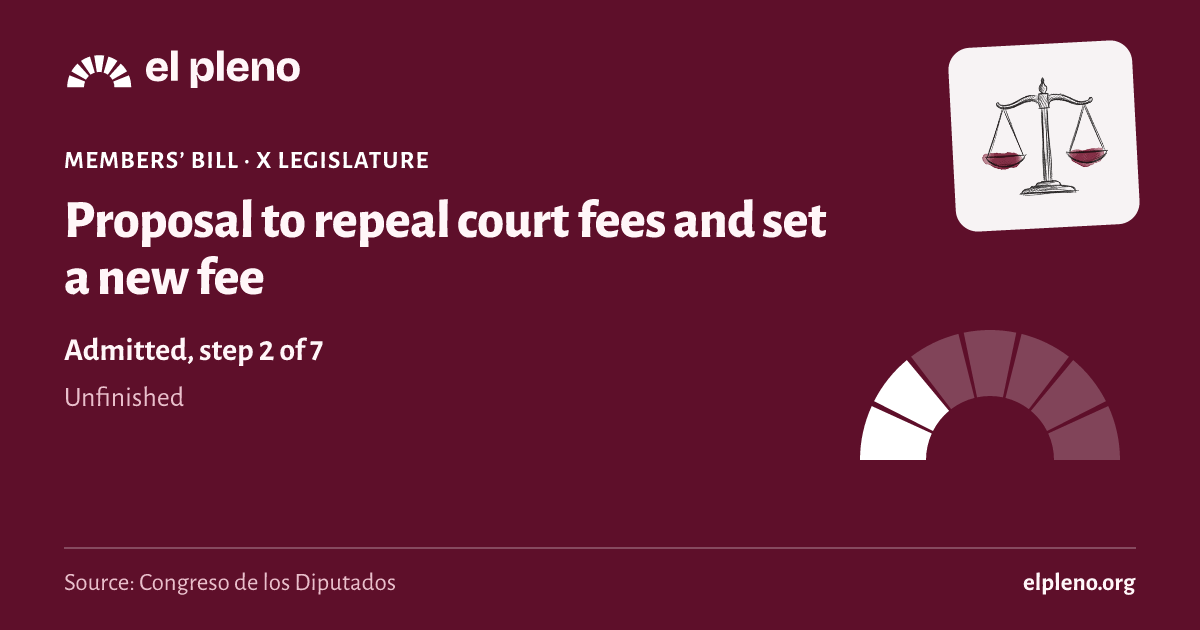
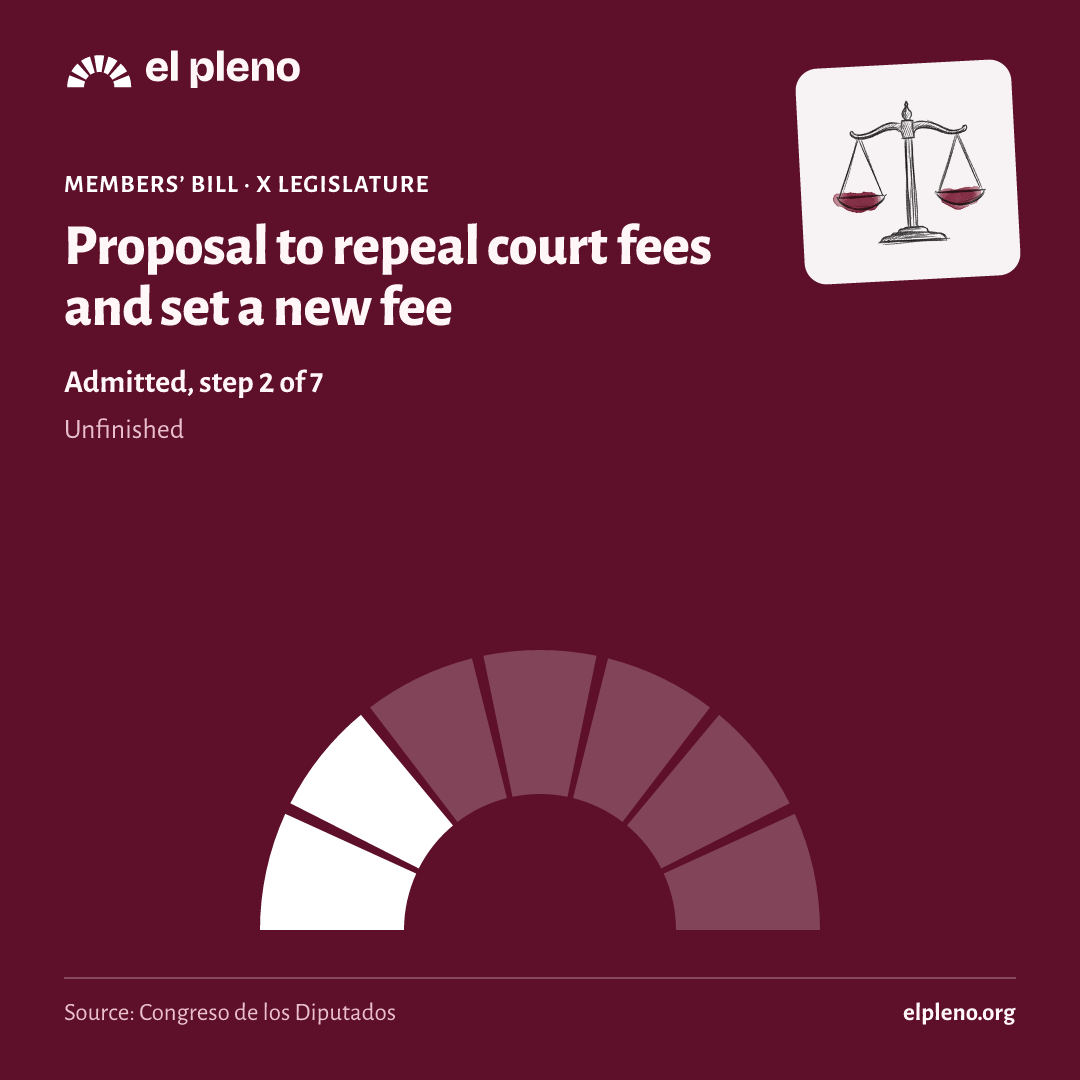
Proposal to repeal court fees and set a new fee
It is a members’ bill. Introduced by parliamentary groups, the Senate, regional governments or citizens. It was introduced on 24 November 2014. Introduced by: Grupo Parlamentario Socialista.
Official title: Private member's bill on the repeal of the court fees established by Law 10/2012, of 20 November.
Source: Congreso de los Diputados, file 122/000177· updated 11 Nov
Automatic summary, not yet reviewed
- The bill would repeal the court fees created by Law 10/2012 of November 20, and Article 1 of royal decree-law A rule with the force of law that the Government passes because it is urgent. It applies from its publication, but the Congreso must validate it within 30 days or it lapses. 3/2013, which amended them. The previous rules would be restored.
- The bill would create a new fee for going to court in civil and administrative litigation proceedings. It would be due when filing lawsuits and appeals, with a fixed amount depending on the type of case plus a percentage of the amount in dispute.
- Individuals, nonprofit entities and entities exempt from corporate income tax The personal income tax (IRPF in Spain): what people pay on what they earn from work, business or savings., among others, would be exempt from the new fee. Inheritance, family and civil status cases, and certain administrative appeals, would also be exempt.
- The bill would amend the Public Fees and Prices Law to include the exercise of judicial power as a feeable activity, and add a section to the Administrative Litigation Law on public employees appearing on their own behalf.
Who it affects
- People filing lawsuits or appeals in civil and administrative litigation: They would stop paying the Law 10/2012 fees but would pay the new proposed fee.
- Individuals: They would be exempt from the new fee.
- Nonprofits and entities exempt from corporate income tax: They would be exempt from the new fee.
- Consumers claiming small amounts: The explanatory statement criticizes the current fee for hurting them; repealing it would remove that obstacle.
- Public employees: They could appear on their own behalf to defend their statutory rights in personnel matters.
Words worth knowing
- Tasa judicial (court fee)
- Money paid to the State to file certain lawsuits or appeals in court.
- Tutela judicial efectiva (effective judicial protection)
- The constitutional right to go to court and get a ruling on your rights.
- Orden jurisdiccional (jurisdictional order)
- Each major branch of the justice system: civil, criminal, administrative litigation and labor.
- Contencioso-administrativo (administrative litigation)
- The courts that resolve disputes between citizens and public administrations.
- Devengo (accrual)
- The moment the obligation to pay the fee arises.
- royal decree-law
- A rule with the force of law that the Government passes because it is urgent. It applies from its publication, but the Congreso must validate it within 30 days or it lapses.
- decree-law
- A rule with the force of law that the Government passes because it is urgent. It applies from its publication, but the Congreso must validate it within 30 days or it lapses.
- income tax
- The personal income tax (IRPF in Spain): what people pay on what they earn from work, business or savings.
It summarizes the text as it was introduced. It is written by artificial intelligence and may contain mistakes: the official text is what counts. Read the official text · How we make summaries
Where it stands
How far did it get?
It took 2 of 7 steps. It reached Admitted, and today it is unfinished.
- Introduced24 November 2014Someone registers the text in the Congreso.
- Admitted3 December 2014The Bureau of the Congreso accepts it and, for a members’ bill, the plenary decides whether to consider it.
- Amendmentsnot reachedGroups propose changes.
- Committeenot reachedA committee goes through the text in detail.
- Plenarynot reachedAll 350 deputies vote.
- Senatenot reachedThe Senate can pass it, amend it or veto it.
- BOEnot reachedIt is published in the Official State Gazette (BOE) and comes into force.
See the 6 official steps on a timeline
Was there a plenary vote?
We have no plenary vote linked to this law in the Congreso’s data.
What happens next
What happens now?
The legislature ended before it finished. To go on, someone would have to introduce it again in the new Cortes.
It has not been presented again yet.
Sources
Where does all this come from?
- Congreso de los Diputados, file 122/000177
Official title, type, author, dates and stage.
Retrieved 11 November 2026
- The data comes from the open files of the Congreso, the Senate and the BOE, unaltered.
- Each deputy’s province is the one of their seat on the day of the vote.
- We only say “passed” or “rejected” when the majority needed is certain; otherwise we say which side had more votes.