What it is
Bill to make it easier to hire public research staff
It is a members’ bill. Introduced by parliamentary groups, the Senate, regional governments or citizens. It was introduced on 14 February 2014. Introduced by: Grupo Parlamentario Socialista.
Official title: Private member's bill on measures to promote the hiring of research staff.
Source: Congreso de los Diputados, file 122/000151· updated 11 Nov
Automatic summary, not yet reviewed
- The bill would extend the specific contract types for research staff to research centers and entities linked to or dependent on public universities, provided they receive funds intended for hiring researchers or for their own R&D programs.
- It would exclude research staff (researchers and technicians) hired under the Science Act from the maximum duration limits of project-based contracts when linked to a project lasting more than three years. It would also exclude them from the limits on chaining temporary contracts.
- The bill would extend the replacement rate up to a maximum of 10% to all research staff positions at public research organizations and universities.
- The bill would add entities such as the Prado Museum, the National Library of Spain, the Spanish Film Library and the royal academies as executing agents under the Science Act, allowing them to hire temporary research staff for specific projects.
Who it affects
- Research staff (researchers and technicians) hired in the public sector: Their hiring and job continuity could become easier, with less restrictive duration limits.
- Public universities and their linked or dependent research centers: They could use the specific contract types for research staff if they receive funds for that purpose.
- Public research organizations: The replacement rate for their research staff positions could reach 10%.
- Public sector foundations and consortia: The stated goal is to remove obstacles to their hiring of research staff.
- Museums, archives, the National Library, the Film Library and the royal academies: They would become executing agents and could hire temporary research staff for projects.
Words worth knowing
- Tasa de reposición (replacement rate)
- A rule limiting new public hiring: a position can only be filled if an equivalent one has been vacated. The bill would allow up to 10% new research positions.
- Contrato por obra o servicio (project-based contract)
- A temporary contract that lasts as long as a specific project or task.
- Encadenamiento de contratos (contract chaining)
- Keeping a worker on a series of consecutive temporary contracts; the law limits this practice.
- Agente de ejecución (executing agent)
- An entity allowed to carry out the activities of the Science Act and, in this case, to hire research staff.
- Proposición de ley (bill introduced by lawmakers)
- A text in the form of a law introduced by members of Congress (not the Government) that must still be debated and passed before it takes effect.
It summarizes the text as it was introduced. It is written by artificial intelligence and may contain mistakes: the official text is what counts. Read the official text · How we make summaries
Where it stands
How far did it get?
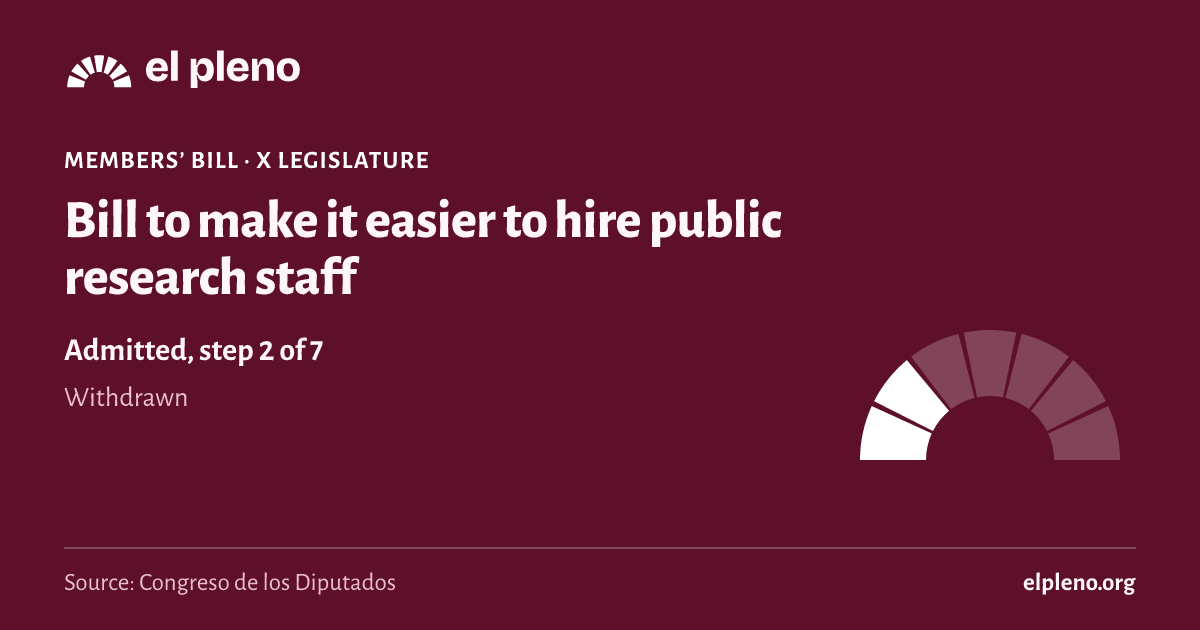
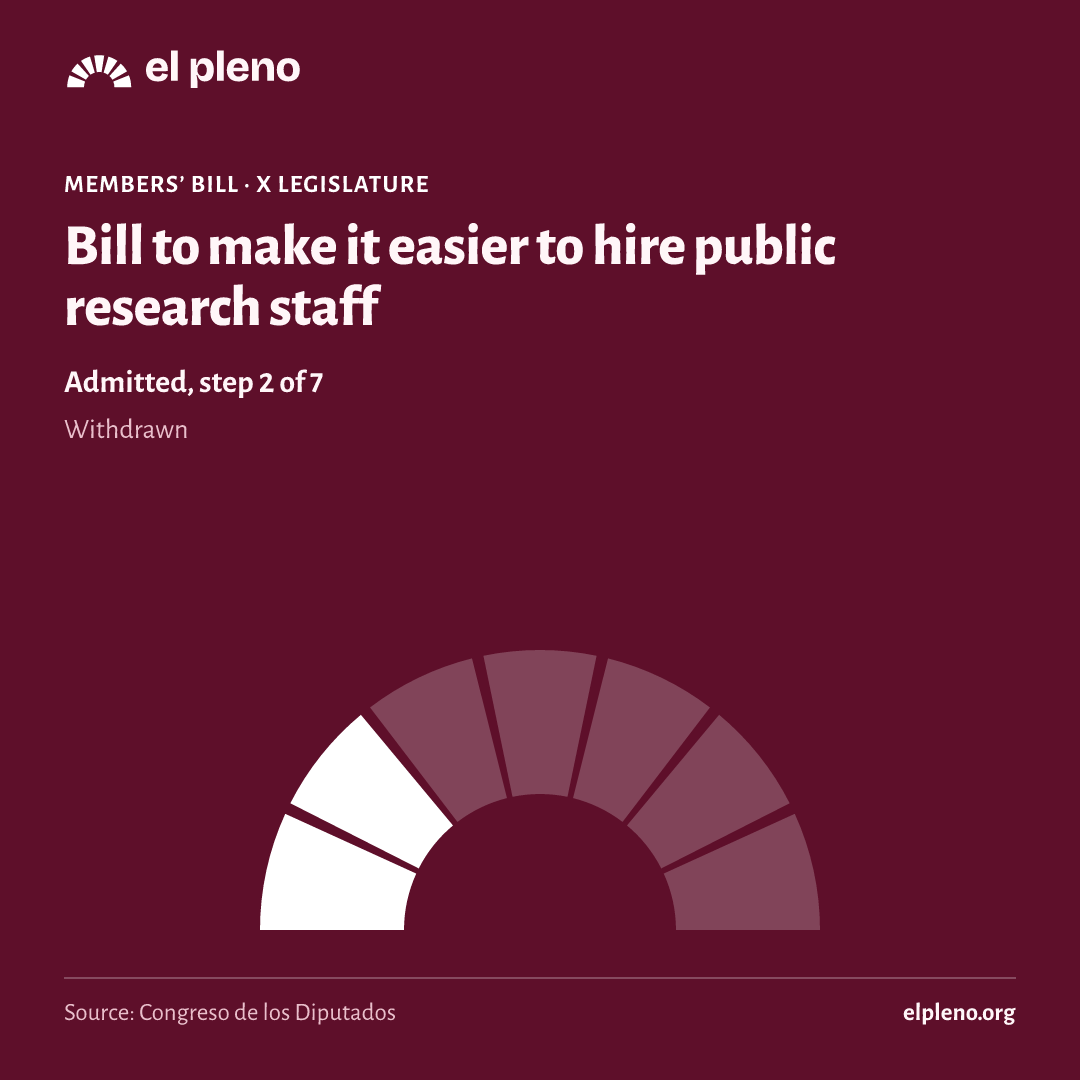
It took 2 of 7 steps. It reached Admitted, and today it is withdrawn.
- Introduced14 February 2014Someone registers the text in the Congreso.
- Admitted18 February 2014The Bureau of the Congreso accepts it and, for a members’ bill, the plenary decides whether to consider it.
- Amendmentsnot reachedGroups propose changes.
- Committeenot reachedA committee goes through the text in detail.
- Plenarynot reachedAll 350 deputies vote.
- Senatenot reachedThe Senate can pass it, amend it or veto it.
- BOEnot reachedIt is published in the Official State Gazette (BOE) and comes into force.
See the 5 official steps on a timeline
Was there a plenary vote?
We have no plenary vote linked to this law in the Congreso’s data.
What happens next
What happens now?
Whoever introduced it withdrew it, or it was merged into another one. It goes no further.
Sources
Where does all this come from?
- Congreso de los Diputados, file 122/000151
Official title, type, author, dates and stage.
Retrieved 11 November 2026
- The data comes from the open files of the Congreso, the Senate and the BOE, unaltered.
- Each deputy’s province is the one of their seat on the day of the vote.
- We only say “passed” or “rejected” when the majority needed is certain; otherwise we say which side had more votes.