What it is
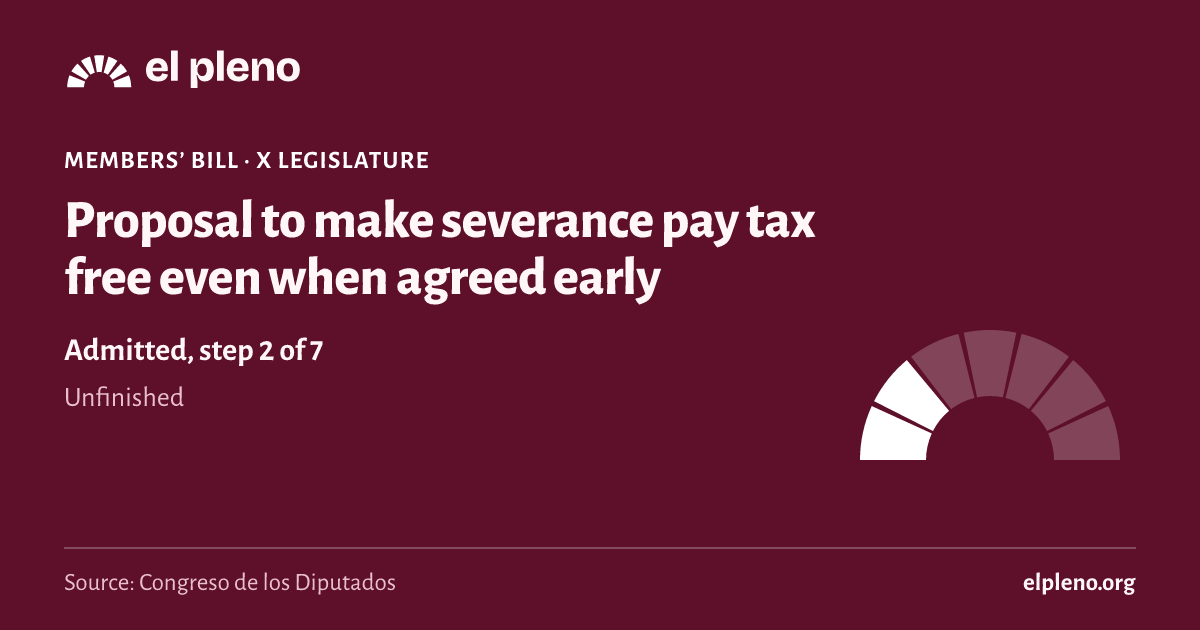
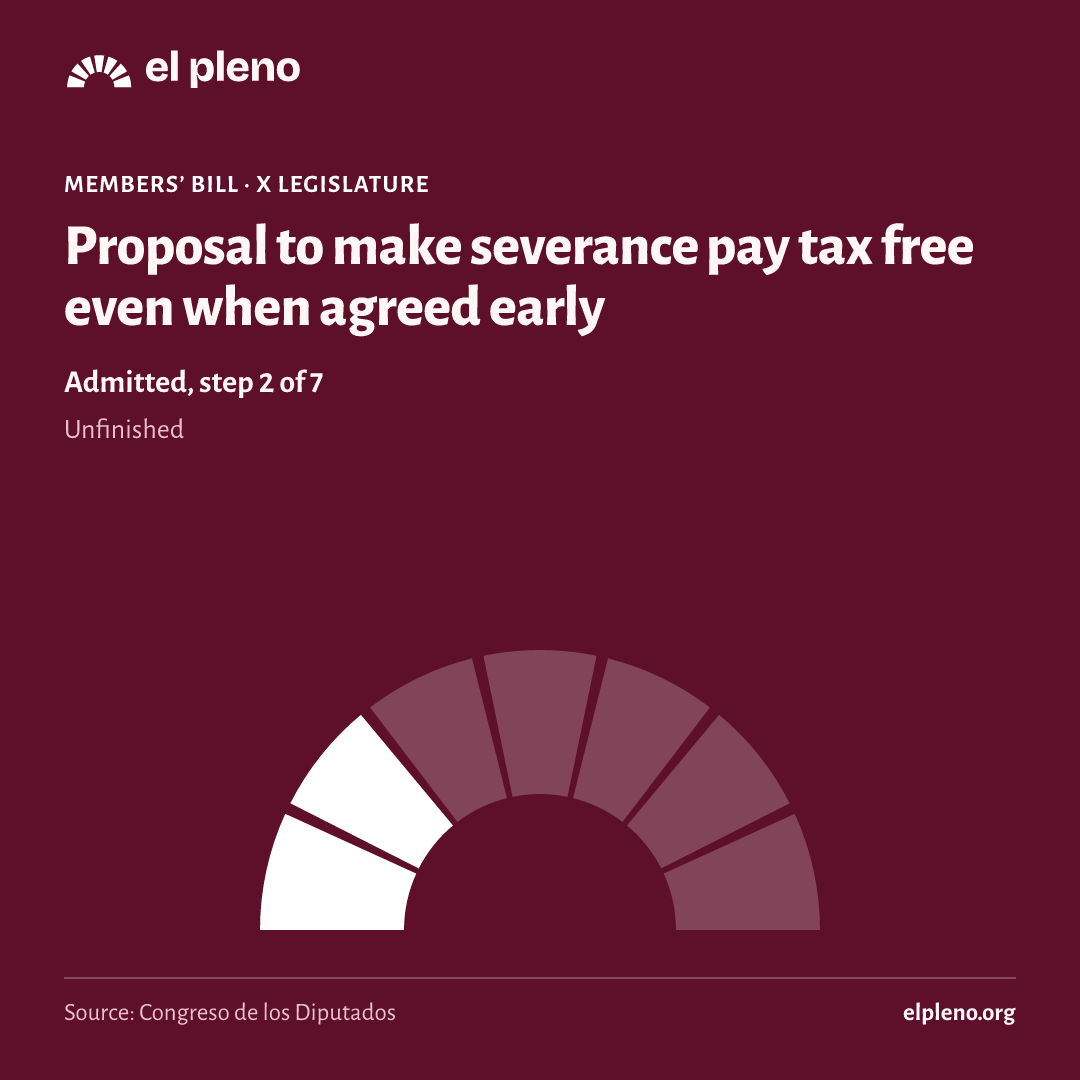
Proposal to make severance pay tax free even when agreed early
It is a members’ bill. Introduced by parliamentary groups, the Senate, regional governments or citizens. It was introduced on 13 February 2014. Introduced by: Grupo Parlamentario Catalán (Convergència i Unió).
Official title: Private member's bill to amend Law 35/2006, of November 28, on the Personal Income Tax, regarding the tax exemption of severance pay or dismissal compensation for workers.
Source: Congreso de los Diputados, file 122/000149· updated 11 Nov
Automatic summary, not yet reviewed
- The bill responds to a sharp rise in conciliation filings for dismissals ruled unfair since the 2012 labor reform. The current rule forces people to go through that step to get the tax exemption, even when the deal already existed, and it overwhelms the conciliation services.
- For that reason, the bill would restore the earlier wording of Article 7 e) of the Personal income tax The personal income tax (IRPF in Spain): what people pay on what they earn from work, business or savings. Law, so that severance pay for unfair dismissal is exempt even if the agreement is reached before the conciliation hearing, except for mutually agreed terminations.
- The proposed text would exempt from income tax severance pay up to the mandatory amount set in the Workers' Statute. If the contract ends before the conciliation hearing, severance is exempt as long as it does not exceed what an unfair dismissal would pay, except for collectively incentivized voluntary departures. It would also exempt the portion within those limits in collective dismissal proceedings or dismissals for economic, technical, organizational, production or force majeure reasons.
- If passed, the law would take effect the day after its publication in the Official State Gazette (Boletín Oficial del Estado).
Who it affects
- Dismissed workers: Dismissed workers: they could pay less income tax on their severance, even if the deal is closed before conciliation.
- Companies and lawyers: Companies and lawyers: they would avoid artificial conciliation steps.
- Mediation, Arbitration and Conciliation Services: The Mediation, Arbitration and Conciliation Services would stop receiving filings that are just a formality.
Words worth knowing
- IRPF
- Spanish personal income tax, paid on income such as wages or severance pay.
- Despido improcedente
- Unfair dismissal: a dismissal that does not meet legal requirements, so the company must pay severance.
- Acto de conciliación
- A pre-court hearing before a public service where employer and worker try to reach a settlement.
- Expediente de regulación de empleo
- A procedure by which a company, with government approval, ends employment contracts on a collective basis.
- Proposición de ley
- A bill introduced by a parliamentary group; it has no legal effect until passed.
- income tax
- The personal income tax (IRPF in Spain): what people pay on what they earn from work, business or savings.
It summarizes the text as it was introduced. It is written by artificial intelligence and may contain mistakes: the official text is what counts. Read the official text · How we make summaries
Where it stands
How far did it get?
It took 2 of 7 steps. It reached Admitted, and today it is unfinished.
- Introduced13 February 2014Someone registers the text in the Congreso.
- Admitted18 February 2014The Bureau of the Congreso accepts it and, for a members’ bill, the plenary decides whether to consider it.
- Amendmentsnot reachedGroups propose changes.
- Committeenot reachedA committee goes through the text in detail.
- Plenarynot reachedAll 350 deputies vote.
- Senatenot reachedThe Senate can pass it, amend it or veto it.
- BOEnot reachedIt is published in the Official State Gazette (BOE) and comes into force.
See the 6 official steps on a timeline
Was there a plenary vote?
We have no plenary vote linked to this law in the Congreso’s data.
What happens next
What happens now?
The legislature ended before it finished. To go on, someone would have to introduce it again in the new Cortes.
It has not been presented again yet.
Sources
Where does all this come from?
- Congreso de los Diputados, file 122/000149
Official title, type, author, dates and stage.
Retrieved 11 November 2026
- The data comes from the open files of the Congreso, the Senate and the BOE, unaltered.
- Each deputy’s province is the one of their seat on the day of the vote.
- We only say “passed” or “rejected” when the majority needed is certain; otherwise we say which side had more votes.