What it is
Proposal to stop the Amnesty Law from shielding Franco-era crimes
It is a members’ bill. Introduced by parliamentary groups, the Senate, regional governments or citizens. It was introduced on 30 January 2014. Introduced by: Grupo Parlamentario Mixto.
Official title: Private member's bill to amend Law 46/1977, of October 15, on Amnesty.
Source: Congreso de los Diputados, file 122/000142· updated 11 Nov
Automatic summary, not yet reviewed
- The bill would add a new article to the 1977 Amnesty Law so that it does not apply to crimes, murders, torture, genocide or crimes against humanity. Those cases would fall under international rules instead.
- The new article says that the definition of genocide and crimes against humanity, their universal scope and the fact that they never expire would follow international human rights law.
- The change would be retroactive: any administrative or judicial decision on these matters could be reviewed or reopened.
- The explanatory statement says the Amnesty Law was created to protect those who fought the dictatorship, but was later used to avoid prosecuting Franco-era crimes. It also notes that many victims seek justice abroad, such as through the lawsuit filed in Argentina.
Who it affects
- Victims and relatives of Franco-era crimes: They could seek justice in Spain, with cases reviewed or reopened.
- People convicted or shielded by the Amnesty Law for these crimes: They would lose that protection if the bill passes.
- Judges and courts: They could investigate and try these acts under international law.
Words worth knowing
- Ley de Amnistía (Amnesty Law)
- A 1977 law that pardons certain offenses committed before it took effect.
- Crímenes de lesa humanidad (crimes against humanity)
- Very serious crimes committed on a widespread scale against civilians, such as torture or murder.
- Imprescriptible (no statute of limitations)
- Crimes that can still be prosecuted no matter how much time has passed.
- Proposición de ley (bill)
- A text proposing a change to the law that still needs to be debated and passed by Congress.
It summarizes the text as it was introduced. It is written by artificial intelligence and may contain mistakes: the official text is what counts. Read the official text · How we make summaries
Where it stands
How far did it get?
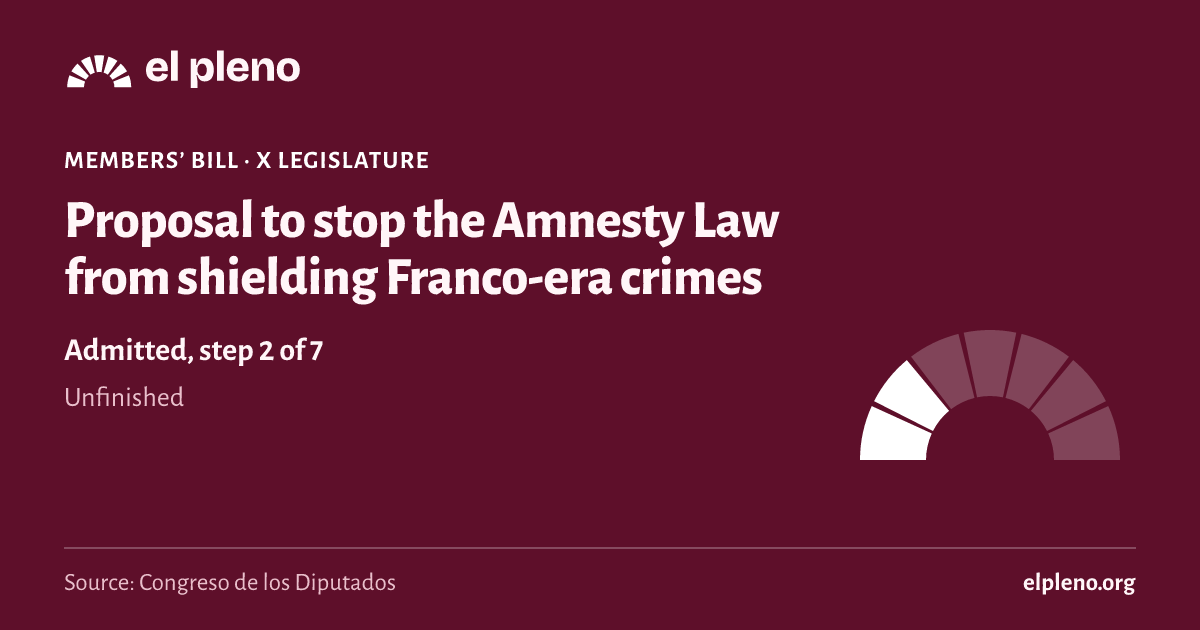
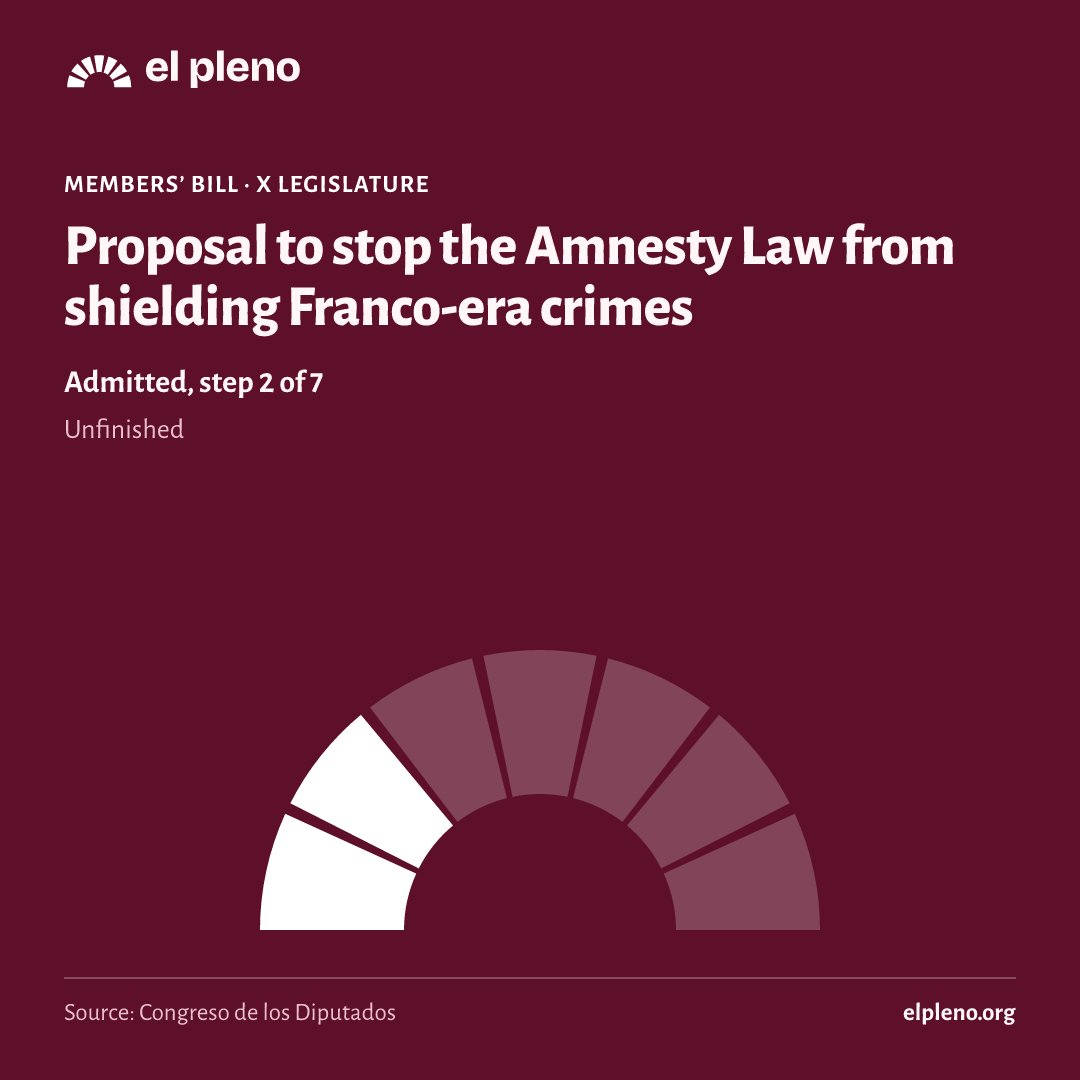
It took 2 of 7 steps. It reached Admitted, and today it is unfinished.
- Introduced30 January 2014Someone registers the text in the Congreso.
- Admitted4 February 2014The Bureau of the Congreso accepts it and, for a members’ bill, the plenary decides whether to consider it.
- Amendmentsnot reachedGroups propose changes.
- Committeenot reachedA committee goes through the text in detail.
- Plenarynot reachedAll 350 deputies vote.
- Senatenot reachedThe Senate can pass it, amend it or veto it.
- BOEnot reachedIt is published in the Official State Gazette (BOE) and comes into force.
See the 6 official steps on a timeline
Was there a plenary vote?
We have no plenary vote linked to this law in the Congreso’s data.
What happens next
What happens now?
The legislature ended before it finished. To go on, someone would have to introduce it again in the new Cortes.
It was presented again:
- XII Legislature, Congreso de los Diputados· Rejected Proposal so the Amnesty Law does not block trials for Franco-era crimes
Presented before in:
- IX Legislature, Congreso de los Diputados· Unfinished Private member's bill to amend Law 46/1977, of October 15, on Amnesty.
- IX Legislature, Congreso de los Diputados· Rejected Private member's bill to amend Law 46/1977, of October 15, on Amnesty.
Sources
Where does all this come from?
- Congreso de los Diputados, file 122/000142
Official title, type, author, dates and stage.
Retrieved 11 November 2026
- The data comes from the open files of the Congreso, the Senate and the BOE, unaltered.
- Each deputy’s province is the one of their seat on the day of the vote.
- We only say “passed” or “rejected” when the majority needed is certain; otherwise we say which side had more votes.