What it is
Proposal for a single permanent employment contract for everyone
It is a members’ bill. Introduced by parliamentary groups, the Senate, regional governments or citizens. It was introduced on 23 January 2014. Introduced by: Grupo Parlamentario de Unión Progreso y Democracia.
Official title: Private member's bill on the regulation of a single indefinite employment contract.
Source: Congreso de los Diputados, file 122/000138· updated 11 Nov
Automatic summary, not yet reviewed
- The bill, introduced by the Unión Progreso y Democracia party, would create a single permanent employment contract and eliminate all other types of contracts, except substitution contracts (interinidad, used to replace a worker entitled to keep their job).
- The single contract would carry a severance payment that grows with years worked: 12 days of salary for the first year, plus two more days per year of service up to a maximum of 24 days per year. If a dismissal is declared unfair, the payment would be 22 days for the first year, rising to 34 days per year with a cap of 24 months of salary.
- The contract could include an objective ground for ending it tied to the completion of a specific work project or service, which must be stated in writing and allowed by the collective agreement. That ground could not be used beyond two years, extendable by twelve more months by agreement.
- The single contract could start with a trial period (for people with a degree or a professional certificate) or a training period, with rules on length, pay and limits. Once the period ends, the general rules of the single contract would apply and the time would count toward seniority.
- Part-time contracts would be adapted to the single contract: they must be in writing, part-time workers would have the same rights as full-time workers (proportional to hours worked), and switching between full-time and part-time would always be voluntary for the worker.
- Labor inspection would be strengthened: its violation reports finding a contract set up in fraud of the law could be directly enforced at the worker's request. In addition, contracts with a project-completion ground would pay an extra two percentage points of Social Security contributions to fund unemployment benefits, and collaboration work lasting more than six months a year with fake self-employed workers would be presumed to be employment.
Words worth knowing
- Interinidad (substitution contract)
- A contract to replace a worker who is entitled to keep their job while absent.
- Indemnización por despido (severance pay)
- Money the company pays the worker when the contract ends.
- Convenio colectivo (collective agreement)
- An agreement negotiated by unions and employers that sets working conditions for a sector or company.
- Certificado de profesionalidad (professional certificate)
- An official document proving a person is qualified to do a specific trade or job.
- Falso autónomo (fake self-employed worker)
- Someone registered as self-employed who actually works for a company like an employee.
It summarizes the text as it was introduced. It is written by artificial intelligence and may contain mistakes: the official text is what counts. Read the official text · How we make summaries
Where it stands
How far did it get?
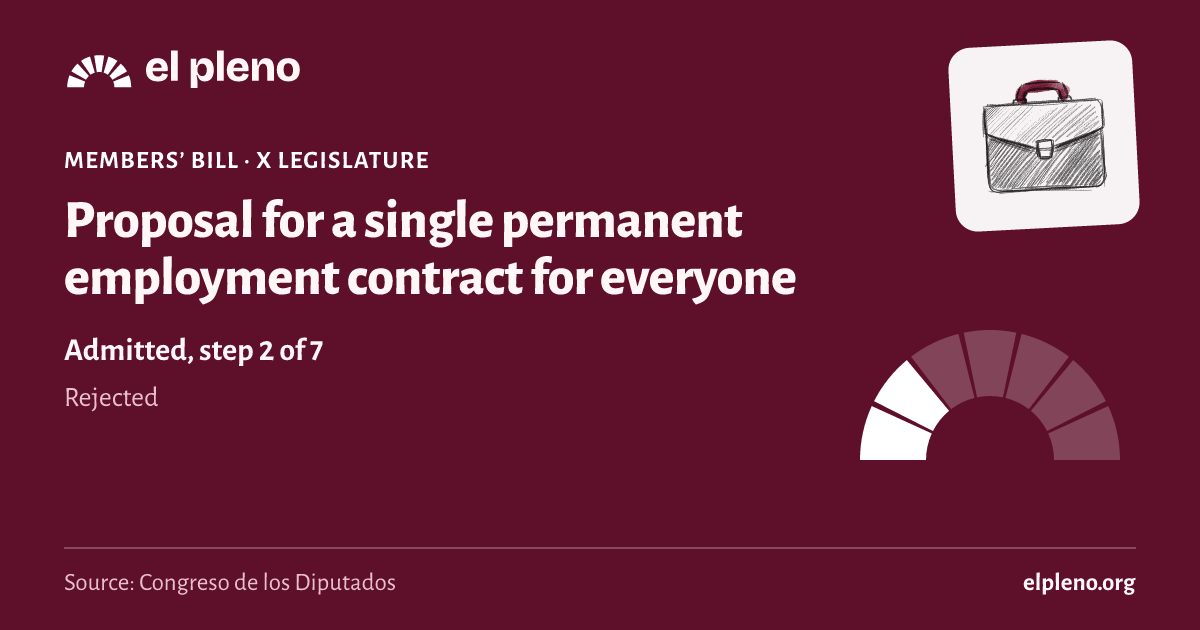
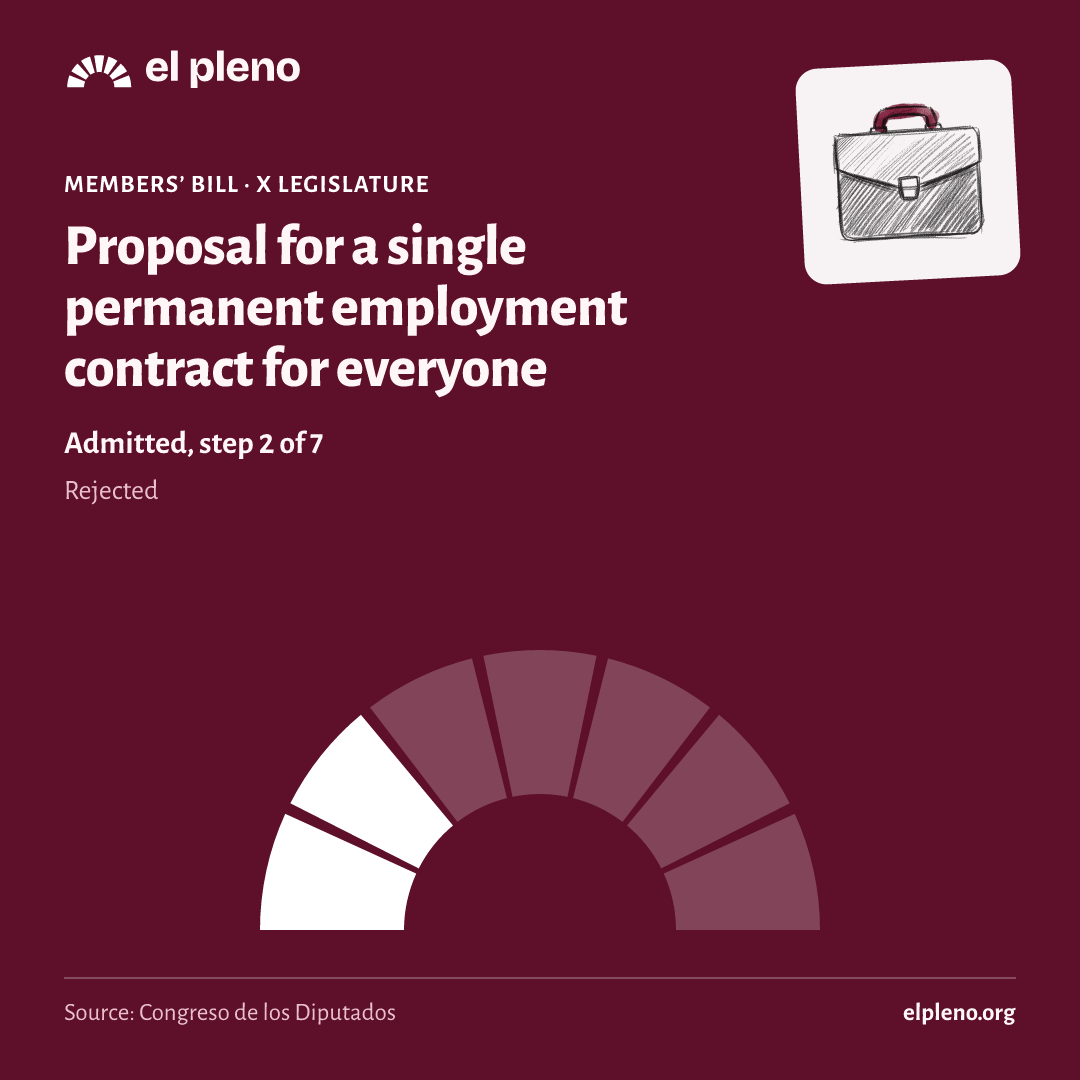
It took 2 of 7 steps. It reached Admitted, and today it is rejected.
- Introduced23 January 2014Someone registers the text in the Congreso.
- Admitted28 January 2014The Bureau of the Congreso accepts it and, for a members’ bill, the plenary decides whether to consider it.
- Amendmentsnot reachedGroups propose changes.
- Committeenot reachedA committee goes through the text in detail.
- Plenarynot reachedAll 350 deputies vote.
- Senatenot reachedThe Senate can pass it, amend it or veto it.
- BOEnot reachedIt is published in the Official State Gazette (BOE) and comes into force.
See the 6 official steps on a timeline
18 March 2014
How did the plenary vote?
Voted on: Private member's bill by the Unión Progreso y Democracia Parliamentary Group, on the regulation of a single indefinite employment contract.
Source: Congreso de los Diputados, vote 1 of sitting 176· updated 10 Nov
Each dot is a seat. Tap one, or use the arrow keys, to see who it is.
Your province
How did the deputies from your province vote?
And your senators: the Senate does not link its votes to this law in its open data, so we cannot put them side by side here.
Or see how most of each province voted
- A Coruña More votes against 0 yes · 7 no
- Albacete More votes against 0 yes · 4 no
- Alicante/Alacant More votes against 0 yes · 11 no
- Almería More votes against 0 yes · 6 no
- Araba/Álava More votes against 0 yes · 3 no
- Asturias More votes against 0 yes · 6 no · 1 abst.
- Ávila More votes against 0 yes · 3 no
- Badajoz More votes against 0 yes · 5 no
- Barcelona More votes against 0 yes · 27 no
- Bizkaia More votes against 0 yes · 6 no
- Burgos More votes against 0 yes · 4 no
- Cáceres More votes against 0 yes · 4 no
- Cádiz More votes against 0 yes · 7 no
- Cantabria More votes against 0 yes · 5 no
- Castellón/Castelló More votes against 0 yes · 5 no
- Ceuta More votes against 0 yes · 1 no
- Ciudad Real More votes against 0 yes · 5 no
- Córdoba More votes against 0 yes · 6 no
- Cuenca More votes against 0 yes · 3 no
- Gipuzkoa More votes against 0 yes · 5 no
- Girona More votes against 0 yes · 6 no
- Granada More votes against 0 yes · 7 no
- Guadalajara More votes against 0 yes · 3 no
- Huelva More votes against 0 yes · 4 no
- Huesca More votes against 0 yes · 3 no
- Illes Balears More votes against 0 yes · 8 no
- Jaén More votes against 0 yes · 5 no
- La Rioja More votes against 0 yes · 4 no
- Las Palmas More votes against 0 yes · 6 no
- León More votes against 0 yes · 5 no
- Lleida More votes against 0 yes · 4 no
- Lugo More votes against 0 yes · 4 no
- Madrid More votes against 4 yes · 22 no
- Málaga More votes against 0 yes · 9 no
- Melilla No count 0 yes · 0 no
- Murcia More votes against 0 yes · 10 no
- Navarra More votes against 0 yes · 2 no · 1 abst.
- Ourense More votes against 0 yes · 4 no
- Palencia More votes against 0 yes · 3 no
- Pontevedra More votes against 0 yes · 5 no
- Salamanca More votes against 0 yes · 4 no
- Santa Cruz de Tenerife More votes against 0 yes · 7 no
- Segovia More votes against 0 yes · 3 no
- Sevilla More votes against 0 yes · 11 no
- Soria More votes against 0 yes · 2 no
- Tarragona More votes against 0 yes · 6 no
- Teruel More votes against 0 yes · 3 no
- Toledo More votes against 0 yes · 5 no
- Valencia/València More votes against 1 yes · 12 no
- Valladolid More votes against 0 yes · 5 no
- Zamora More votes against 0 yes · 3 no
- Zaragoza More votes against 0 yes · 7 no
More details: how each group and each province voted
The groups
Who voted in favour and who against?
In favour, most of GUPyD. Against, most of Socialista, Vasco (EAJ-PNV), Mixto, GC-CiU, GIP and Popular en el Congreso. 2 deputies voted differently from their group.
By province: in 0 most voted in favour; in 51, against.
Coloured by how most of each province’s deputies voted.
- In favour: 0
- Against: 51
| Group | Seats | How it voted |
|---|---|---|
| Socialista | 110 | 96 against · 14 did not vote |
| Vasco (EAJ-PNV) | 5 | 5 against |
| Mixto | 18 | 11 against · 2 abst. · 5 did not vote |
| GC-CiU | 16 | 14 against · 2 did not vote |
| GIP | 11 | 9 against · 2 did not vote |
| GUPyD | 5 | 5 in favour |
| Popular en el Congreso | 185 | 170 against · 15 did not vote |
What happens next
What happens now?
It goes no further. A similar one could be introduced later.
Sources
Where does all this come from?
- Congreso de los Diputados, file 122/000138
Official title, type, author, dates and stage.
Retrieved 11 November 2026
- Congreso de los Diputados, vote 1 of sitting 176
The count and every seat’s vote.
Retrieved 10 November 2026
- The data comes from the open files of the Congreso, the Senate and the BOE, unaltered.
- Each deputy’s province is the one of their seat on the day of the vote.
- We only say “passed” or “rejected” when the majority needed is certain; otherwise we say which side had more votes.