What it is
Bill to help people who cannot pay their debts
It is a members’ bill. Introduced by parliamentary groups, the Senate, regional governments or citizens. It was introduced on 5 December 2013. Introduced by: Grupo Parlamentario Socialista.
Official title: Private member's bill on measures for personal insolvency and protection against over-indebtedness.
Source: Congreso de los Diputados, file 122/000131· updated 11 Nov
Automatic summary, not yet reviewed
- The bill would create an out-of-court procedure, before a notary, so that an individual overindebted for reasons beyond their control can negotiate a payment agreement with creditors before going to court.
- Overindebtedness would mean current or imminent insolvency, using more than 50% of household income to pay debts, or having lost one's home through foreclosure while still owing the mortgage holder. Objective causes would include unemployment, precarious work, disability, and separation, divorce or the death of a spouse.
- The debtor would file a request with a notary listing income, expenses, assets and creditors. The notary would review the case, notify creditors and, if the case proceeds, prepare a financial recovery plan with payment proposals. The agreement must be authorized within three months at most.
- Once the procedure starts, lawsuits and enforcement actions against the debtor's assets and guarantors would be suspended, and the debtor could not take on new credit without the notary's approval. The agreement would bind creditors if those representing more than 50% of the debt join, and could include debt forgiveness, payment deferrals and interest reductions.
- If the agreement fails, the case would go to court. A judge could impose a payment plan with installments, interest reductions, suspension of guarantees and debt forgiveness, and even release the debtor from unpaid debt three to five years later, with the release revocable in cases of bad faith.
- To make access cheaper, the bill would waive court fees, cut notary fees by 50%, and require credit institutions in which the FROB Fondo de Reestructuración Ordenada Bancaria, a public fund that holds stakes in credit institutions. holds a stake to negotiate and join the notarial agreement.
Who it affects
- Individual consumers and self-employed people with debts caused by events beyond their control, such as unemployment or divorce.: They could renegotiate their debts before a notary and, if that fails, use a court procedure with payment relief.
- Creditors, including banks and credit institutions.: They would have to negotiate, with enforcement suspended and possible debt forgiveness.
- Guarantors and cosigners.: The suspension would also apply to them, but only regarding their primary home.
- Credit institutions with FROB participation.: They would be required to negotiate and join the notarial agreement.
Words worth knowing
- Sobreendeudamiento (overindebtedness)
- Current or imminent insolvency, or using more than half of household income to pay debts.
- Convenio (agreement)
- An agreement between the debtor and creditors on how debts will be paid.
- Concurso de acreedores (creditors' insolvency proceeding)
- A court procedure to distribute the assets of someone who cannot pay their debts among all creditors.
- Garantía real (secured guarantee)
- An asset, such as a home, pledged to secure a debt that can be seized if the debt is not paid.
- FROB
- Fondo de Reestructuración Ordenada Bancaria, a public fund that holds stakes in credit institutions.
It summarizes the text as it was introduced. It is written by artificial intelligence and may contain mistakes: the official text is what counts. Read the official text · How we make summaries
Where it stands
How far did it get?
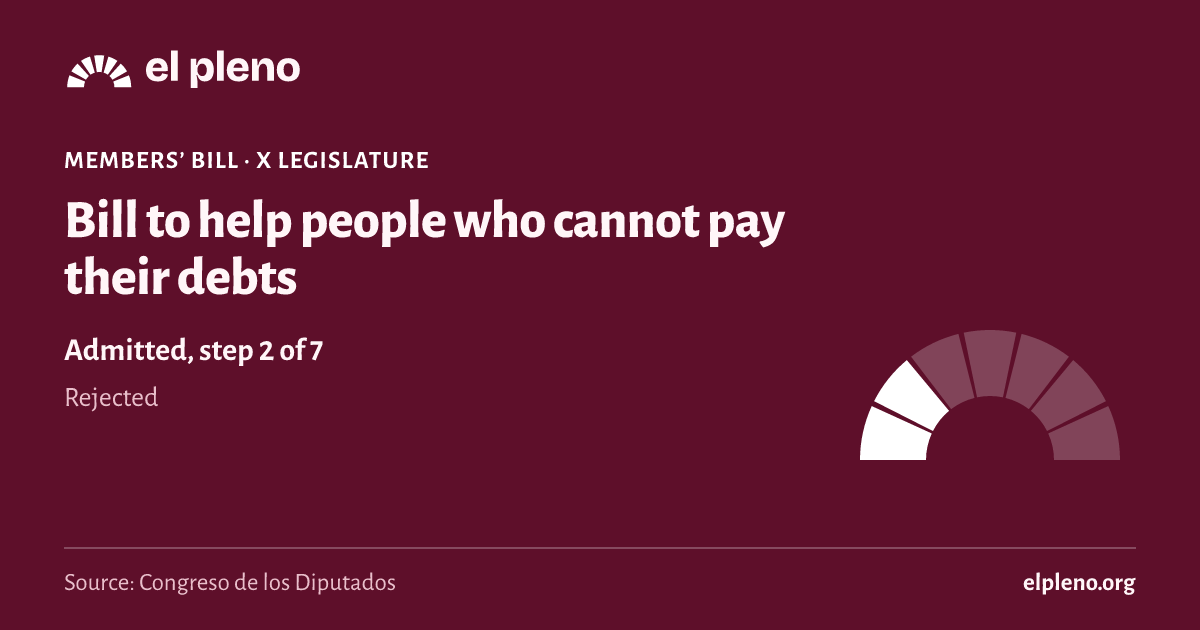
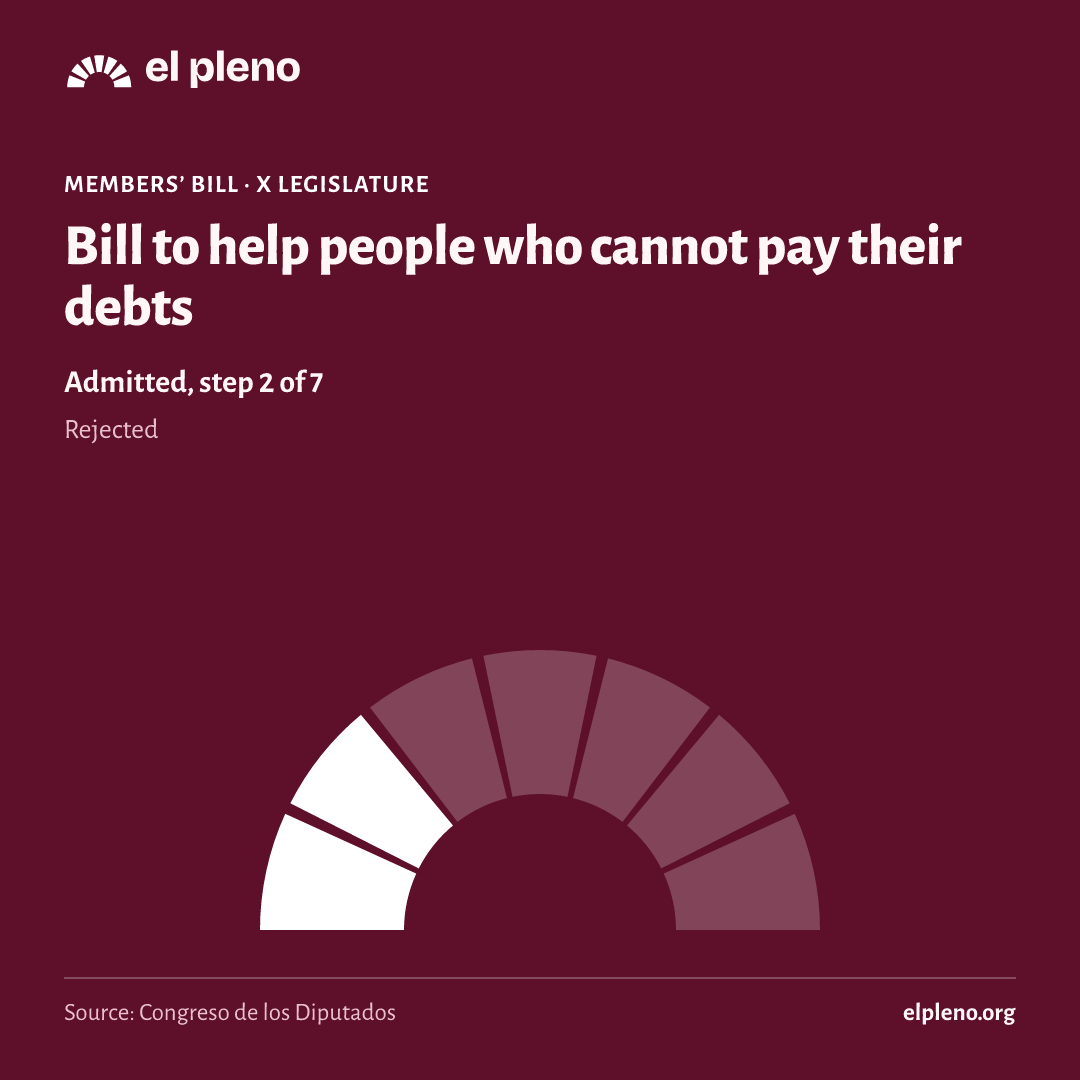
It took 2 of 7 steps. It reached Admitted, and today it is rejected.
- Introduced5 December 2013Someone registers the text in the Congreso.
- Admitted10 December 2013The Bureau of the Congreso accepts it and, for a members’ bill, the plenary decides whether to consider it.
- Amendmentsnot reachedGroups propose changes.
- Committeenot reachedA committee goes through the text in detail.
- Plenarynot reachedAll 350 deputies vote.
- Senatenot reachedThe Senate can pass it, amend it or veto it.
- BOEnot reachedIt is published in the Official State Gazette (BOE) and comes into force.
See the 6 official steps on a timeline
24 June 2014
How did the plenary vote?
Voted on: Private member's bill by the Socialist Parliamentary Group, on measures regarding personal insolvency and protection against over-indebtedness.
Source: Congreso de los Diputados, vote 1 of sitting 193· updated 10 Nov
Each dot is a seat. Tap one, or use the arrow keys, to see who it is.
Your province
How did the deputies from your province vote?
And your senators: the Senate does not link its votes to this law in its open data, so we cannot put them side by side here.
Or see how most of each province voted
- A Coruña More votes against 3 yes · 5 no
- Albacete More votes against 1 yes · 3 no
- Alicante/Alacant More votes against 3 yes · 8 no
- Almería More votes against 1 yes · 3 no
- Araba/Álava More votes in favour 2 yes · 1 no
- Asturias More votes in favour 4 yes · 3 no
- Ávila More votes against 1 yes · 2 no
- Badajoz More votes against 2 yes · 4 no
- Barcelona More votes in favour 19 yes · 6 no · 1 abst.
- Bizkaia More votes in favour 5 yes · 1 no
- Burgos More votes against 1 yes · 3 no
- Cáceres Tie 2 yes · 2 no
- Cádiz More votes against 3 yes · 4 no
- Cantabria More votes against 1 yes · 4 no
- Castellón/Castelló More votes against 2 yes · 3 no
- Ceuta More votes against 0 yes · 1 no
- Ciudad Real More votes against 1 yes · 3 no
- Córdoba Tie 3 yes · 3 no
- Cuenca More votes against 1 yes · 2 no
- Gipuzkoa More votes in favour 4 yes · 1 no
- Girona More votes in favour 3 yes · 1 no
- Granada More votes against 3 yes · 4 no
- Guadalajara More votes against 1 yes · 2 no
- Huelva More votes against 1 yes · 2 no
- Huesca More votes against 1 yes · 2 no
- Illes Balears More votes against 3 yes · 5 no
- Jaén More votes in favour 3 yes · 2 no
- La Rioja More votes against 1 yes · 3 no
- Las Palmas More votes against 2 yes · 4 no
- León More votes against 2 yes · 3 no
- Lleida More votes in favour 3 yes · 1 no
- Lugo More votes against 0 yes · 3 no
- Madrid More votes against 13 yes · 14 no
- Málaga More votes against 4 yes · 6 no
- Melilla More votes against 0 yes · 1 no
- Murcia More votes against 2 yes · 8 no
- Navarra More votes in favour 4 yes · 1 no
- Ourense More votes against 1 yes · 3 no
- Palencia More votes against 1 yes · 2 no
- Pontevedra Tie 3 yes · 3 no
- Salamanca More votes against 0 yes · 3 no
- Santa Cruz de Tenerife More votes against 3 yes · 4 no
- Segovia More votes against 1 yes · 2 no
- Sevilla More votes in favour 7 yes · 4 no
- Soria Tie 1 yes · 1 no
- Tarragona More votes in favour 4 yes · 2 no
- Teruel Tie 1 yes · 1 no
- Toledo More votes against 1 yes · 3 no
- Valencia/València More votes against 6 yes · 7 no
- Valladolid More votes against 2 yes · 3 no
- Zamora More votes against 1 yes · 2 no
- Zaragoza More votes against 3 yes · 4 no
More details: how each group and each province voted
The groups
Who voted in favour and who against?
In favour, most of Socialista, Vasco (EAJ-PNV), Mixto, GC-CiU, GIP and GUPyD. Against, most of Popular en el Congreso. 1 deputy voted differently from their group.
By province: in 11 most voted in favour; in 36, against.
Coloured by how most of each province’s deputies voted.
- In favour: 11
- Against: 36
- Tie: 5
| Group | Seats | How it voted |
|---|---|---|
| Socialista | 110 | 93 in favour · 1 abst. · 16 did not vote |
| Vasco (EAJ-PNV) | 5 | 5 in favour |
| Mixto | 18 | 13 in favour · 5 did not vote |
| GC-CiU | 16 | 13 in favour · 3 did not vote |
| GIP | 11 | 11 in favour |
| GUPyD | 5 | 5 in favour |
| Popular en el Congreso | 185 | 168 against · 17 did not vote |
What happens next
What happens now?
It goes no further. A similar one could be introduced later.
Sources
Where does all this come from?
- Congreso de los Diputados, file 122/000131
Official title, type, author, dates and stage.
Retrieved 11 November 2026
- Congreso de los Diputados, vote 1 of sitting 193
The count and every seat’s vote.
Retrieved 10 November 2026
- The data comes from the open files of the Congreso, the Senate and the BOE, unaltered.
- Each deputy’s province is the one of their seat on the day of the vote.
- We only say “passed” or “rejected” when the majority needed is certain; otherwise we say which side had more votes.