What it is
Proposal so disability does not block getting Spanish nationality
It is a members’ bill. Introduced by parliamentary groups, the Senate, regional governments or citizens. It was introduced on 5 December 2013. Introduced by: Grupo Parlamentario Socialista.
Official title: Private member's bill on measures to guarantee equality and non-discrimination in access to nationality by residence for persons with disabilities.
Source: Congreso de los Diputados, file 122/000130· updated 11 Nov
Automatic summary, not yet reviewed
- The bill would add a provision to the General Law on the Rights of Persons with Disabilities so that people with disabilities can obtain Spanish nationality on equal terms, and so that no requirement that discriminates because of disability would apply.
- The new rule would also apply to residence-based nationality applications pending at any stage when the law takes effect.
- Applications denied in the previous two years for reasons related, directly or indirectly, to the applicant's disability would be urgently reviewed by the authorities on their own initiative.
- The law would take effect on the same day it is published in the Official State Gazette (Boletín Oficial del Estado).
Who it affects
- People with disabilities applying for Spanish nationality by residence: They could obtain it on equal terms, without requirements that discriminate against them.
- People whose nationality application was denied in the previous two years because of their disability: Their files would be urgently reviewed by the authorities on their own initiative.
- Applicants with pending nationality files: The rule would also apply to their applications even if already underway.
Words worth knowing
- Nacionalidad por residencia
- A way to get Spanish nationality after living legally in Spain for a period of time.
- Expediente
- The file or set of steps the Administration opens to process an application.
- Revisar de oficio
- The Administration reviews the matter on its own initiative, without anyone asking.
- Disposición adicional
- A section added at the end of a law to regulate a specific point.
It summarizes the text as it was introduced. It is written by artificial intelligence and may contain mistakes: the official text is what counts. Read the official text · How we make summaries
Where it stands
How far did it get?
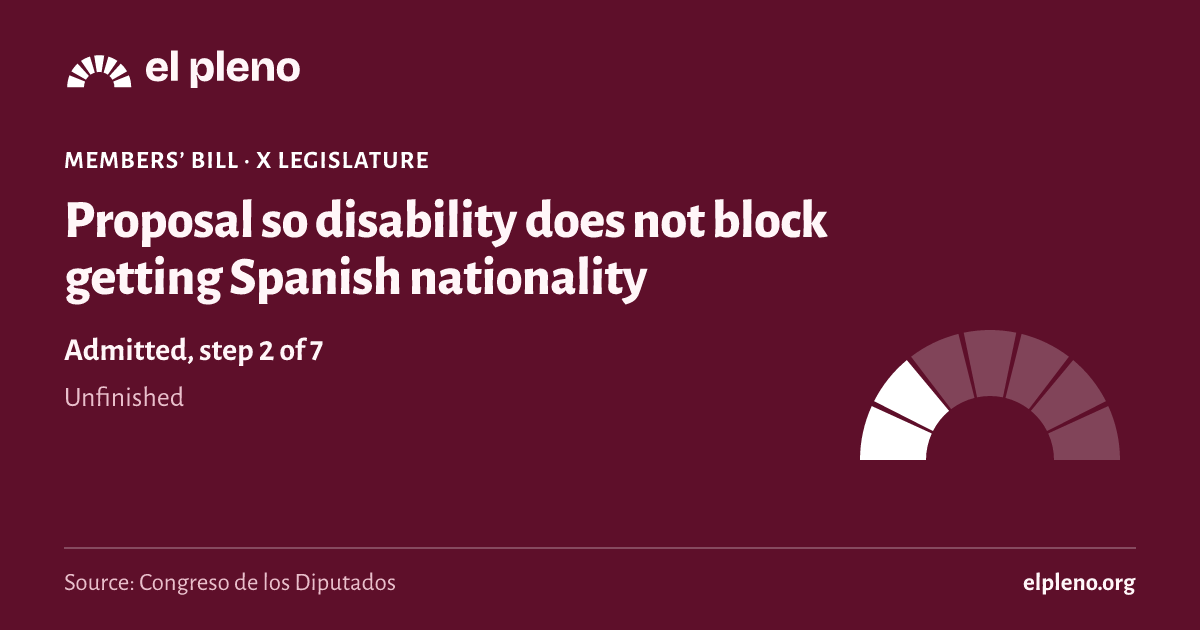
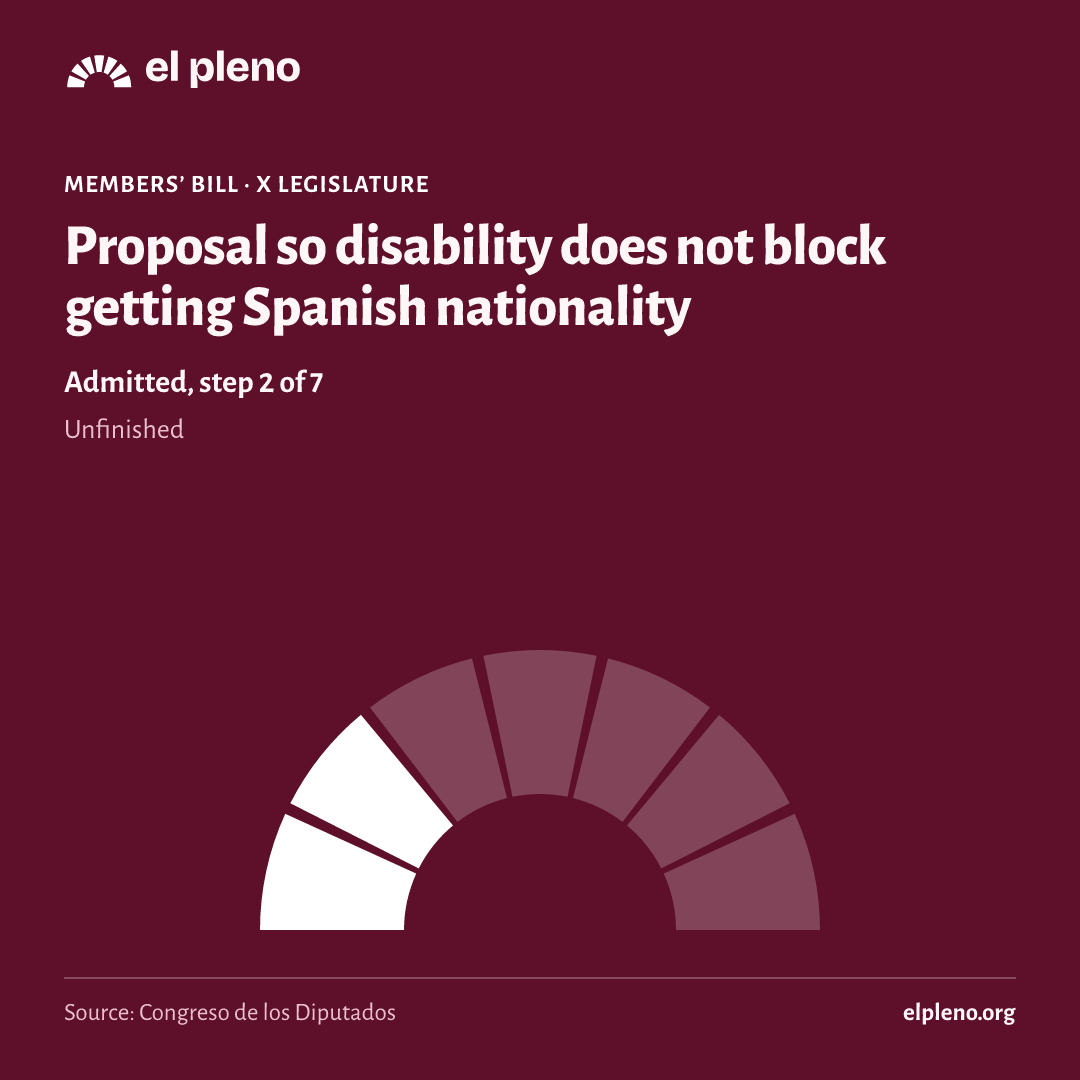
It took 2 of 7 steps. It reached Admitted, and today it is unfinished.
- Introduced5 December 2013Someone registers the text in the Congreso.
- Admitted10 December 2013The Bureau of the Congreso accepts it and, for a members’ bill, the plenary decides whether to consider it.
- Amendmentsnot reachedGroups propose changes.
- Committeenot reachedA committee goes through the text in detail.
- Plenarynot reachedAll 350 deputies vote.
- Senatenot reachedThe Senate can pass it, amend it or veto it.
- BOEnot reachedIt is published in the Official State Gazette (BOE) and comes into force.
See the 6 official steps on a timeline
Was there a plenary vote?
We have no plenary vote linked to this law in the Congreso’s data.
What happens next
What happens now?
The legislature ended before it finished. To go on, someone would have to introduce it again in the new Cortes.
It has not been presented again yet.
Sources
Where does all this come from?
- Congreso de los Diputados, file 122/000130
Official title, type, author, dates and stage.
Retrieved 11 November 2026
- The data comes from the open files of the Congreso, the Senate and the BOE, unaltered.
- Each deputy’s province is the one of their seat on the day of the vote.
- We only say “passed” or “rejected” when the majority needed is certain; otherwise we say which side had more votes.