What it is
Bill would exempt foreign public pensions from Spanish income tax The personal income tax (IRPF in Spain): what people pay on what they earn from work, business or savings.
It is a members’ bill. Introduced by parliamentary groups, the Senate, regional governments or citizens. It was introduced on 21 October 2013. Introduced by: Grupo Parlamentario Mixto.
Official title: Private member's bill to reform Law 35/2006, of November 28, on the Personal Income Tax and partial amendment of the laws on the Corporate Tax, regarding the taxation of public pensions received by returned emigrants from States with which there is a double taxation agreement.
Source: Congreso de los Diputados, file 122/000120· updated 11 Nov
Automatic summary, not yet reviewed
- The bill adds an income tax exemption for public pensions received from abroad, when the paying country has a treaty with Spain to avoid double taxation and grants reciprocal tax treatment. The origin of the contributions to the pension system would not matter.
- It also changes the duty to file a tax return: people whose only income is public pensions from those States, under 22,000 euros a year and with withholding applied, would be treated the same as other taxpayers with pensions from several payers.
- The exemption would apply retroactively for four years, even if a final administrative decision already exists. The Tax Agency would have to reverse its decisions and penalties within three months and refund the money collected.
- The law would take effect on the day of its publication in the Official State Gazette, with the retroactivity set out in the additional provision.
Who it affects
- Returned emigrants receiving public pensions from abroad: They would no longer pay Spanish income tax on those pensions if a double taxation treaty exists, and could recover amounts paid over the last four years.
- People receiving pensions from several payers under 22,000 euros a year: They would share a common threshold for the duty to file, even if the pensions come from different payers.
- People who paid income tax on these pensions and faced penalties: The Tax Agency would have to reverse its decisions and refund the payments within three months.
Words worth knowing
- Doble imposición (double taxation)
- When the same income, such as a pension, is taxed in two countries at once. Treaties prevent this.
- Exención (exemption)
- Income that does not have to be declared or taxed under income tax.
- Resolución administrativa firme (final administrative decision)
- A decision by the administration that can no longer be challenged through the usual channels.
- Intereses de demora (late payment interest)
- An extra amount charged when money is paid late.
- Revocar (revoke)
- To cancel a previous decision made by the administration.
- income tax
- The personal income tax (IRPF in Spain): what people pay on what they earn from work, business or savings.
It summarizes the text as it was introduced. It is written by artificial intelligence and may contain mistakes: the official text is what counts. Read the official text · How we make summaries
Where it stands
How far did it get?
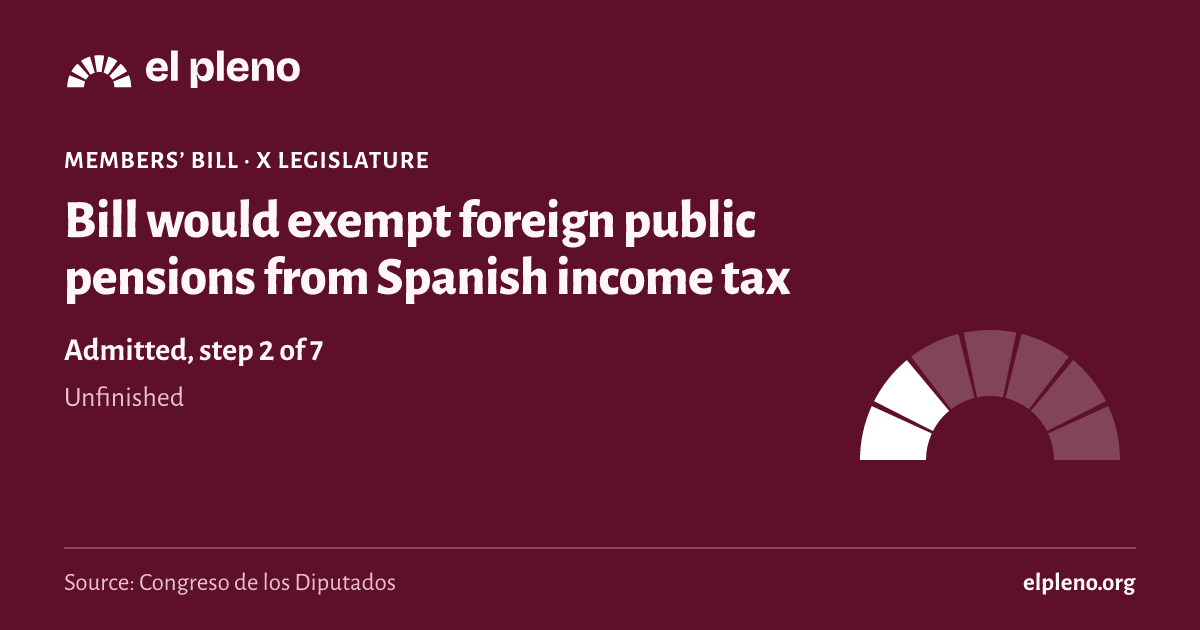
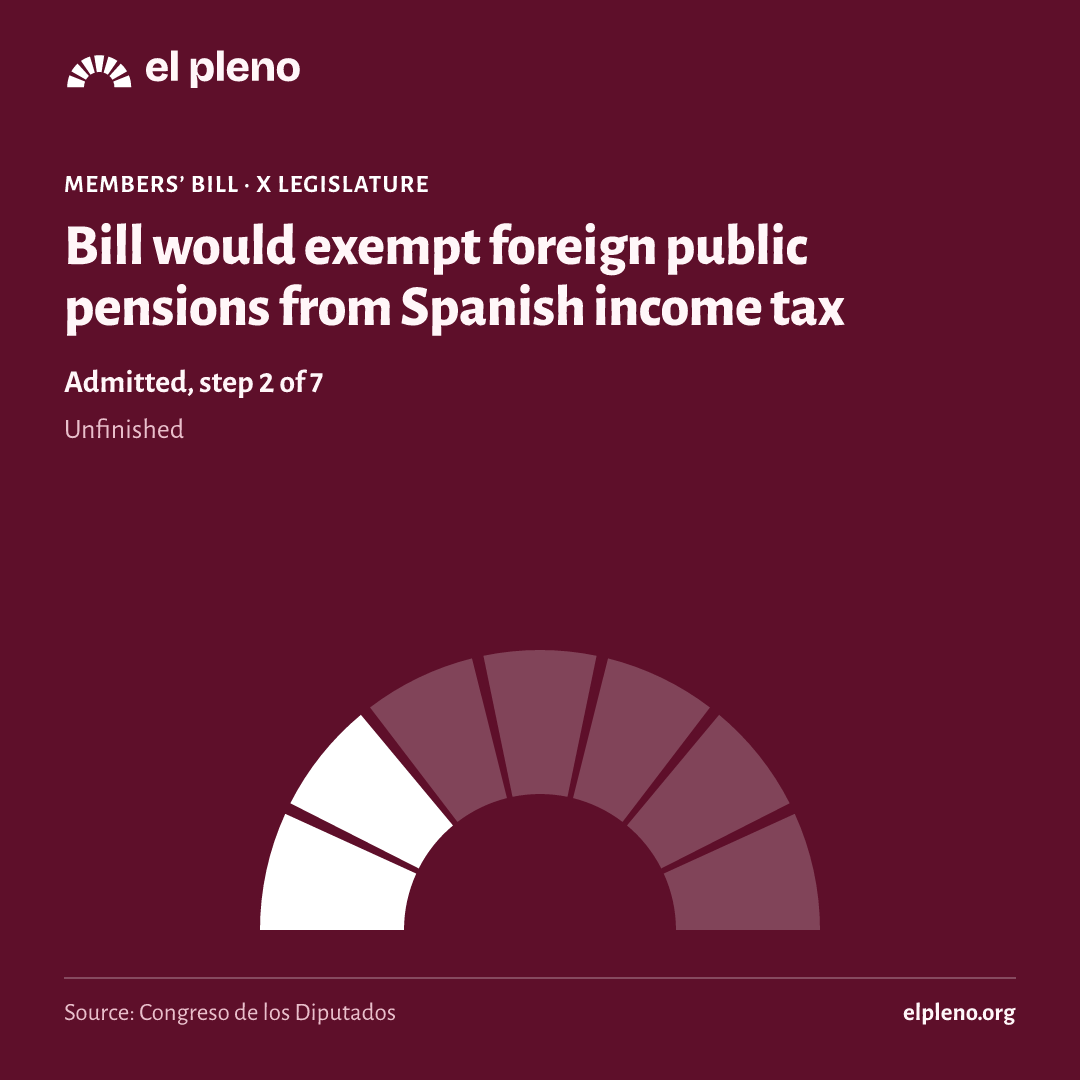
It took 2 of 7 steps. It reached Admitted, and today it is unfinished.
- Introduced21 October 2013Someone registers the text in the Congreso.
- Admitted29 October 2013The Bureau of the Congreso accepts it and, for a members’ bill, the plenary decides whether to consider it.
- Amendmentsnot reachedGroups propose changes.
- Committeenot reachedA committee goes through the text in detail.
- Plenarynot reachedAll 350 deputies vote.
- Senatenot reachedThe Senate can pass it, amend it or veto it.
- BOEnot reachedIt is published in the Official State Gazette (BOE) and comes into force.
See the 6 official steps on a timeline
Was there a plenary vote?
We have no plenary vote linked to this law in the Congreso’s data.
What happens next
What happens now?
The legislature ended before it finished. To go on, someone would have to introduce it again in the new Cortes.
It has not been presented again yet.
Sources
Where does all this come from?
- Congreso de los Diputados, file 122/000120
Official title, type, author, dates and stage.
Retrieved 11 November 2026
- The data comes from the open files of the Congreso, the Senate and the BOE, unaltered.
- Each deputy’s province is the one of their seat on the day of the vote.
- We only say “passed” or “rejected” when the majority needed is certain; otherwise we say which side had more votes.