What it is
Bill would give women an ultrasound before deciding on abortion
It is a members’ bill. Introduced by parliamentary groups, the Senate, regional governments or citizens. It was introduced on 2 October 2013. Introduced by: Grupo Parlamentario Mixto.
Official title: Organic private member's bill to amend Organic Law 2/2010, of March 3, on Sexual and Reproductive Health and Voluntary Interruption of Pregnancy.
Source: Congreso de los Diputados, file 122/000117· updated 11 Nov
Automatic summary, not yet reviewed
- The bill would add, to the information already given to women considering an abortion, a sealed envelope containing an ultrasound image of the fetus. This information would be provided at public health centers or at accredited abortion centers.
- The explanatory statement argues that the image of the unborn completes the information the mother, and where applicable the father, receive before deciding. It relies on a 2009 opinion by the Council of State (Consejo de Estado) calling for information aimed at protecting motherhood.
- The Government would have two months to issue the rules needed to implement the law, including the content and format of the information.
- The law would take effect the day after its publication in the Official State Gazette (Boletín Oficial del Estado).
Who it affects
- Women considering ending their pregnancy: They would receive, in addition to current information, a sealed envelope with an ultrasound image.
- Public health centers and accredited abortion centers: They would hand over this information and a document recording the delivery date.
- The Government: It would have to regulate within two months how this information is prepared, its content and its format.
Words worth knowing
- Proposición de Ley Orgánica
- A bill to amend a law affecting fundamental rights. Introduced by members of Congress, it is not an approved law.
- Nasciturus
- Latin term used to refer to the fetus, the unborn human being.
- Dictamen del Consejo de Estado
- An opinion issued by this advisory body when the Government asks it to review a draft bill.
- Sistema de plazos
- A system allowing abortion freely within set weeks of pregnancy; the text mentions the first 14 weeks.
It summarizes the text as it was introduced. It is written by artificial intelligence and may contain mistakes: the official text is what counts. Read the official text · How we make summaries
Where it stands
How far did it get?
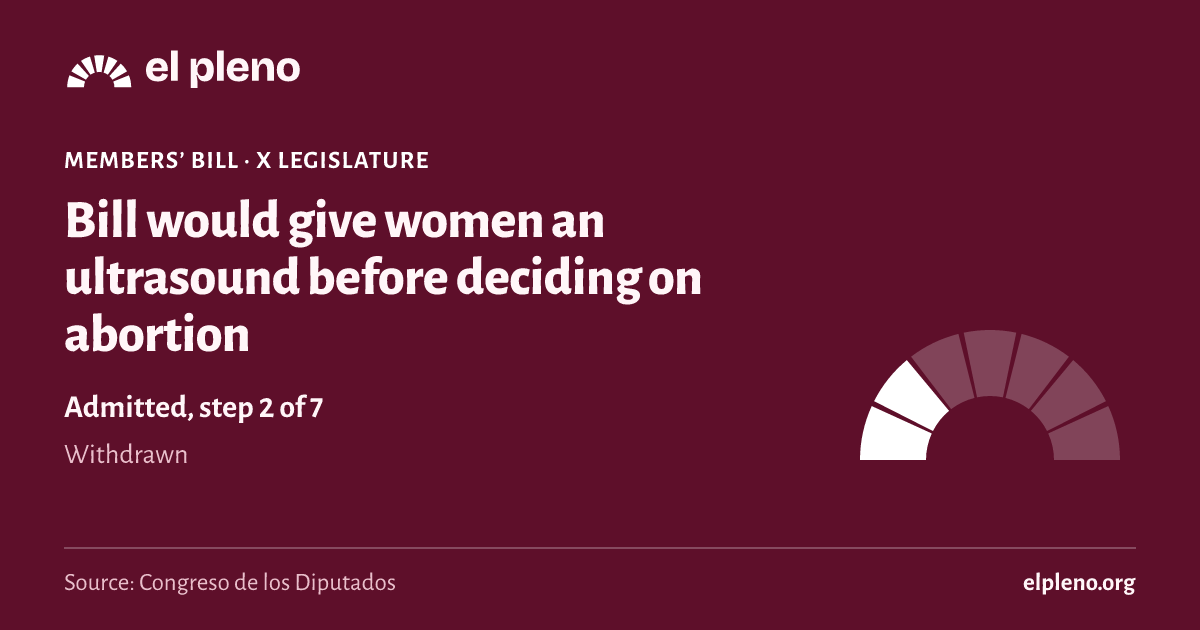
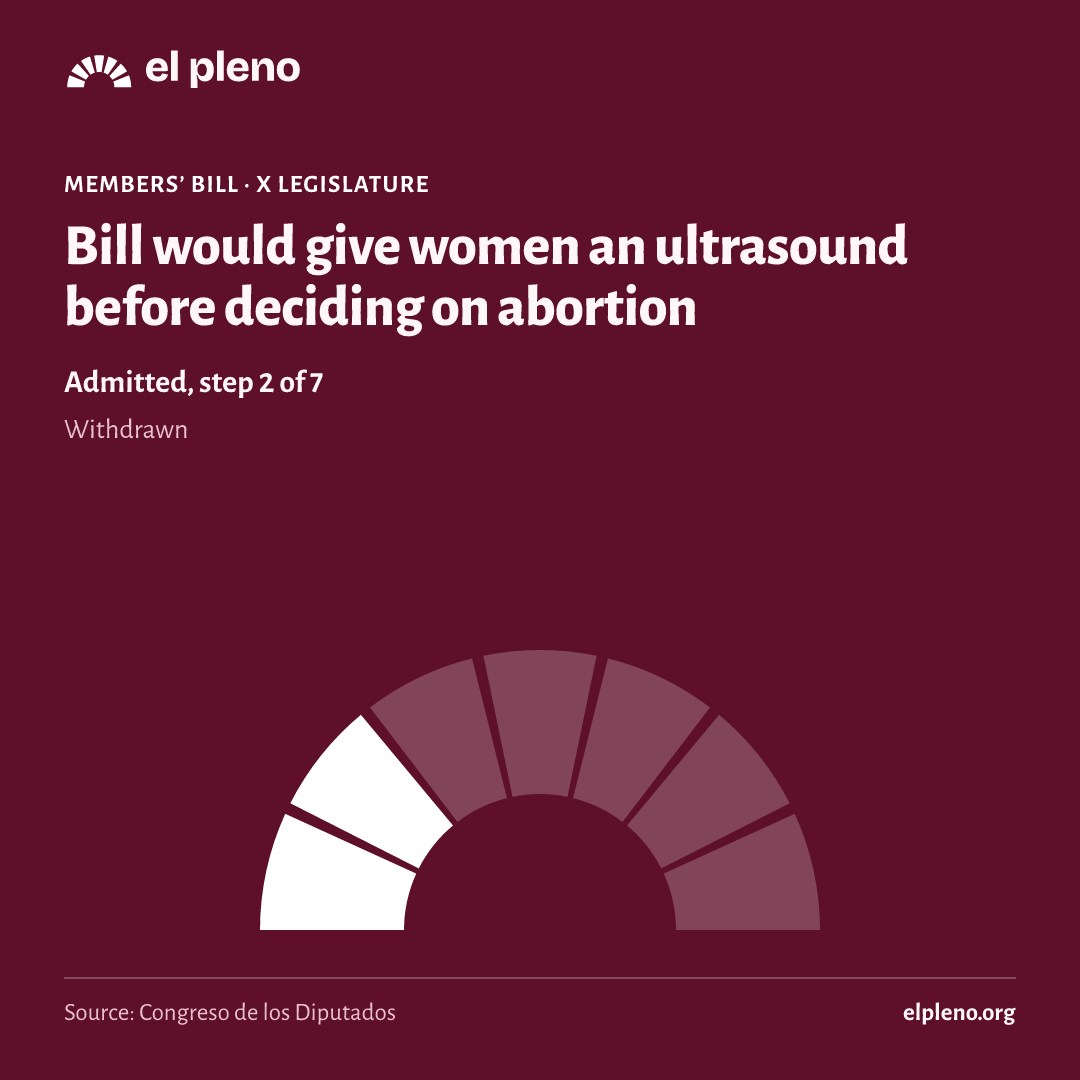
It took 2 of 7 steps. It reached Admitted, and today it is withdrawn.
- Introduced2 October 2013Someone registers the text in the Congreso.
- Admitted8 October 2013The Bureau of the Congreso accepts it and, for a members’ bill, the plenary decides whether to consider it.
- Amendmentsnot reachedGroups propose changes.
- Committeenot reachedA committee goes through the text in detail.
- Plenarynot reachedAll 350 deputies vote.
- Senatenot reachedThe Senate can pass it, amend it or veto it.
- BOEnot reachedIt is published in the Official State Gazette (BOE) and comes into force.
See the 6 official steps on a timeline
Was there a plenary vote?
We have no plenary vote linked to this law in the Congreso’s data.
What happens next
What happens now?
Whoever introduced it withdrew it, or it was merged into another one. It goes no further.
Sources
Where does all this come from?
- Congreso de los Diputados, file 122/000117
Official title, type, author, dates and stage.
Retrieved 11 November 2026
- The data comes from the open files of the Congreso, the Senate and the BOE, unaltered.
- Each deputy’s province is the one of their seat on the day of the vote.
- We only say “passed” or “rejected” when the majority needed is certain; otherwise we say which side had more votes.