What it is
Bill proposes tougher punishment for political corruption
It is a members’ bill. Introduced by parliamentary groups, the Senate, regional governments or citizens. It was introduced on 2 September 2013. Introduced by: Grupo Parlamentario Socialista.
Official title: Private member's organic bill to reform the Penal Code.
Source: Congreso de los Diputados, file 122/000112· updated 11 Nov
Automatic summary, not yet reviewed
- The bill would extend the time limits for prosecuting crimes such as bribery, embezzlement or abuse of office when public officials are involved. Prescription means a crime can no longer be punished after a certain time passes.
- It would add four new crimes related to political party funding: falsifying party accounts, hiding evidence of those crimes, repeatedly accepting illegal donations or failing to file accounts, and making donations that break the funding law.
- The bill would bring back the pre-2012 version of the tax fraud offense, so that anyone who regularizes their tax situation before the tax authorities come after them would be exempt from criminal liability. The threshold for the crime would be 50,000 euros.
- It would create a new crime of unjustified enrichment: a public official whose wealth grows during their time in office and who cannot explain where the money came from could face six months to one year in prison and a fine.
Who it affects
- Public officials and civil servants: They could face longer prosecution periods and a new crime if they cannot justify the origin of their wealth.
- Party representatives and managers: New prison terms and fines for falsifying accounts, accepting illegal donations or failing to file accounts.
- Individuals or companies donating to parties: They could be punished for donations that break the party funding law.
- Tax fraudsters: They could avoid punishment if they regularize their situation in time, but the crime applies above 50,000 euros.
Words worth knowing
- Prescripción (prescription)
- A crime can no longer be prosecuted after a set period of time has passed since it was committed.
- Prevaricación (abuse of office)
- When a judge or public official knowingly issues unfair rulings or decisions.
- Cohecho (bribery)
- When an official asks for or accepts gifts or money in exchange for doing or not doing something in their position.
- Malversación de caudales públicos (embezzlement of public funds)
- When an official uses public money for purposes other than those it was allocated for.
- Hacienda Pública (Public Treasury)
- The income and spending of the state, regional governments and local councils, in other words, everyone's money.
It summarizes the text as it was introduced. It is written by artificial intelligence and may contain mistakes: the official text is what counts. Read the official text · How we make summaries
Where it stands
How far did it get?
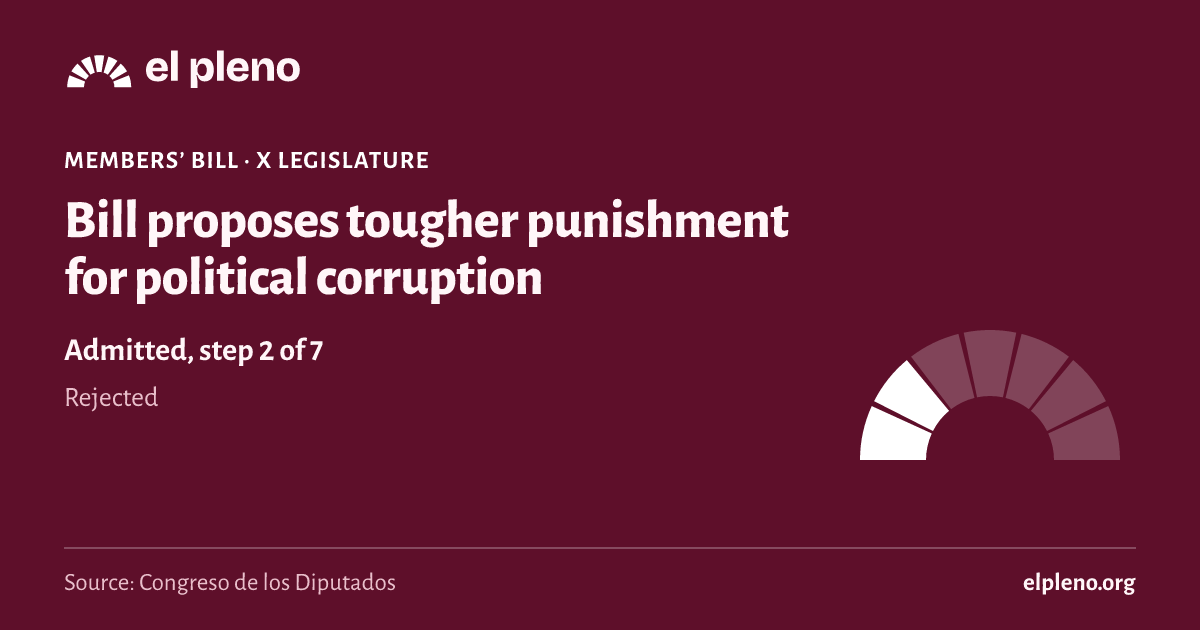
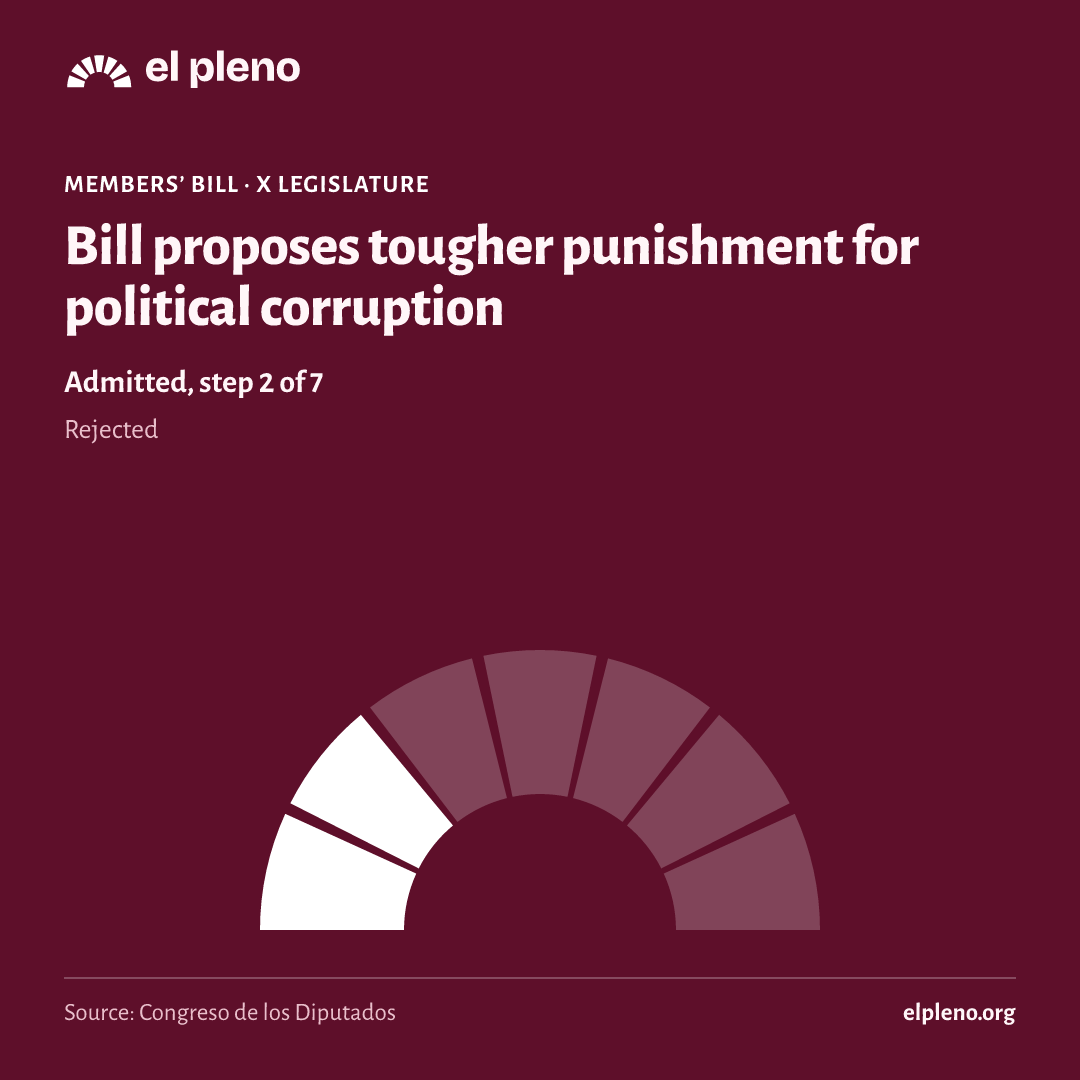
It took 2 of 7 steps. It reached Admitted, and today it is rejected.
- Introduced2 September 2013Someone registers the text in the Congreso.
- Admitted10 September 2013The Bureau of the Congreso accepts it and, for a members’ bill, the plenary decides whether to consider it.
- Amendmentsnot reachedGroups propose changes.
- Committeenot reachedA committee goes through the text in detail.
- Plenarynot reachedAll 350 deputies vote.
- Senatenot reachedThe Senate can pass it, amend it or veto it.
- BOEnot reachedIt is published in the Official State Gazette (BOE) and comes into force.
See the 6 official steps on a timeline
14 April 2015
How did the plenary vote?
Voted on: Private member's bill by the Socialista Parliamentary Group, Organic bill to reform the Penal Code.
Source: Congreso de los Diputados, vote 1 of sitting 253· updated 10 Nov
Each dot is a seat. Tap one, or use the arrow keys, to see who it is.
Your province
How did the deputies from your province vote?
And your senators: the Senate does not link its votes to this law in its open data, so we cannot put them side by side here.
Or see how most of each province voted
- A Coruña More votes against 3 yes · 5 no
- Albacete More votes against 1 yes · 3 no
- Alicante/Alacant More votes against 4 yes · 8 no
- Almería More votes against 2 yes · 4 no
- Araba/Álava Tie 1 yes · 1 no
- Asturias Tie 4 yes · 4 no
- Ávila More votes against 1 yes · 2 no
- Badajoz More votes against 2 yes · 4 no
- Barcelona More votes in favour 23 yes · 6 no
- Bizkaia More votes in favour 4 yes · 1 no · 1 abst.
- Burgos More votes against 1 yes · 3 no
- Cáceres Tie 2 yes · 2 no
- Cádiz More votes against 1 yes · 5 no
- Cantabria More votes against 1 yes · 4 no
- Castellón/Castelló More votes against 2 yes · 3 no
- Ceuta More votes against 0 yes · 1 no
- Ciudad Real More votes against 2 yes · 3 no
- Córdoba Tie 3 yes · 3 no
- Cuenca More votes against 1 yes · 2 no
- Gipuzkoa Tie 1 yes · 1 no
- Girona More votes in favour 4 yes · 1 no
- Granada More votes against 3 yes · 4 no
- Guadalajara More votes against 1 yes · 2 no
- Huelva Tie 2 yes · 2 no
- Huesca More votes against 1 yes · 2 no
- Illes Balears More votes against 3 yes · 5 no
- Jaén More votes against 2 yes · 3 no
- La Rioja More votes against 1 yes · 3 no
- Las Palmas More votes against 2 yes · 4 no
- León More votes against 2 yes · 3 no
- Lleida More votes in favour 3 yes · 1 no
- Lugo More votes against 1 yes · 3 no
- Madrid More votes against 16 yes · 18 no
- Málaga More votes against 4 yes · 6 no
- Melilla More votes against 0 yes · 1 no
- Murcia More votes against 2 yes · 8 no
- Navarra Tie 2 yes · 2 no
- Ourense More votes against 1 yes · 3 no
- Palencia More votes against 1 yes · 2 no
- Pontevedra More votes against 3 yes · 4 no
- Salamanca More votes against 1 yes · 3 no
- Santa Cruz de Tenerife More votes against 1 yes · 4 no
- Segovia More votes against 1 yes · 2 no
- Sevilla More votes in favour 7 yes · 5 no
- Soria Tie 1 yes · 1 no
- Tarragona More votes in favour 3 yes · 2 no
- Teruel More votes against 1 yes · 2 no
- Toledo More votes against 2 yes · 4 no
- Valencia/València More votes against 6 yes · 9 no
- Valladolid More votes against 2 yes · 3 no
- Zamora More votes against 1 yes · 2 no
- Zaragoza More votes against 3 yes · 4 no
More details: how each group and each province voted
The groups
Who voted in favour and who against?
In favour, most of Socialista, Vasco (EAJ-PNV), Mixto, GC-CiU, GIP, GUPyD and Sin grupo. Against, most of Popular en el Congreso. 3 deputies voted differently from their group.
By province: in 6 most voted in favour; in 38, against.
Coloured by how most of each province’s deputies voted.
- In favour: 6
- Against: 38
- Tie: 8
| Group | Seats | How it voted |
|---|---|---|
| Socialista | 110 | 104 in favour · 6 did not vote |
| Vasco (EAJ-PNV) | 5 | 3 in favour · 2 did not vote |
| Mixto | 18 | 6 in favour · 2 against · 1 abst. · 9 did not vote |
| GC-CiU | 16 | 14 in favour · 2 did not vote |
| GIP | 10 | 10 in favour |
| GUPyD | 4 | 4 in favour |
| Sin grupo | 1 | 1 in favour |
| Popular en el Congreso | 185 | 181 against · 4 did not vote |
What happens next
What happens now?
It goes no further. A similar one could be introduced later.
Sources
Where does all this come from?
- Congreso de los Diputados, file 122/000112
Official title, type, author, dates and stage.
Retrieved 11 November 2026
- Congreso de los Diputados, vote 1 of sitting 253
The count and every seat’s vote.
Retrieved 10 November 2026
- The data comes from the open files of the Congreso, the Senate and the BOE, unaltered.
- Each deputy’s province is the one of their seat on the day of the vote.
- We only say “passed” or “rejected” when the majority needed is certain; otherwise we say which side had more votes.