What it is
Tax and funding support for new business founders and their investors
It is a members’ bill. Introduced by parliamentary groups, the Senate, regional governments or citizens. It was introduced on 19 February 2013. Introduced by: Grupo Parlamentario Catalán (Convergència i Unió).
Official title: Private member's bill on measures to support the creation of companies by entrepreneurs and their financing by local investors.
Source: Congreso de los Diputados, file 122/000094· updated 11 Nov
Automatic summary, not yet reviewed
- The bill would define as an entrepreneur anyone starting an economic activity, either self-employed or through a company, and also companies less than five years old. Entities whose main activity is managing a securities or real estate portfolio would be excluded.
- It would grant a 75% exemption in personal income tax The personal income tax (IRPF in Spain): what people pay on what they earn from work, business or savings. or corporate tax during the first four years of activity. If annual revenue exceeds 200,000 euros, the exemption would apply proportionally.
- It would allow unemployment benefit recipients to cash out 100% of their benefit in a lump sum if they become self-employed or partners in a new company.
- It would create the figure of the proximity investor, who provides capital and advice to new projects, capped at 200,000 euros per company. Such investors would get a 25% deduction in personal income tax or corporate tax, plus other reductions and exemptions if they hold the investment for at least four years.
- It would boost public funding: ENISA participating loans, microcredits with priority for women, young people and people with disabilities, guarantee programs with CERSA and mutual guarantee societies, and state-guaranteed securitization funds.
- It would add rebates of 90%, 75% and 50% on social security contributions for the self-employed and for hiring unemployed workers during the first three years, simplified bookkeeping, and a requirement that credit institutions devote 0.5% of their assets to entrepreneurship projects. It would also commit the Government to regulate the social entrepreneur and the entrepreneur visa.
Who it affects
- People who want to start a company or have run one for less than five years: They would get tax exemptions, social security rebates and the option to cash out unemployment benefits.
- Private investors who finance new projects: They would receive tax deductions and exemptions for investing.
- Unemployed people who want to become self-employed or partners in a new company: They could receive 100% of their unemployment benefit in a single payment.
- Banks and credit institutions: They would have to devote at least 0.5% of their assets to financing entrepreneurship projects.
- Women, young people and people with disabilities who are entrepreneurs: They would have priority for microcredit approval.
Words worth knowing
- Inversor de proximidad (proximity investor)
- A person who invests their own money in a new project and also advises the entrepreneur. Also known as a business angel.
- Préstamo participativo (participating loan)
- A loan whose interest depends on how the business performs, so the lender earns more if the company does well.
- Capitalizar el paro (cashing out unemployment benefits)
- Receiving the full unemployment benefit in a single payment to start a business or become a partner in a new company.
- Sociedad de Garantía Recíproca (mutual guarantee society)
- A company that guarantees small businesses and the self-employed so banks will lend to them.
- Titulización (securitization)
- Turning a bundle of loans into securities that can be sold, so banks recover money and can lend more.
- income tax
- The personal income tax (IRPF in Spain): what people pay on what they earn from work, business or savings.
It summarizes the text as it was introduced. It is written by artificial intelligence and may contain mistakes: the official text is what counts. Read the official text · How we make summaries
Where it stands
How far did it get?
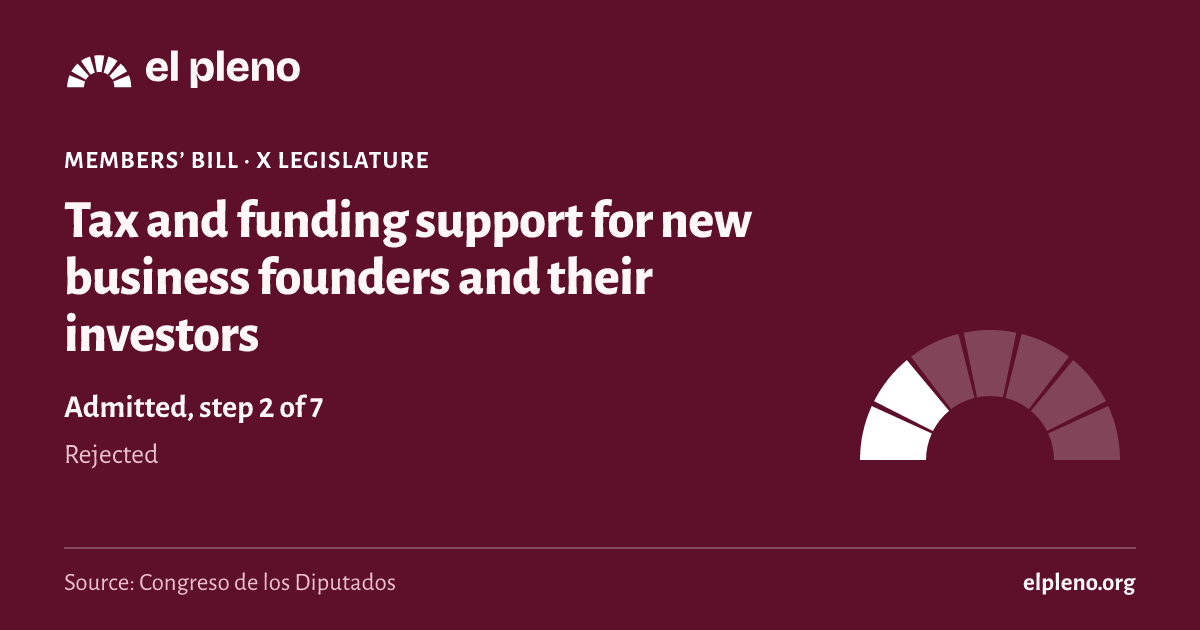
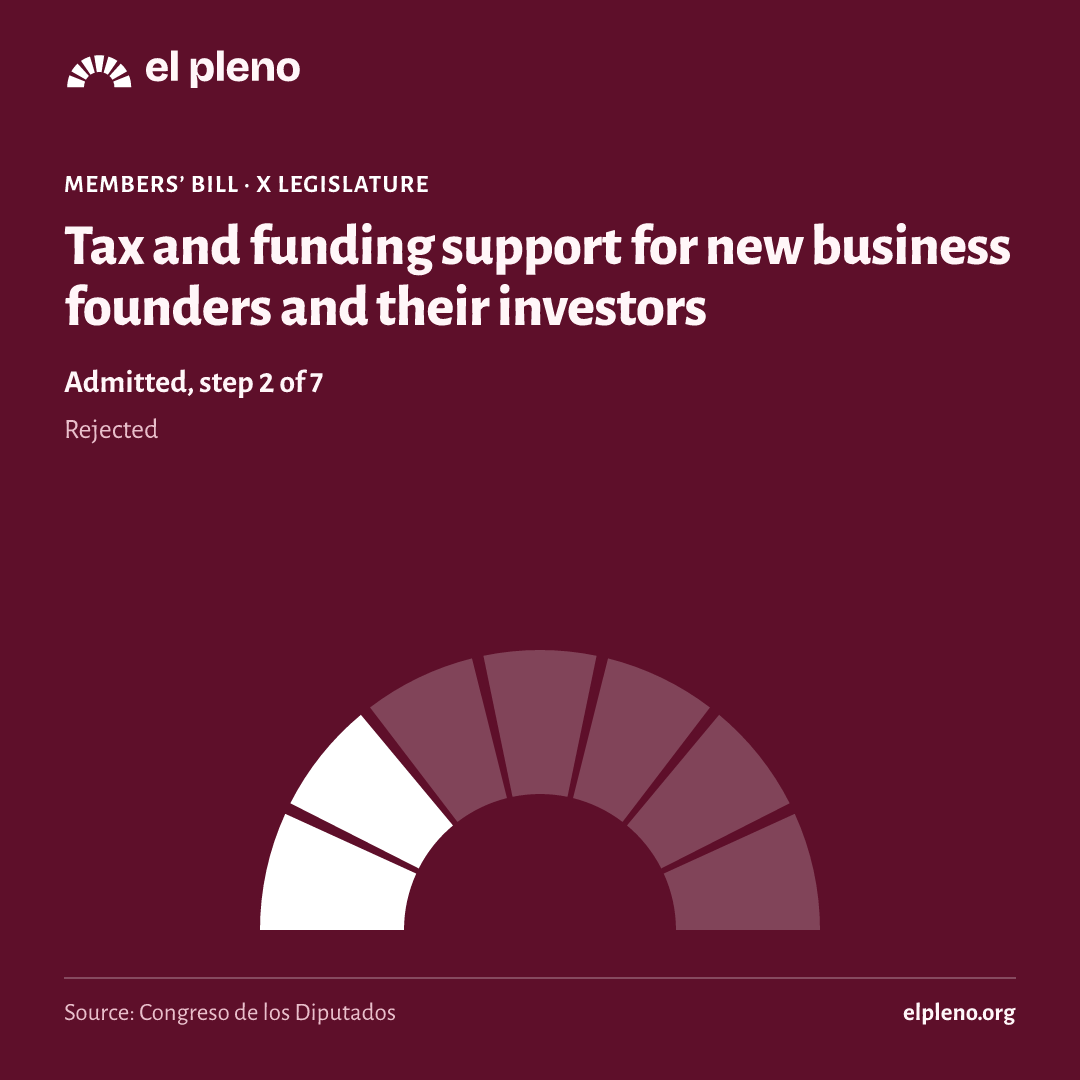
It took 2 of 7 steps. It reached Admitted, and today it is rejected.
- Introduced19 February 2013Someone registers the text in the Congreso.
- Admitted26 February 2013The Bureau of the Congreso accepts it and, for a members’ bill, the plenary decides whether to consider it.
- Amendmentsnot reachedGroups propose changes.
- Committeenot reachedA committee goes through the text in detail.
- Plenarynot reachedAll 350 deputies vote.
- Senatenot reachedThe Senate can pass it, amend it or veto it.
- BOEnot reachedIt is published in the Official State Gazette (BOE) and comes into force.
See the 6 official steps on a timeline
23 April 2013
How did the plenary vote?
Voted on: Private member's bill on measures to support the creation of companies by entrepreneurs and their financing by local investors.
Source: Congreso de los Diputados, vote 2 of sitting 101· updated 10 Nov
Each dot is a seat. Tap one, or use the arrow keys, to see who it is.
Your province
How did the deputies from your province vote?
And your senators: the Senate does not link its votes to this law in its open data, so we cannot put them side by side here.
Or see how most of each province voted
- A Coruña More votes against 3 yes · 5 no
- Albacete More votes against 1 yes · 3 no
- Alicante/Alacant More votes against 4 yes · 8 no
- Almería More votes against 2 yes · 3 no
- Araba/Álava More votes against 0 yes · 1 no
- Asturias More votes in favour 4 yes · 3 no
- Ávila More votes against 1 yes · 2 no
- Badajoz More votes against 2 yes · 4 no
- Barcelona More votes in favour 18 yes · 6 no
- Bizkaia More votes in favour 7 yes · 1 no
- Burgos More votes against 1 yes · 3 no
- Cáceres Tie 2 yes · 2 no
- Cádiz More votes against 3 yes · 4 no
- Cantabria More votes against 1 yes · 4 no
- Castellón/Castelló More votes against 2 yes · 3 no
- Ceuta More votes against 0 yes · 1 no
- Ciudad Real More votes against 2 yes · 3 no
- Córdoba Tie 3 yes · 3 no
- Cuenca Tie 1 yes · 1 no
- Gipuzkoa More votes in favour 4 yes · 1 no
- Girona More votes in favour 3 yes · 1 no
- Granada More votes against 3 yes · 4 no
- Guadalajara More votes against 1 yes · 2 no
- Huelva More votes in favour 2 yes · 1 no
- Huesca More votes against 1 yes · 2 no
- Illes Balears More votes against 3 yes · 5 no
- Jaén More votes against 2 yes · 3 no
- La Rioja More votes against 1 yes · 3 no
- Las Palmas More votes against 2 yes · 4 no
- León More votes against 2 yes · 3 no
- Lleida More votes in favour 3 yes · 1 no
- Lugo More votes against 1 yes · 3 no
- Madrid More votes against 9 yes · 16 no · 4 abst.
- Málaga More votes against 3 yes · 6 no
- Melilla More votes against 0 yes · 1 no
- Murcia More votes against 2 yes · 8 no
- Navarra More votes in favour 3 yes · 2 no
- Ourense More votes against 1 yes · 3 no
- Palencia More votes against 1 yes · 2 no
- Pontevedra More votes against 3 yes · 4 no
- Salamanca More votes against 1 yes · 3 no
- Santa Cruz de Tenerife More votes against 3 yes · 4 no
- Segovia More votes against 1 yes · 2 no
- Sevilla More votes in favour 7 yes · 3 no
- Soria Tie 1 yes · 1 no
- Tarragona More votes in favour 3 yes · 2 no
- Teruel More votes against 1 yes · 2 no
- Toledo More votes against 2 yes · 4 no
- Valencia/València More votes against 6 yes · 7 no · 1 abst.
- Valladolid More votes against 2 yes · 3 no
- Zamora More votes against 1 yes · 2 no
- Zaragoza More votes against 3 yes · 4 no
More details: how each group and each province voted
The groups
Who voted in favour and who against?
In favour, most of Socialista, Vasco (EAJ-PNV), Mixto, GC-CiU and GIP. Against, most of Popular en el Congreso. 1 deputy voted differently from their group.
By province: in 10 most voted in favour; in 38, against.
Coloured by how most of each province’s deputies voted.
- In favour: 10
- Against: 38
- Tie: 4
| Group | Seats | How it voted |
|---|---|---|
| Socialista | 110 | 102 in favour · 8 did not vote |
| Vasco (EAJ-PNV) | 5 | 4 in favour · 1 did not vote |
| Mixto | 18 | 12 in favour · 1 against · 5 did not vote |
| GC-CiU | 16 | 11 in favour · 5 did not vote |
| GIP | 11 | 9 in favour · 2 did not vote |
| GUPyD | 5 | 5 abst. |
| Popular en el Congreso | 185 | 171 against · 14 did not vote |
What happens next
What happens now?
It goes no further. A similar one could be introduced later.
Sources
Where does all this come from?
- Congreso de los Diputados, file 122/000094
Official title, type, author, dates and stage.
Retrieved 11 November 2026
- Congreso de los Diputados, vote 2 of sitting 101
The count and every seat’s vote.
Retrieved 10 November 2026
- The data comes from the open files of the Congreso, the Senate and the BOE, unaltered.
- Each deputy’s province is the one of their seat on the day of the vote.
- We only say “passed” or “rejected” when the majority needed is certain; otherwise we say which side had more votes.