What it is
Bill proposes immediate destruction of seized drugs
It is a members’ bill. Introduced by parliamentary groups, the Senate, regional governments or citizens. It was introduced on 22 January 2013. Introduced by: Grupo Parlamentario Socialista.
Official title: Private member's bill to amend the Criminal Procedure Law to regulate the custody and destruction of toxic drugs, narcotics and psychotropic substances.
Source: Congreso de los Diputados, file 122/000088· updated 11 Nov
Automatic summary, not yet reviewed
- The bill responds to a real problem: court storage facilities hold more seized drugs than they can handle, and since 2010 thousands of kilos have been stolen from official depots mainly in Valencia and Andalusia.
- It explains that current rules conflict: the Criminal Code allows destroying drugs unless the judge objects, while the Criminal Procedure Act has required since 2006 that the judge expressly authorize destruction after hearing the parties.
- The bill would amend Article 367 ter so that seized drugs are destroyed immediately, keeping enough samples for later checks. An express court ruling would only be needed to keep everything, and the judge would have 72 hours to decide.
- It would also require recording in the case file the nature, quality, quantity, weight and measure of what was destroyed, and its value if it cannot be determined afterwards.
Who it affects
- Investigating judges: Would have to order immediate destruction of seized drugs unless they rule to keep them.
- Public Prosecutor and owners or holders of the items: Must be heard before destruction of seized items is ordered.
- Agencies in charge of storing seized substances: Would face fewer risks and less overcrowding in the depots where they store drugs.
Words worth knowing
- Ley de Enjuiciamiento Criminal
- The Spanish law that governs how criminal proceedings work.
- Efectos judiciales
- Items or substances seized and held under court control during a case.
- Juez instructor
- The judge who leads the investigation of a crime before trial.
- Ministerio Fiscal
- The public prosecution service, which acts in court to uphold the law.
It summarizes the text as it was introduced. It is written by artificial intelligence and may contain mistakes: the official text is what counts. Read the official text · How we make summaries
Where it stands
How far did it get?
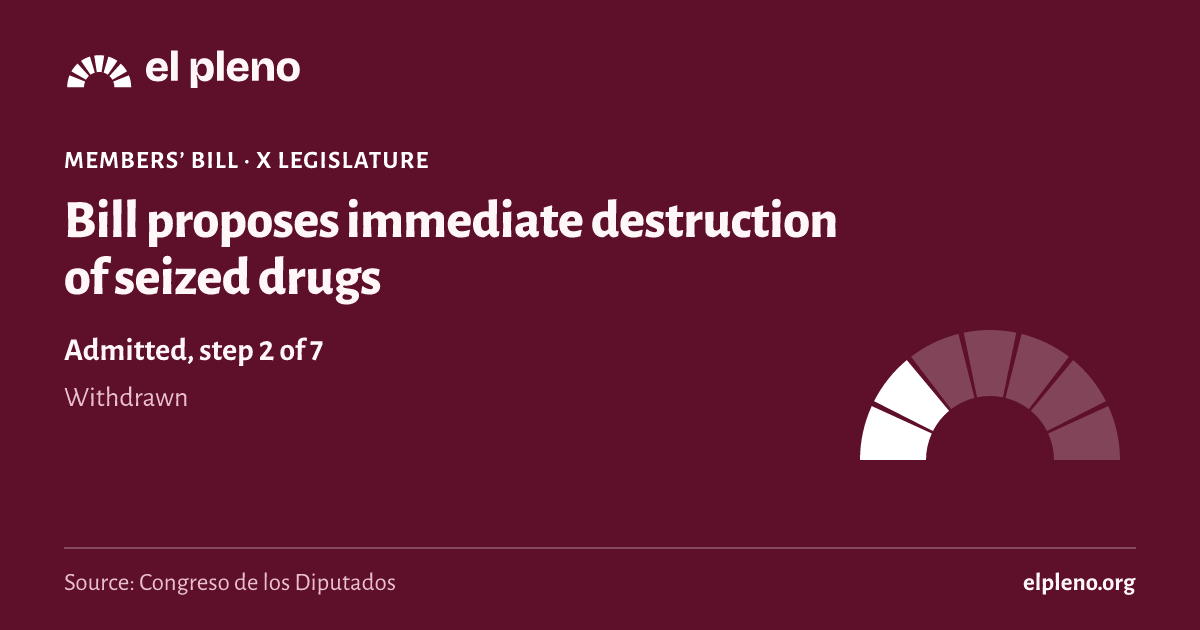
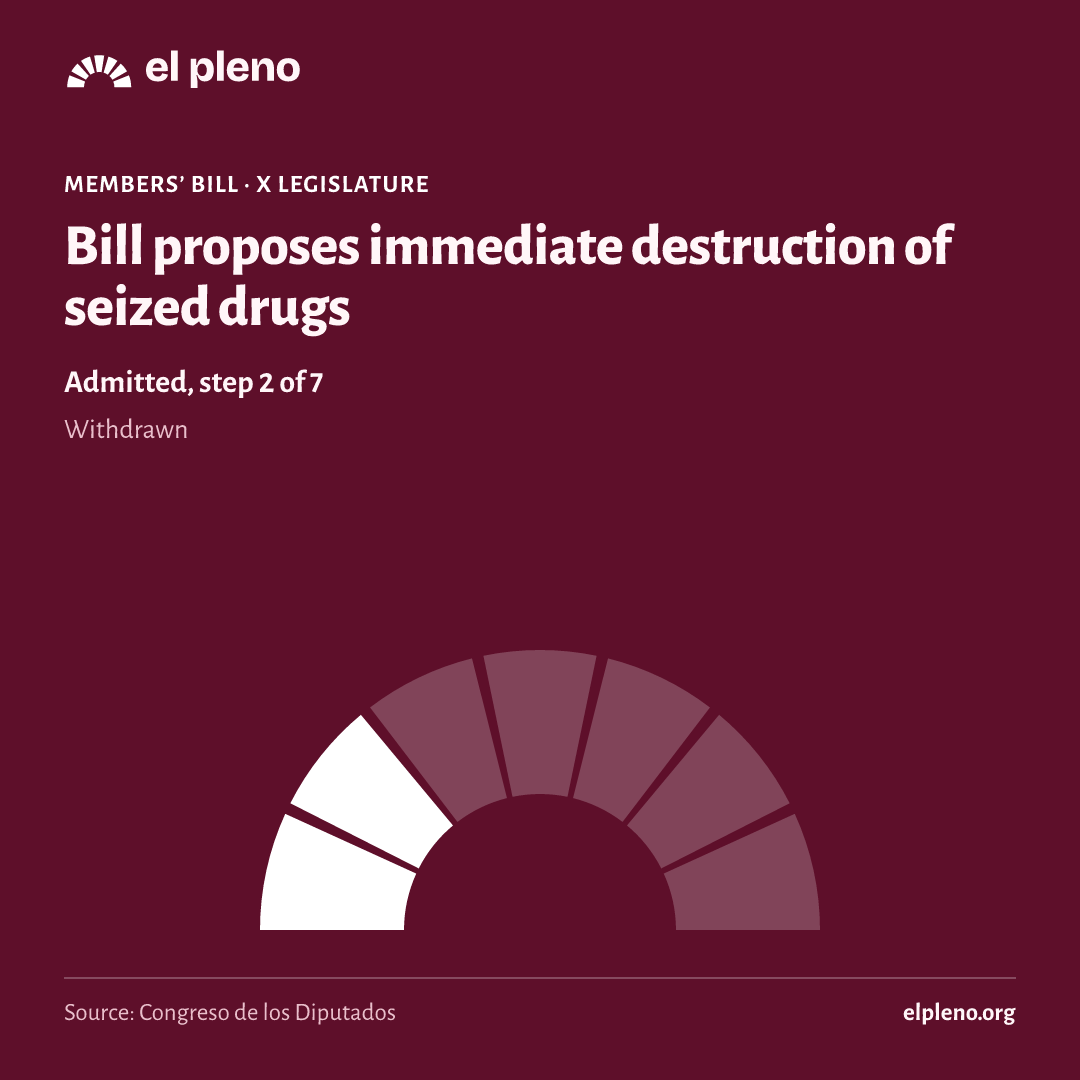
It took 2 of 7 steps. It reached Admitted, and today it is withdrawn.
- Introduced22 January 2013Someone registers the text in the Congreso.
- Admitted29 January 2013The Bureau of the Congreso accepts it and, for a members’ bill, the plenary decides whether to consider it.
- Amendmentsnot reachedGroups propose changes.
- Committeenot reachedA committee goes through the text in detail.
- Plenarynot reachedAll 350 deputies vote.
- Senatenot reachedThe Senate can pass it, amend it or veto it.
- BOEnot reachedIt is published in the Official State Gazette (BOE) and comes into force.
See the 6 official steps on a timeline
Was there a plenary vote?
We have no plenary vote linked to this law in the Congreso’s data.
What happens next
What happens now?
Whoever introduced it withdrew it, or it was merged into another one. It goes no further.
Sources
Where does all this come from?
- Congreso de los Diputados, file 122/000088
Official title, type, author, dates and stage.
Retrieved 11 November 2026
- The data comes from the open files of the Congreso, the Senate and the BOE, unaltered.
- Each deputy’s province is the one of their seat on the day of the vote.
- We only say “passed” or “rejected” when the majority needed is certain; otherwise we say which side had more votes.