What it is
Bill to bring back prison penalties for illegal election or referendum calls
It is a members’ bill. Introduced by parliamentary groups, the Senate, regional governments or citizens. It was introduced on 28 September 2012. Introduced by: Grupo Parlamentario de Unión Progreso y Democracia.
Official title: Organic private member's bill regarding the reform of the Penal Code to recover the crime of illegal calling of elections or popular consultations by way of referendum.
Source: Congreso de los Diputados, file 122/000078· updated 11 Nov
Automatic summary, not yet reviewed
- The bill would add a new Article 506 bis to the Criminal Code. It would punish with three to five years in prison any authority or public official who calls or authorizes general, regional or local elections, or popular consultations by referendum, without having the powers to do so. It would also impose a full ban on holding public office.
- The same article would punish with one to three years in prison an authority or official who, without making the call, facilitates, promotes or secures such an illegal process once it has been declared illegal.
- The bill would add a new Article 521 bis to the Criminal Code. It would punish with six months to one year in prison, or a fine of 12 to 24 months, those who take part as poll workers or who facilitate, promote or secure such illegal elections or consultations.
- The proposal seeks to bring back a crime that was removed in 2005, arguing that popular consultations outside the law attack the constitutional order. The law would take effect the day after its publication in the Official State Gazette.
Who it affects
- Authorities and public officials who call or authorize elections or referendums without having the powers to do so: Three to five years in prison and a full ban on holding public office.
- Authorities and officials who facilitate or promote such illegal processes: One to three years in prison and a full ban on holding public office.
- Poll workers and people who help stage such illegal elections or consultations: Six months to one year in prison, or a fine of 12 to 24 months.
Words worth knowing
- Proposición de Ley Orgánica
- A bill to amend a law that has not been passed yet; an organic law (ley orgánica) needs a special majority in the Congress of Deputies (Congreso de los Diputados).
- Inhabilitación absoluta
- A penalty that bars the person from holding any public job or office for the length of the sentence.
- Interventores
- People who help run a vote, for example at polling stations.
- Consultas populares por vía de referéndum
- Questions put to citizens for a vote, in the forms allowed by the Spanish Constitution.
It summarizes the text as it was introduced. It is written by artificial intelligence and may contain mistakes: the official text is what counts. Read the official text · How we make summaries
Where it stands
How far did it get?
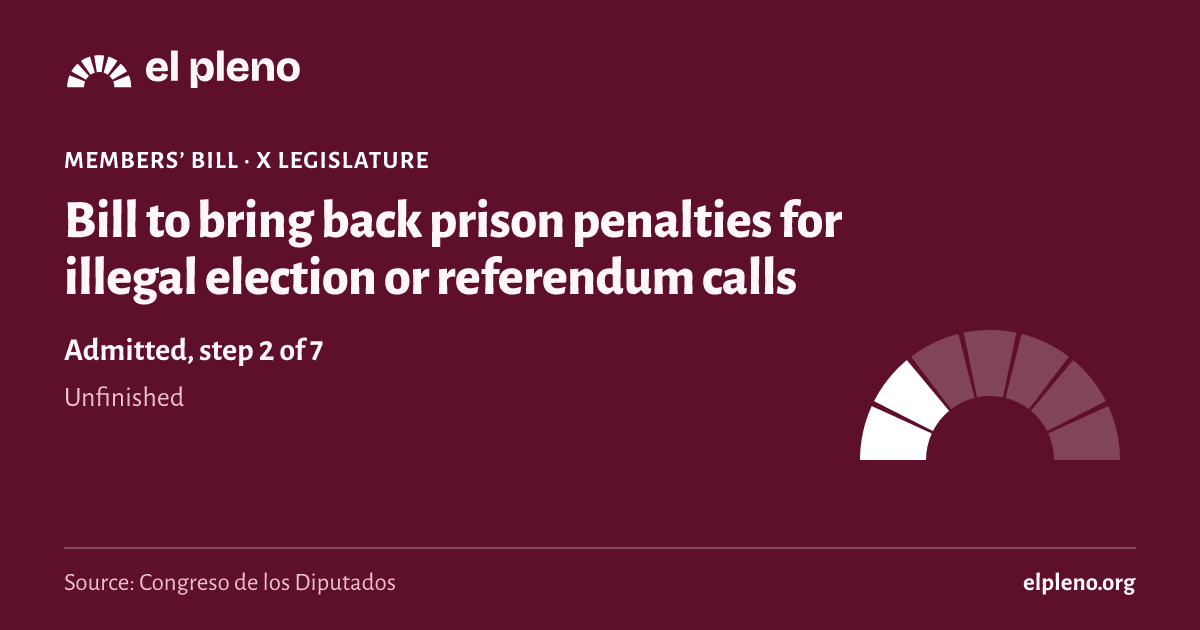
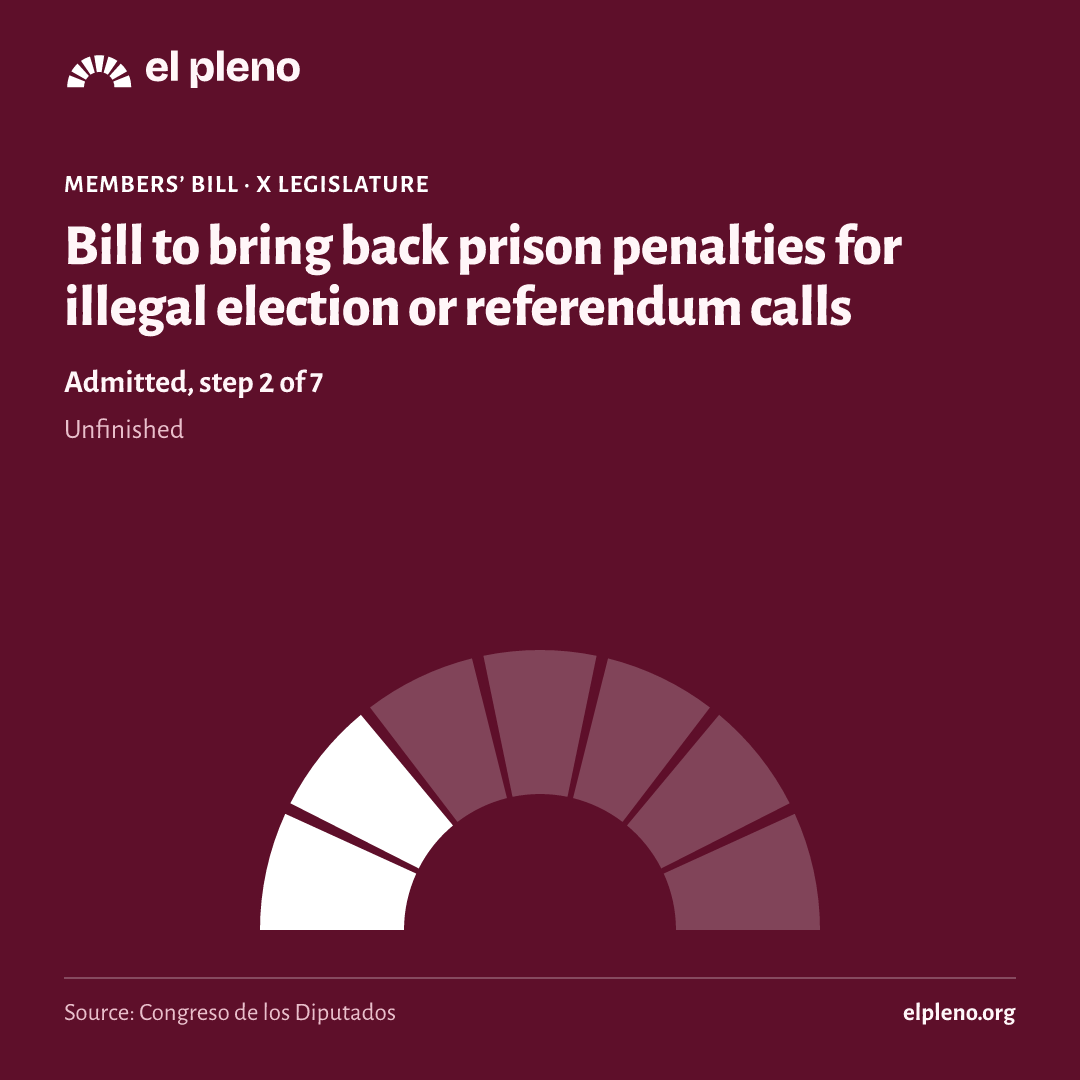
It took 2 of 7 steps. It reached Admitted, and today it is unfinished.
- Introduced28 September 2012Someone registers the text in the Congreso.
- Admitted9 October 2012The Bureau of the Congreso accepts it and, for a members’ bill, the plenary decides whether to consider it.
- Amendmentsnot reachedGroups propose changes.
- Committeenot reachedA committee goes through the text in detail.
- Plenarynot reachedAll 350 deputies vote.
- Senatenot reachedThe Senate can pass it, amend it or veto it.
- BOEnot reachedIt is published in the Official State Gazette (BOE) and comes into force.
See the 6 official steps on a timeline
Was there a plenary vote?
We have no plenary vote linked to this law in the Congreso’s data.
What happens next
What happens now?
The legislature ended before it finished. To go on, someone would have to introduce it again in the new Cortes.
It has not been presented again yet.
Sources
Where does all this come from?
- Congreso de los Diputados, file 122/000078
Official title, type, author, dates and stage.
Retrieved 11 November 2026
- The data comes from the open files of the Congreso, the Senate and the BOE, unaltered.
- Each deputy’s province is the one of their seat on the day of the vote.
- We only say “passed” or “rejected” when the majority needed is certain; otherwise we say which side had more votes.