What it is
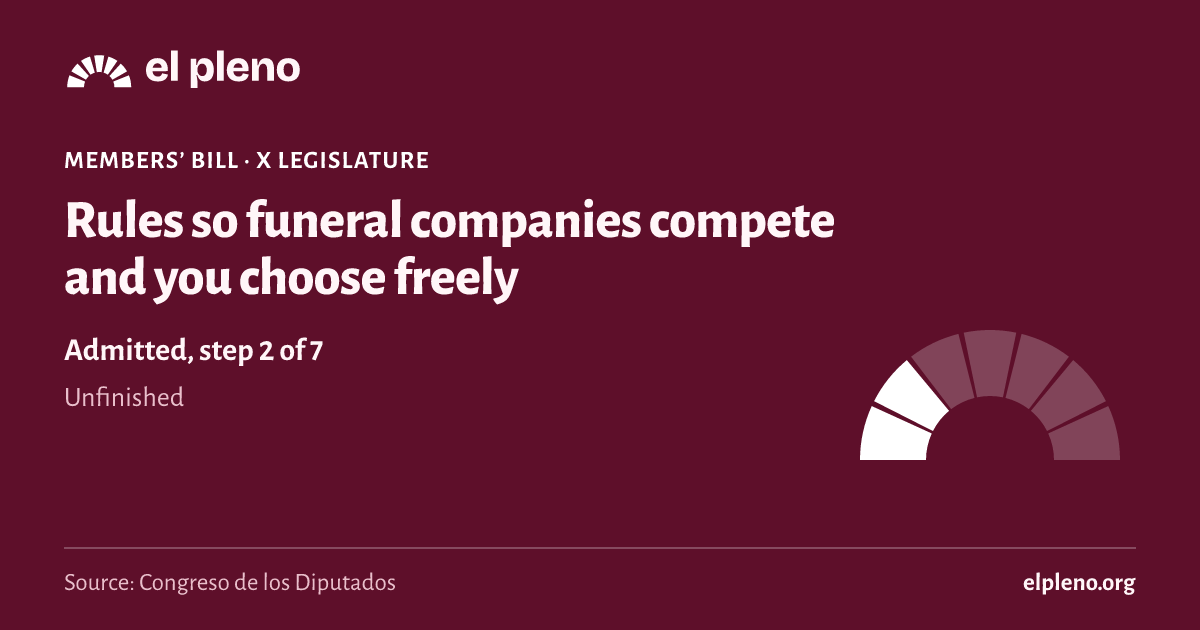
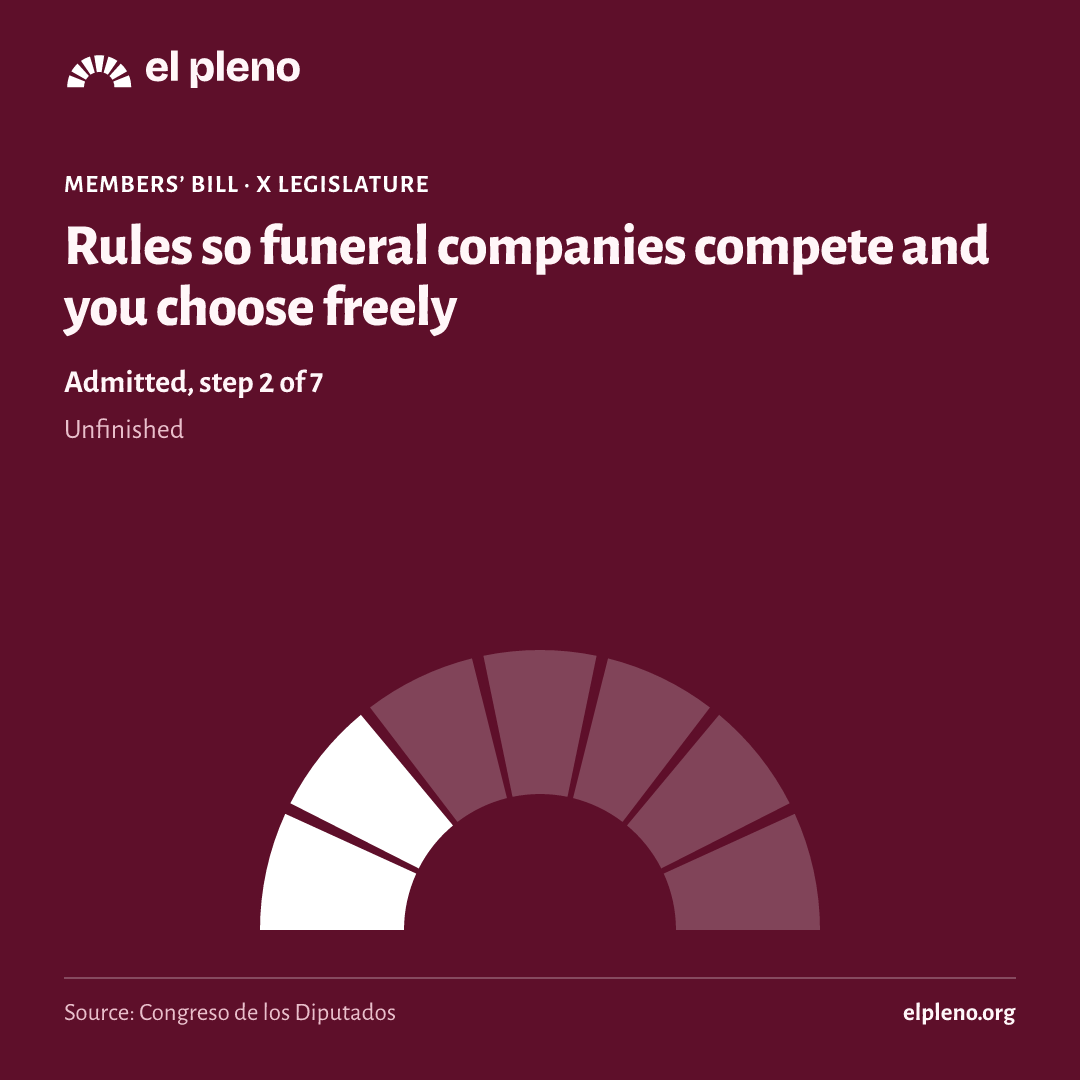
Rules so funeral companies compete and you choose freely
It is a members’ bill. Introduced by parliamentary groups, the Senate, regional governments or citizens. It was introduced on 13 December 2011. Introduced by: Grupo Parlamentario Socialista.
Official title: Private member's bill on funeral services.
Source: Congreso de los Diputados, file 122/000006· updated 11 Nov
Automatic summary, not yet reviewed
- The bill would let any company provide funeral services nationwide by filing a single responsible statement with the town council where it sets up, with no extra requirements in other municipalities.
- Companies that move bodies would have to meet duties such as using a funeral vehicle, performing basic hygiene treatment, and supplying coffins and funeral materials.
- Bodies would be classified into three groups by public health risk. Only those with infectious disease or radiological risk would face restrictions; the rest could be moved freely within Spain.
- Burial or cremation would generally have to take place within 72 hours of death, extendable to one week with a special coffin, temporary preservation, or embalming.
- The bill would guarantee free choice of funeral provider, even with a death insurance policy, and companies would have to offer a price and service catalog plus a free written quote.
- The rules would not apply to ashes or to organ transplants, and the law would take effect the day after its publication in the official state gazette.
Who it affects
- Relatives and friends of deceased people: They could freely choose the funeral company and get clear information on prices and services.
- Funeral companies: They could operate nationwide with a single responsible statement and would face new information duties.
- Town councils: They would receive the responsible statements and check the conditions of funeral homes.
- Death insurance companies: They would have to offer a list of funeral providers that guarantees free choice.
Words worth knowing
- Declaración responsable (responsible statement)
- A document in which a company declares it meets the required duties, allowing it to start operating.
- Tanatorio-velatorio (funeral home)
- A facility where deceased people are laid out before burial or cremation.
- Embalsamamiento (embalming)
- A method that prevents the decay of the body.
- Seguro de decesos (death insurance)
- Insurance that covers funeral costs and services when the insured person dies.
It summarizes the text as it was introduced. It is written by artificial intelligence and may contain mistakes: the official text is what counts. Read the official text · How we make summaries
Where it stands
How far did it get?
It took 2 of 7 steps. It reached Admitted, and today it is unfinished.
- Introduced13 December 2011Someone registers the text in the Congreso.
- Admitted21 December 2011The Bureau of the Congreso accepts it and, for a members’ bill, the plenary decides whether to consider it.
- Amendmentsnot reachedGroups propose changes.
- Committeenot reachedA committee goes through the text in detail.
- Plenarynot reachedAll 350 deputies vote.
- Senatenot reachedThe Senate can pass it, amend it or veto it.
- BOEnot reachedIt is published in the Official State Gazette (BOE) and comes into force.
See the 6 official steps on a timeline
Was there a plenary vote?
We have no plenary vote linked to this law in the Congreso’s data.
What happens next
What happens now?
The legislature ended before it finished. To go on, someone would have to introduce it again in the new Cortes.
It has not been presented again yet.
Sources
Where does all this come from?
- Congreso de los Diputados, file 122/000006
Official title, type, author, dates and stage.
Retrieved 11 November 2026
- The data comes from the open files of the Congreso, the Senate and the BOE, unaltered.
- Each deputy’s province is the one of their seat on the day of the vote.
- We only say “passed” or “rejected” when the majority needed is certain; otherwise we say which side had more votes.