What it is
Bill to update the Spanish land transport law to EU rules
It is a members’ bill. Introduced by parliamentary groups, the Senate, regional governments or citizens. It was introduced on 13 December 2011. Introduced by: Grupo Parlamentario Socialista.
Official title: Private member's bill amending Law 16/1987, of July 30, on the Regulation of Land Transport, to adapt it to various European Union Regulations.
Source: Congreso de los Diputados, file 122/000005· updated 11 Nov
Automatic summary, not yet reviewed
- The bill would amend the 1987 Land Transport Regulation Law to adapt it to several European Union Regulations, updating a text that has not been overhauled in more than two decades.
- It would revise the classification of offenses and the penalty system, especially regarding access to road transport professions and drivers' driving time and rest rules. Offenses would be classified as very serious, serious, or minor, with fines ranging from €100 to €18,000 depending on the case.
- Transport authorizations would be granted without a fixed term, although their validity could be subject to periodic renewal checks. If not renewed on time, they would automatically lose their validity.
- The Registry of Transport Companies and Activities would be strengthened, with full public disclosure of the valid enabling titles held by any company, so businesses would only need to show paper documents when the Registry cannot be consulted.
- It would eliminate the mandatory Passenger Insurance requirement in road and rail transport where mandatory civil liability insurance already covers passenger and luggage damage sufficiently. The Government would have six months to adopt the necessary measures.
- The term 'concesión de transporte regular de viajeros' would be replaced by 'contrato de gestión del servicio público de transporte regular de viajeros', and the 'concesionario' would become the 'contratista del servicio público'.
- Administrative burdens on companies would be reduced: electronic processing of authorization applications would be allowed, and provisions with commercial content already covered by the Land Freight Transport Contract Law would be removed.
- The Government would have two years to adapt the Law's Regulations and one year from entry into force to consolidate the full Land Transport Regulation Law into a single revised text.
Who it affects
- Road and rail transport companies: They would have to meet new authorization requirements, periodic renewals, and computer equipment rules, under a revised penalty system.
- Professional drivers: Rules on driving time and rest would be reinforced, with detailed offenses and fines for violations.
- Passengers: Mandatory Passenger Insurance would be removed where sufficient coverage already exists, and rights such as free luggage transport would be kept.
- Shippers and clients of transport companies: They could be fined for hiring unauthorized carriers or transport operators.
- Transport managers of companies: They could lose their 'Honorabilidad A good-reputation requirement for a company's transport manager; losing it bars that person from holding the role for a period of time.' (good standing) for up to one year for very serious offenses committed by the company.
Words worth knowing
- Visado
- A periodic check by the Administration to confirm that the company still meets the requirements for holding its transport authorization.
- Título habilitante
- An official document (authorization, license, or permit) that legally allows someone to carry out a transport activity.
- Contrato de gestión de servicios públicos
- A contract under which a public administration hires a company to operate a regular public passenger transport service.
- Obligaciones de servicio público
- Requirements imposed by the Administration to guarantee a transport service that an operator would not provide on commercial grounds alone without compensation.
- Honorabilidad
- A good-reputation requirement for a company's transport manager; losing it bars that person from holding the role for a period of time.
It summarizes the text as it was introduced. It is written by artificial intelligence and may contain mistakes: the official text is what counts. Read the official text · How we make summaries
Where it stands
How far did it get?
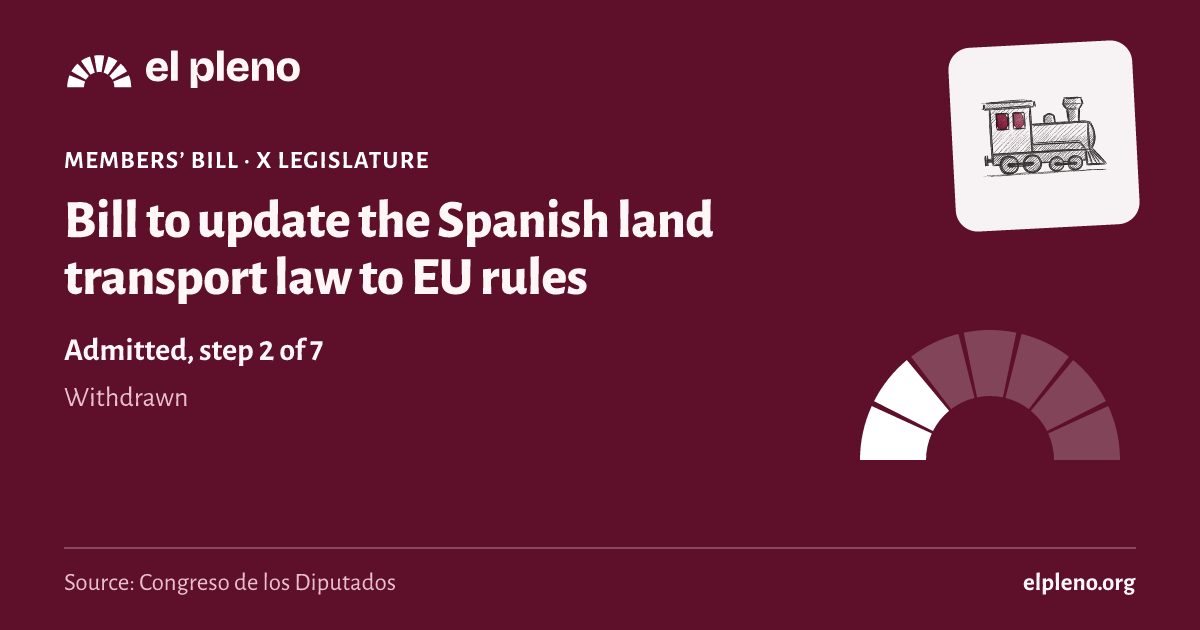
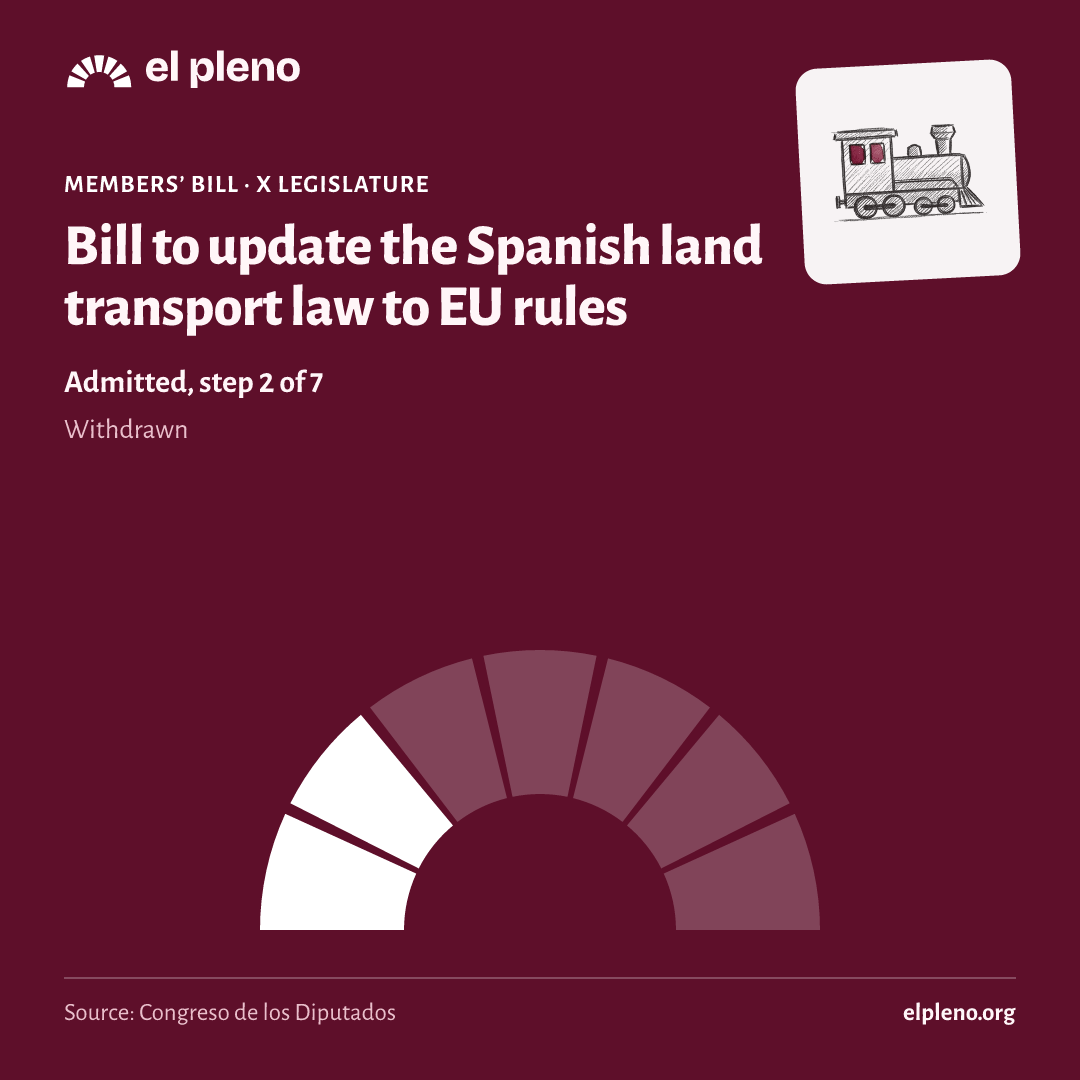
It took 2 of 7 steps. It reached Admitted, and today it is withdrawn.
- Introduced13 December 2011Someone registers the text in the Congreso.
- Admitted21 December 2011The Bureau of the Congreso accepts it and, for a members’ bill, the plenary decides whether to consider it.
- Amendmentsnot reachedGroups propose changes.
- Committeenot reachedA committee goes through the text in detail.
- Plenarynot reachedAll 350 deputies vote.
- Senatenot reachedThe Senate can pass it, amend it or veto it.
- BOEnot reachedIt is published in the Official State Gazette (BOE) and comes into force.
See the 6 official steps on a timeline
Was there a plenary vote?
We have no plenary vote linked to this law in the Congreso’s data.
What happens next
What happens now?
Whoever introduced it withdrew it, or it was merged into another one. It goes no further.
Sources
Where does all this come from?
- Congreso de los Diputados, file 122/000005
Official title, type, author, dates and stage.
Retrieved 11 November 2026
- The data comes from the open files of the Congreso, the Senate and the BOE, unaltered.
- Each deputy’s province is the one of their seat on the day of the vote.
- We only say “passed” or “rejected” when the majority needed is certain; otherwise we say which side had more votes.